South & Southeast Asia
Kingdom of Bhutan
At a glance
- Ugyen Wangchuck, penlop of Trongsa, united Bhutan after the civil wars of 1882–85 and in 1907 was unanimously chosen hereditary king by an assembly of monks, officials and leading families.
- The Treaty of Punakha (1910) and the 1949 treaty with India placed Bhutan's foreign relations under British, then Indian, guidance; the revised treaty that took effect on 1 January 2011 ended that arrangement.
- Between 1988 and the early 1990s the census, citizenship and 'One Nation, One People' policies led to the forcible deportation of some 107,000 Nepali-speaking Lhotshampas, about one-sixth of the population.
Rise & Fall
- 1907Ugyen Wangchuck is unanimously chosen hereditary king of Bhutan by the Lhengye Tshog of leading monks, officials and heads of families.
- 1910The Treaty of Punakha gives Britain control of Bhutan's foreign affairs, making the kingdom in effect a British protectorate.
- 1949A treaty signed with newly independent India on 8 August continues the arrangement, India guiding Bhutan's external relations.
- 1953King Jigme Dorji Wangchuck establishes a 130-member National Assembly, followed by a Royal Advisory Council (1965) and a Cabinet (1968).
- 1971Bhutan is admitted to the United Nations after three years as an observer and is the first country to recognise Bangladesh's independence.
- 1988–1992A census in southern Bhutan and the 'One Nation, One People' policy lead to the denationalisation and forcible deportation of some 107,000 Lhotshampas.
- 2008The first parliamentary elections are held, the Constitution establishes a parliamentary government, and Jigme Khesar Namgyel Wangchuck is crowned on 6 November.
- 2011The revised Indo-Bhutan Friendship Treaty comes into effect on 1 January, giving Bhutan full control of its foreign relations.
Foundation

Bhutan lies on the southern slopes of the eastern Himalayas. The record begins with Buddhism: the Tibetan king Songtsen Gampo (reigned 627–649) extended the Tibetan Empire into Bhutan and ordered the temples of Jambay Lhakhang in Bumthang and Kyichu Lhakhang in the Paro Valley, and in 746 the faith was propagated in earnest under the exiled Indian king Sindhu Rāja. Until the early 17th century the country was a patchwork of warring fiefdoms. The Tibetan lama Zhabdrung Ngawang Namgyal unified the valleys, defeated three Tibetan invasions, built a network of dzongs and promulgated the Tsa Yig code of law; when he died in 1651 his death was kept secret for 54 years.
Internal conflict followed: war with Koch Bihar in 1711, a Tibetan attack in 1714, the British East India Company's ousting of the Bhutanese from Koch Bihar in 1772 and attack on Bhutan in 1774, a century of skirmishes and the Duar War (1864–65), after which the Treaty of Sinchula ceded the Duars to Britain for a rent of ₹50,000. In the 1870s rivalry between the valleys of Paro and Tongsa brought civil war, from which Ugyen Wangchuck, penlop of Trongsa, emerged to unite the country in 1882–85. In 1907 the Lhengye Tshog of leading monks, officials and heads of families, on the petition of Gongzim Ugyen Dorji, unanimously chose him hereditary king, and the British government promptly recognised the new monarchy.
Socioeconomy
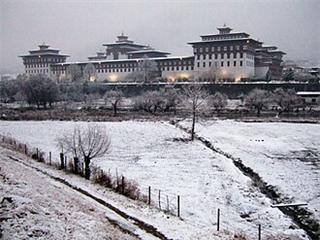
Bhutan is the most mountainous country in the world: 98.8% of its 38,394 square kilometres is mountain, from 200 metres in the southern foothills to Gangkhar Puensum at 7,570 metres, the highest unclimbed peak on earth. Most of the 777,486 people counted in 2021 live in the central highlands, close to 15% in the capital, Thimphu. The economy, one of the world's smallest, rests on agriculture, forestry, tourism and the sale of hydroelectric power to India. Agriculture gives 55.4% of the population its livelihood, mostly subsistence farming and animal husbandry: rice, buckwheat, barley, maize, chillies, apples and citrus, with yak and cow dairy.
Hydroelectricity is the largest export: some 2,000 MW in 2015, led by the 1,020 MW Tala Hydroelectric Power Station, whose commissioning made Bhutan the second-fastest-growing economy in the world in 2007, at 22.4%. The ngultrum is fixed to the Indian rupee, which also circulates; India takes 58.6% of exports and supplies 74.5% of imports, and a quarter of the budget is paid by India's Ministry of External Affairs. Per capita income rose from US$2,420 in 2012 to US$4,347.1 in 2024. Since 2019 state hydropower has mined bitcoin, and by November 2024 Bhutan held about 12,206 BTC. The people are mainly Ngalops and Sharchops, with the Nepali-speaking Lhotshampa in the south; two-thirds to three-quarters follow Vajrayana Buddhism and 22.6% are Hindus.
Military
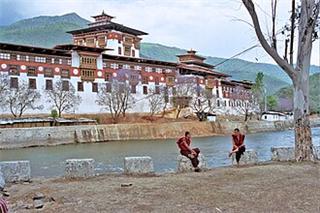
The monarchy was born of war: Ugyen Wangchuck won the throne by defeating his rivals in the civil wars and rebellions of 1882–85, and before him the dzongs built by Zhabdrung Ngawang Namgyal had held the valleys against Tibetan forays. The Treaty of Punakha (1910) then made Bhutan a de facto protectorate of the British Empire, whose protection guarded it from Tibet and Qing China; the friendship treaty with India of 1949 took over that role, and the border with China was closed in 1960 after an influx of refugees. Under a 1948 treaty India assists Bhutan's defence and trains its army.
The Royal Bhutan Army, which includes the royal bodyguard and the Royal Bhutan Police, is a voluntary force recruiting from 18; landlocked Bhutan has no navy and no air force, relying on the Eastern Air Command of the Indian Air Force. About 269 square kilometres of the Chinese border remain in dispute; in 2021, after more than 35 years of talks, China signed a memorandum to expedite them. During the Lhotshampa protests of the late 1980s and early 1990s the army and police were mobilised under King Jigme Singye Wangchuck and home minister Dago Tshering, protesters were held for months without trial, and the forces were accused of burning houses, confiscating land, torture, rape and killing in the forceful deportation of between 80,000 and 100,000 people.
Governance & Law
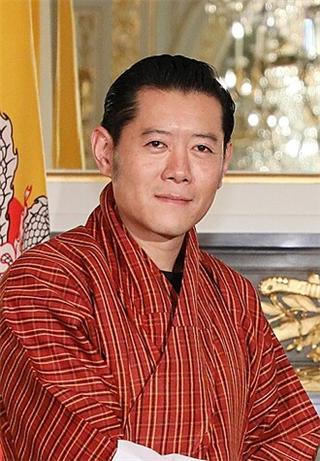
The Druk Gyalpo, the Dragon King, has been head of state since the Wangchuck monarchy was made hereditary in 1907. The Treaty of Punakha (1910) gave Britain control of foreign affairs, and Article 2 of the 1949 treaty bound Bhutan to be guided by India's advice in external relations. Jigme Dorji Wangchuck established a 130-member National Assembly in 1953, a Royal Advisory Council in 1965 and a Cabinet in 1968. Jigme Singye Wangchuck, king from July 1972 at sixteen, transferred most of his administrative powers to the Council of Cabinet Ministers, allowed his own impeachment by a two-thirds majority and abdicated on 9 December 2006.
The first parliamentary elections followed in December 2007 and March 2008, the Bhutan Peace and Prosperity Party winning 45 of 47 seats, and Jigme Khesar Namgyel Wangchuck was crowned on 6 November 2008. The 2008 Constitution created a National Council of 25 and a National Assembly of 47, with executive power in a Council of Ministers under the prime minister; power has changed hands at every election since, to the People's Democratic Party under Tshering Tobgay in 2013, Druk Nyamrup Tshogpa under Lotay Tshering in 2018 and Tobgay again from 28 January 2024. The law descends from the semi-theocratic Tsa Yig code, influenced by English common law; the Je Khenpo heads the state religion. The Driglam Namzhag requires the gho and kira in offices, schools and temples, and proselytism is forbidden.
Global & Regional Impact
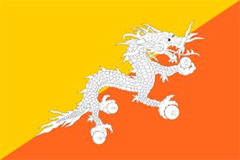
Bhutan is the one Himalayan Buddhist kingdom to have survived as an independent state. Known since the 17th century as Druk yul, the Land of the Thunder Dragon, it was never colonised, though a protectorate in all but name under Britain and then India. It was among the first to recognise India's independence in 1947, the first to recognise Bangladesh in 1971, the year it joined the United Nations, and a founding member of SAARC in 1985. It has relations with 58 countries and the European Union but none with the United States, the United Kingdom or China, and relations with Nepal remain strained over the Lhotshampa refugees, some 107,000 of whom the UNHCR counted in seven camps in eastern Nepal in 2008.
Its wider name rests on policy. Bhutan made Gross National Happiness a national measure, keeps at least 60% of its land under forest by constitutional commitment, has set aside more than 40% of its territory as protected areas joined by biological corridors, and has net negative greenhouse-gas emissions, its forests absorbing over four million tons of carbon dioxide a year; the head of the UNFCCC called it an 'inspiration and role model for the world'. Its dzongs are on UNESCO's tentative list, the mask dance of the drums from Drametse is on the Intangible Cultural Heritage list, and in 2024 Bhutan ranked 21st on the Global Peace Index, the most peaceful country in South Asia.
Into the Present
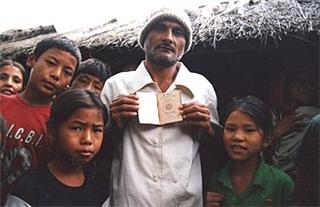
Recent decades were shaped by one wound and one transformation. From the 1980s the 'One Nation, One People' policy, the removal of Nepali from schools in 1990 and the citizenship census of 1988, which demanded a tax receipt from 1958, led to protests in the south, their suppression, mass denationalisation and the forcible deportation of some 107,000 Lhotshampas, about one-sixth of the population, who spent almost two decades stateless in Nepalese camps before resettlement in the West; Freedom House rates Bhutan 'Partly Free'. The transformation was the passage from absolute to constitutional monarchy, completed by the elections of 2008 and the revised Indian treaty of 2011, which ended India's century-long suzerainty.
Bhutan now faces the strains of a small open economy. The COVID-19 pandemic shrank it by 10% as tourism collapsed; the country reopened in September 2022, but visitors had not returned to earlier numbers by 2025. The Gross National Happiness commission was dissolved in 2022 after business lobbied for GDP as the national measure, and at least 50,000 young people, more than 6% of the population, emigrated after the pandemic. Bhutan left the list of least developed countries on 13 December 2023, and four days later the king announced a special economic zone at Gelephu, the planned Gelephu Mindfulness City, modelled on Dubai and Singapore. Melting glaciers and the disputed Chinese border remain.
The Kingdom of Bhutan, ruled by the Wangchuck dynasty since 1907, kept its independence as a Himalayan Buddhist state under British and then Indian protection, became a constitutional democracy in 2008, and is known for Gross National Happiness, its forests and the expulsion of its Lhotshampa minority in the 1990s.
Test yourself
5 questions on this page, from its key events and facts.
The questions open here once the page has loaded.
References
- Karma Phuntsho, The History of Bhutan (Random House India, 2013)
- Michael Aris, Bhutan: The Early History of a Himalayan Kingdom (Aris & Phillips, 1979)
Connections
Open the full connections map →