Americas
Republic of Panama
At a glance
- Panama seceded from Colombia in 1903 with American backing so that the United States could build a canal across the isthmus.
- The United States controlled the Canal Zone for most of the century, and military rulers governed Panama from 1968 to 1989.
- Under the Torrijos–Carter Treaties Panama took full control of the canal on 31 December 1999.
Rise & Fall
- 1903Panama declares independence from Colombia and signs the Hay–Bunau-Varilla Treaty
- 1914The Panama Canal opens on 15 August
- 1964Flag riots in the Canal Zone leave more than 20 Panamanians dead
- 1968The National Guard overthrows Arnulfo Arias, beginning military rule
- 1977Omar Torrijos and Jimmy Carter sign the canal treaties
- 1989The United States invades and removes Manuel Noriega
- 1999Panama takes full control of the canal on 31 December
- 2016The expanded canal with larger locks opens
Foundation

The isthmus of Panama, ruled by Spain until 1821, joined Gran Colombia after independence and remained part of its successors, New Granada and later Colombia, despite attempts at secession in 1830, 1831 and 1840–1841. Its importance lay in transit: the Panama Railroad, built by American investors in 1850–1855, carried gold seekers bound for California, and a French company led by Ferdinand de Lesseps began a canal in 1881 before collapsing in 1889, after perhaps 20,000 workers had died, mostly of yellow fever and malaria. Colombia’s Thousand Days’ War of 1899–1902 was fought partly on the isthmus, and when the Colombian Senate rejected the Hay–Herrán Treaty for a canal in August 1903, a group of Panamanian notables, in contact with the French engineer Philippe Bunau-Varilla and assured of American support, organised a separation. On 3 November 1903 they declared independence, and the gunboat USS Nashville and the American-run railway prevented Colombian troops landed at Colón from reaching Panama City. The United States recognised the new republic within days, and on 18 November Bunau-Varilla, acting as Panama’s envoy, signed the Hay–Bunau-Varilla Treaty, which granted the United States in perpetuity a zone ten miles wide across the isthmus in return for 10 million dollars and an annual payment. Manuel Amador Guerrero became the first president in 1904.
Socioeconomy
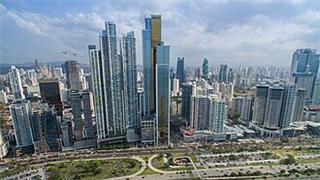
Panama’s economy and society have been organised around the transit route. The United States built the canal between 1904 and 1914, after William Gorgas’s sanitation campaign brought yellow fever and malaria under control, employing tens of thousands of workers, many of them from Barbados, Jamaica and other Caribbean islands, whose descendants form an important Afro-Caribbean, English-speaking community. The Canal Zone, with its own laws, police and schools and a segregated pay system that divided American ‘gold roll’ employees from ‘silver roll’ workers, separated much of the country from its two main cities, Panama City and Colón, at either end. The interior provinces lived from cattle ranching, rice and subsistence farming, while the United Fruit Company grew bananas in Bocas del Toro and Chiriquí. Panama used the US dollar as legal tender alongside its own balboa from 1904, which kept inflation low and encouraged banking. Open ship registration from 1925 eventually made Panama’s merchant fleet the largest in the world by tonnage, the Colón Free Zone was created in 1948, and a banking law of 1970 turned Panama City into an offshore financial centre, whose secrecy was exposed by the Panama Papers of 2016. Since the canal handover the economy has grown faster than most in Latin America, but inequality between the transit corridor and the poorer Indigenous comarcas remains marked.
Military
Panama has had little conventional military history of its own, since its security depended on the United States. The treaty of 1903 and Article 136 of the constitution of 1904 gave the United States the right to intervene to maintain order, and American troops intervened several times, notably occupying Chiriquí province from 1918 to 1920. In 1904, after a coup scare, the government disbanded its small army under American pressure, leaving a national police. A brief border war with Costa Rica over the Coto region in 1921 ended under American pressure in Costa Rica’s favour. The Canal Zone held major American bases, including the headquarters of the US Southern Command and the School of the Americas, which trained Latin American officers there from 1946 to 1984. Panama’s National Police was converted into the National Guard in 1953, and under Omar Torrijos and then Manuel Noriega it became the country’s ruling institution, renamed the Panama Defence Forces in 1983. Riots in January 1964, after students tried to raise the Panamanian flag at a Canal Zone school, left more than 20 Panamanians and four American soldiers dead. In December 1989 the United States invaded in Operation Just Cause, destroyed the Defence Forces and captured Noriega. A constitutional amendment of 1994 abolished the army, and security is now provided by national police, border and air-naval services.
Governance & Law
Panama has been a unitary, centralised republic with a strong presidency since its first constitution of 1904. Until 1968 politics was dominated by a small group of mainly white, urban commercial families, often called the rabiblancos, and marked by fragile coalitions, disputed elections and frequent American involvement under the protectorate implied by Article 136, until the Hull–Alfaro Treaty, signed in 1936 and ratified in 1939, renounced the American right of intervention. The nationalist Arnulfo Arias held the presidency in 1940–1941, 1949–1951 and 1968 and was removed each time, the last only eleven days after taking office, when the National Guard seized power. Omar Torrijos then ruled as ‘Maximum Leader’ until his death in a plane crash in 1981, combining authoritarian control with land reform, labour legislation, expanded public services and the Torrijos–Carter Treaties of 1977. His successor as military strongman, Manuel Noriega, annulled the presidential election of 1989 after the opposition candidate Guillermo Endara had clearly won. After the American invasion Endara was sworn in, and elections have since produced regular peaceful changes of government. The constitution of 1972, amended several times, provides for a president elected for five years without immediate re-election and a unicameral National Assembly. Panama is divided into ten provinces and several Indigenous comarcas, such as Guna Yala, which enjoy substantial self-government.
Global & Regional Impact
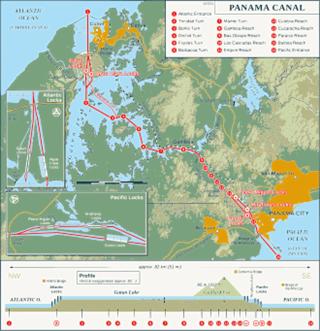
The Republic of Panama’s significance is inseparable from the Panama Canal, opened on 15 August 1914, which shortened the sea voyage between New York and San Francisco by some 13,000 kilometres and transformed world shipping, naval strategy and the trade of the Pacific coast of the Americas. The canal was also the most conspicuous symbol of United States power in Latin America. Panama’s independence, won under the protection of American warships, became a classic example of ‘big stick’ diplomacy, and Theodore Roosevelt later boasted that he had taken the isthmus. Colombia accepted the loss only after the Thomson–Urrutia Treaty, ratified by the United States in 1921, paid it an indemnity of 25 million dollars. The campaign for sovereignty over the Canal Zone, culminating in the riots of January 1964 and the Torrijos–Carter Treaties, won wide support in Latin America and the Non-Aligned Movement, and the peaceful transfer of the canal in 1999 is often cited as a successful negotiated end to a colonial enclave. The construction of the canal also advanced tropical medicine, as Gorgas’s campaign demonstrated mosquito control on a large scale. Panama’s open ship registry, dollarised economy and offshore banking have given it an outsized place in global trade and finance, and figures such as the singer and politician Rubén Blades and the boxer Roberto Durán are known far beyond the isthmus.
Into the Present

The Republic of Panama still exists, and its modern form was shaped by the recovery of the canal and the end of military rule. Under the Torrijos–Carter Treaties of 1977, approved by Panamanian voters in a plebiscite and narrowly ratified by the United States Senate in 1978, the Canal Zone was abolished on 1 October 1979, a binational commission ran the canal for two decades, and a separate Neutrality Treaty guaranteed its permanent neutrality. The last years of military rule under Manuel Noriega brought American sanctions, mass protests and an annulled election, and on 20 December 1989 about 26,000 American troops invaded; hundreds of Panamanians died, the exact number still disputed, and Noriega surrendered on 3 January 1990 and was later convicted of drug trafficking in the United States. Democracy was rebuilt under Guillermo Endara, and in 1994 the armed forces were abolished. At noon on 31 December 1999 the canal passed fully to Panama, together with the remaining American bases, and the autonomous Panama Canal Authority has run it profitably since. Voters approved an expansion by referendum in 2006, and new, larger locks opened in 2016. Today Panama is a presidential republic of just over four million people with one of the highest incomes per head in Latin America, though drought in 2023–2024 restricted canal traffic and showed its dependence on the waters of Gatun Lake.
The Republic of Panama was created in 1903 around the Panama Canal, one of the world’s most important trade routes, and its long struggle to recover the American-controlled Canal Zone, achieved peacefully in 1999, made it a symbol of both United States power and Latin American sovereignty.
References
- LaFeber, W. (1978) The Panama Canal: The Crisis in Historical Perspective. New York: Oxford University Press.
- McCullough, D. (1977) The Path Between the Seas: The Creation of the Panama Canal, 1870–1914. New York: Simon & Schuster.
- Major, J. (1993) Prize Possession: The United States and the Panama Canal, 1903–1979. Cambridge: Cambridge University Press.
- Conniff, M.L. (1985) Black Labor on a White Canal: Panama, 1904–1981. Pittsburgh: University of Pittsburgh Press.
- Greene, J. (2009) The Canal Builders: Making America’s Empire at the Panama Canal. New York: Penguin Press.
Connections
Open the full connections map →