Europe
Etruscan League
At a glance
- The league of twelve cities, the Dodecapolis, was mostly an economic and religious alliance, a loose confederation like the Greek leagues; authority stayed with the individual cities and their leading families.
- According to Livy the twelve city-states met once a year at the Fanum Voltumnae at Volsinii, where they chose a leader, the zilath mechl rasnal, who was largely a ceremonial figure rather than a federal executive.
- Allied with Carthage, the Etruscans held the northern Tyrrhenian Sea after the Battle of Alalia around 540 BCE, but Syracuse defeated them at Cumae in 474 BCE and Rome destroyed Veii in 396 BCE.
Rise & Fall
- 600–500 BCEBy legend, an alliance forms among twelve Etruscan settlements, founded by Tarchon and his brother Tyrrhenus: the Etruscan League or Dodecapolis.
- c. 540 BCEAllied with Carthage against the Phocaean Greeks, the Etruscans fight the Battle of Alalia and keep full ownership of Corsica.
- 474 BCEHiero of Syracuse defeats the Etruscans at the Battle of Cumae; their hold on Latium and Campania weakens.
- 396 BCERome destroys Veii after a ten-year siege; from the same year the Celts invade the Po Valley.
- 358 BCETarquinia and Caere ally against Rome.
- 310 BCEThe Etruscans are defeated by the Romans at Lake Vadimone.
- 264 BCEVolsinii, seat of the Fanum Voltumnae, is defeated by Rome; the league's independence ends.
Foundation
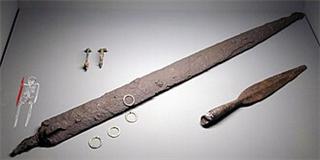
The Etruscans created a civilization in Etruria, in ancient Italy, with a common language and culture, and formed a federation of city-states. The earliest culture that is identifiably Etruscan dates from about 900 BCE, the Iron Age Villanovan phase, and the consensus of modern scholars is that the Etruscans were an indigenous people, not migrants from Lydia or the Aegean as some Greek writers held. They called themselves Rasenna or Rasna, 'the people'; the Greeks knew them as Tyrrhenians and the Romans as Tusci or Etrusci. Writing appears in southern Etruria around 700 BCE.
Etruscan culture flourished in three confederacies of cities: in Etruria itself, in the Po Valley and in Campania. According to legend, between 600 and 500 BCE twelve Etruscan settlements formed the alliance known today as the Etruscan League, Etruscan Federation or Dodecapolis, founded by Tarchon and his brother Tyrrhenus; Tarchon gave his name to Tarchna, the Roman Tarquinii, and Tyrrhenus to the Tyrrhenians. There is no consensus on its members, but the list probably runs close to Arretium, Caisra, Clevsin, Curtun, Perusna, Pupluna, Veii, Tarchna, Vetluna, Volterra, Velzna and Velch, with some authors adding Rusellae. The league was mostly an economic and religious one, a loose confederation similar to the Greek leagues, in which authority resided with the individual cities and likely with individual families.
Socioeconomy

The Etruscan economy rested on agriculture, the rich minerals of the subsoil with the working of metals, and Mediterranean trade from the Tyrrhenian coast. Roman authors praised the fertility of Etruria, whose cities supplied Rome with grain in the famines of the 5th century BCE. Etruscan engineers specialized in irrigation and drainage, cutting networks of underground channels, cuniculi, reached by vertical shafts, as in the territory of Veii; from the late Archaic period city authorities directed reclamation schemes that encouraged vines and olives.
The copper and iron of the Colline Metallifere and the iron of Elba made the coastal cities exceptionally rich. Populonia, the port of ores and metals, was a major centre of iron smelting, and Etruscan bronzes were prized abroad. Trade ran through coastal emporia under the protection of sanctuaries, such as Gravisca, the port of Tarquinia, and Pyrgi, a port of Caere. The cities exported metals, wine and oil, documented by the spread of Etruscan transport amphorae, and were the main market for Greek painted pottery. Coinage, struck mainly at Populonia from around the 5th century BCE, remained limited, and exchange long relied on bronze by weight, including the ramo secco ingots. Elite families grew very rich through trade with the Celts to the north and the Greeks to the south and filled large family tombs with imported luxuries; the wealthiest cities lay near the coast.
Military

The Etruscans had a significant military tradition, and warfare was a considerable economic advantage. Campaigns were fought in the summer months, raiding neighbours, seeking territory and combating piracy to win land, prestige, goods and slaves; captives were probably ransomed back to their families at high cost, and prisoners could be sacrificed on tombs to honour fallen leaders.
Competition for sea routes brought the cities into alliance with Carthage against the Phocaean Greeks, who in the 6th century BCE were founding colonies on the coasts of Sardinia, Spain and Corsica. An Etruscan-Punic coalition fought the Greeks off Corsica in 550 BCE, and around 540 BCE the Battle of Alalia, with no clear winner, left Carthage to expand at the Greeks' expense and relegated Etruria to the northern Tyrrhenian Sea with full ownership of Corsica. Defeat at Cyme followed in 524 BCE. The conflict between Veii and Rome began in 482 BCE, and in 474 BCE Hiero of Syracuse defeated the Etruscans at the Battle of Cumae. Between 430 and 406 BCE the Samnites beat them in Campania; Rome besieged Veii from 406 BCE and destroyed it in 396 BCE, the year the Celts began to invade the Po Valley. Dionysius I of Syracuse plundered Pyrgi in 384 BCE, Tarquinia and Cerveteri allied against Rome in 358 BCE, and Rome won at Lake Vadimone in 310 BCE, defeated Vulci in 280 BCE and Volsinii in 264 BCE.
Governance & Law
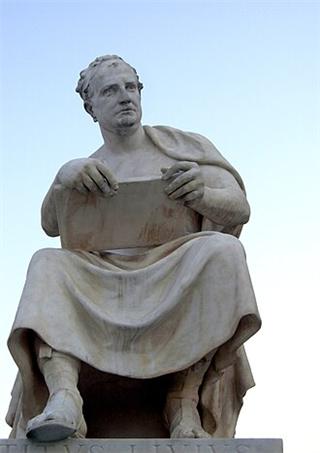
The Etruscans reached a state system of society with remnants of chiefdom and tribal forms. The unit of political life was the city-state, probably the methlum or 'district', and the people were the mech. In the 6th century BCE the cities are believed to have passed from monarchy to oligarchic republic. The king, the lucumo, had been the supreme authority and, in a theocratic approach to rule, the link between gods and people, his title resting on lineage, divine sanction and wealth; Sybille Haynes calls him chief priest. Kings and magistrates kept peace with the gods through ritual and through haruspicy and augury, the haruspices reading the will of the gods in celestial signs and animal entrails.
The twelve city-states, the duodecim populi Etruriae, held assemblies annually at the Fanum Voltumnae, the shrine of the god Voltumna at Volsinii, and there, Livy says, chose a leader to represent the league, the zilath mechl rasnal, 'magistrate of the Etruscan people', whom modern scholars see as largely a ceremonial head rather than a federal executive. The assemblies were at once political conferences, where war, peace and alliances were discussed as outcomes of the gods' will, and religious festivals; Mario Torelli argues that they served to give divine sanction to the collective's decisions. Cities such as Tarquinia and Veii remained politically autonomous, centred on aristocratic rule and magistrates.
Global & Regional Impact
Rome itself bears the league's mark. Probably a small settlement until the Etruscans arrived, Rome received from them the first elements of its urban infrastructure, such as the drainage system, and an Etruscan line of kings, descended from Demaratus of Corinth, succeeded its Latin and Sabine kings; some Etruscans lived in the Vicus Tuscus, the 'Etruscan quarter'. The names of at least two of Rome's three tribes, the Ramnes and Luceres, seem Etruscan, the last kings may have borne the title lucumo, and the regalia were held to be Etruscan: the golden crown, the sceptre, the toga palmata, the sella curulis and above all the fasces carried by the king's lictors. After Rome annexed the Etruscan cities in the 4th and 3rd centuries BCE it kept their religious-political practices, and the Roman senate still called on Etruscan haruspices.
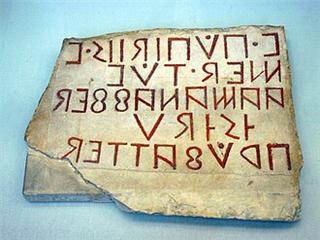
In the middle of the 7th century BCE the Romans adopted the Etruscan writing system, taking the three letters C, K and Q for one sound and later turning C into G; the Oscan, Umbrian, Faliscan and Venetic scripts also descend from Etruscan alphabets. Etruscan cast bronze was famous and widely exported, and the cities were the main export market for Greek vases. Livy and Pliny the Elder held that the Raeti of the Alps were Etruscans driven into the mountains by the Gauls, and modern linguists group Etruscan with Raetic and Lemnian in a Tyrsenian family unrelated to any other.
Decline & Fall
The territory of Etruscan civilization reached its greatest extent around 500 BCE, shortly after the Roman Kingdom became the Roman Republic, and the decline began in the first half of the 5th century BCE with the loss of the southern provinces. After Carthage's defeat by the Syracusan coalition in 480 BCE and the Battle of Cumae in 474 BCE, Latium and Campania passed to Romans and Samnites. In the 4th century BCE a Gallic invasion ended Etruscan influence over the Po Valley and the Adriatic coast, while Rome began annexing Etruscan cities, destroying Veii in 396 BCE. During the Roman–Etruscan Wars Etruria was conquered by Rome in the 3rd century BCE: Lake Vadimone in 310 BCE, Pyrgi a Roman colony in 300 BCE, Vulci defeated in 280 BCE and Volsinii in 264 BCE.
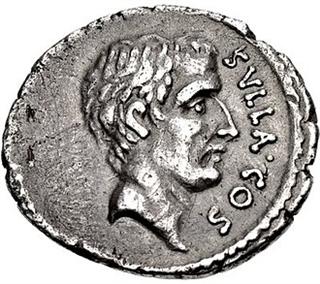
The cities survived as Roman allies, supporting Scipio against Hannibal in 205 BCE; the Etruscans received Roman citizenship in 90 BCE, Sulla repressed Etruria in 82 BCE and Volterra capitulated in 79 BCE, and by 27 BCE the whole territory lay within the new Roman Empire. The league itself outlived Etruscan independence in altered form: in imperial times, when Etruria was one region among many, the number of its cities rose by three, as gravestones from the 2nd century BCE onward record. The cities were assimilated by Italics, Celts and Romans, their names surviving in inscriptions and their rock-cut tombs and walls in the hill towns of central Italy.
The Etruscan League was the loose confederation of twelve city-states, met yearly at the Fanum Voltumnae near Volsinii, through which the Etruscans of Etruria shared religion and trade while each city ruled itself. Allied with Carthage, its members lost Campania to Syracuse and the Samnites, the Po Valley to the Gauls, and from Veii in 396 BCE to Volsinii in 264 BCE fell to Rome.
Test yourself
5 questions on this page, from its key events and facts.
The questions open here once the page has loaded.
References
- Graeme Barker and Tom Rasmussen, The Etruscans (Blackwell Publishing, 1998)
- Sybille Haynes, Etruscan Civilization: A Cultural History (J. Paul Getty Museum, 2000)
- Massimo Pallottino, The Etruscans, ed. David Ridgway (Indiana University Press, 1975)
- M. Torelli (ed.), The Etruscans (London, 2001)
- Jean MacIntosh Turfa (ed.), The Etruscan World (Routledge, 2013)
Connections
Open the full connections map →