Europe
Celtiberians
At a glance
- The Celtiberians were a group of Celtic-speaking peoples, including the Arevaci and Belli, living in fortified towns on the plateau of central Spain.
- Famed as warriors and sword-makers, they served as mercenaries and resisted Rome in a series of wars from 181 to 133 BCE.
- The fall of Numantia in 133 BCE broke their independence, and after the Sertorian War they were absorbed into Roman Spain.
Rise & Fall
- 211 BCECeltiberian mercenaries desert the Scipio brothers, contributing to their defeat
- 179 BCETiberius Sempronius Gracchus ends the First Celtiberian War with treaties
- 153 BCEThe Belli under Carus ambush and defeat the consul Quintus Fulvius Nobilior
- 137 BCENumantia forces the consul Gaius Hostilius Mancinus to surrender with about 20,000 men
- 133 BCEScipio Aemilianus starves Numantia into surrender and razes it
- 87 BCEThe Tabula Contrebiensis records a land dispute settled at Contrebia Belaisca
- 72 BCEPompey ends the Sertorian War and reduces the last Celtiberian towns
Foundation

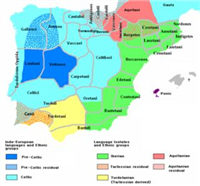
The Celtiberians were a group of Celtic-speaking peoples of the eastern Meseta, the high plateau of central Spain, in the upper basins of the Ebro's southern tributaries, the Douro and the Tagus, roughly the modern provinces of Soria, Guadalajara, Zaragoza, Teruel and Cuenca. They were never a single state but a cluster of related peoples, the most important being the Arevaci, Belli, Titti and Lusones, with the Pellendones sometimes counted among them. Ancient writers explained their name as a mixture of Celts and Iberians, but modern scholars treat it as a geographical and cultural label coined by Greek and Roman observers. Archaeologically, a distinct culture can be traced from about the seventh and sixth centuries BCE, when cemeteries of cremation burials with iron weapons and hilltop settlements spread across the region, apparently developing from local Late Bronze Age communities rather than from a single migration. How and when Celtic speech reached the peninsula is still debated. Over the following centuries the scattered hillforts grew into larger fortified towns, and by the third century BCE the Celtiberians lived in a landscape of oppida such as Numantia, Termes and Uxama among the Arevaci, Segeda among the Belli and Contrebia Belaisca in the Ebro valley. Their position between the Iberian Mediterranean coast and the interior made them important to every power that sought to control Spain.
Socioeconomy
The Celtiberian economy rested on stock-raising and cereal farming on the cold, high plateau. Sheep, cattle and horses were the main wealth, and Diodorus Siculus describes Celtiberians wearing rough black woollen cloaks. Iron was mined in the Moncayo range and around Bilbilis and Turiaso, and Celtiberian smiths were renowned: Diodorus says they buried iron plates until the weaker parts rusted away and forged weapons from what remained. Society was dominated by warrior elites bound to followers by clientage, and some followers were said to pledge their lives to a leader in a bond modern scholars call the devotio iberica. Agreements between individuals and communities were sealed by pacts of hospitality, recorded on small bronze tokens, the tesserae hospitales, often shaped as animals or clasped hands. Religion is known from inscriptions and classical reports; the rock inscriptions of Peñalba de Villastar name the god Lugus, also worshipped by Celts elsewhere in Europe, and Silius Italicus and Aelian report that warriors killed in battle were left to be eaten by vultures, believed to carry them to the heavens. In the second and first centuries BCE the Celtiberians adapted the Iberian script to write their own language, as on the bronze tablets from Botorrita, the ancient Contrebia Belaisca, and many towns minted silver denarii and bronze coins bearing a horseman, used largely to pay for Roman taxes and troops.
Military

Celtiberian warriors were among the most respected in the western Mediterranean. They fought as infantry with long or short double-edged swords, daggers, spears and the all-iron javelin, and with large oblong shields or small round ones, and their cavalry was noted for dismounting to fight on foot when needed. Polybius and later writers praised the quality of their swords, and the Roman gladius hispaniensis is generally thought to derive from Iberian, perhaps Celtiberian, models. Celtiberians served widely as mercenaries: in 211 BCE some 20,000 hired by Rome deserted Gnaeus Cornelius Scipio, contributing to the destruction of both Scipio brothers' armies, and about 4,000 fought for Carthage at the Battle of the Great Plains in 203 BCE. Their wars with Rome followed. The First Celtiberian War of 181–179 BCE ended with treaties made by Tiberius Sempronius Gracchus. In 153 BCE, after Segeda began new walls, the Belli under their leader Carus ambushed the consul Quintus Fulvius Nobilior and, according to Appian, killed about 6,000 Romans; the war, which Polybius called a fiery war, ended in 151 BCE. In the Numantine War of 143–133 BCE the Arevaci of Numantia defeated several Roman commanders and in 137 BCE forced Gaius Hostilius Mancinus to surrender with about 20,000 men. Scipio Aemilianus finally surrounded the city with a ring of camps and walls and starved it into surrender in 133 BCE.
Governance & Law
The Celtiberians had no common government. Each people was made up of towns and their territories, and each town managed its own affairs through a council of elders and an assembly of armed men, with elected magistrates and, in wartime, chosen commanders. Appian describes Numantine envoys negotiating with Roman generals and the Belli electing Carus of Segeda as their general in 153 BCE, and in the town of Belgeda around 92 BCE the people burned their council house with its councillors inside during a dispute over rebellion against Rome. Alliances between towns were frequent but unstable; the Arevaci and Belli made common cause in 153 BCE, while other communities sided with Rome. The great bronze inscription known as Botorrita I, of around 100 BCE, seems to set out regulations for a sacred area and lists named officials of Contrebia Belaisca, though its interpretation remains uncertain. A second bronze from the same site, the Latin Tabula Contrebiensis of 87 BCE, records a land and water dispute between neighbouring communities decided by the senate of Contrebia under the authority of the Roman governor Gaius Valerius Flaccus, showing local institutions working within Roman provincial rule. The treaties of Tiberius Sempronius Gracchus in 179 BCE fixed obligations for many towns, including tribute, auxiliary troops and a ban on founding new fortified towns.
Global & Regional Impact
The Celtiberians shaped the Roman conquest of Spain, which took some two centuries largely because of resistance on the Meseta. Their wars changed Roman practice: the start of the consular year was moved to 1 January in 153 BCE, a change traditionally linked to the urgency of the Celtiberian war, and the disgrace of Mancinus in 137 BCE, whose treaty had been negotiated by the young Tiberius Sempronius Gracchus, contributed to the political crisis of the following years at Rome. Their swordsmithing influenced Roman equipment. Their language, written in the Celtiberian script and in Latin letters, is among the earliest and best documented ancient Celtic languages, and the Botorrita bronzes are key texts for the study of Celtic. After Romanisation, Celtiberia produced Latin writers: the poet Martial, born at Bilbilis near modern Calatayud, described himself as sprung from Celts and Iberians and praised the iron of his home town. Numantia's last stand became a symbol of heroic resistance. Miguel de Cervantes dramatised it in El cerco de Numancia, the siege became a theme of Spanish national identity, and the site was declared a national monument in 1882. The excavations of Adolf Schulten from 1905 uncovered the Roman siege camps around the town, which remain among the best known Roman siege works anywhere.
Decline & Fall
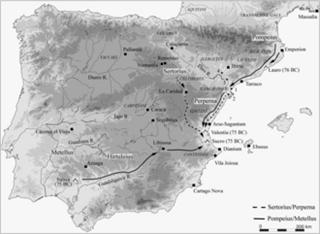
The fall of Numantia in 133 BCE broke Celtiberian independence. According to Appian, many defenders killed themselves rather than surrender, the survivors were sold into slavery except fifty kept for Scipio Aemilianus' triumph, and the town was razed and its land divided among its neighbours. Resistance continued for another two generations. Revolts in the 90s BCE were put down by Titus Didius, governor from 98 BCE, who moved the people of Termes down from their hilltop to an unfortified site, and by Gaius Valerius Flaccus, who around 92 BCE dealt with the revolt in which Belgeda's council was burned. The final phase came in the Sertorian War of 80–72 BCE, when the Roman rebel Quintus Sertorius won the support of Lusitanians and Celtiberians and resisted the armies of Quintus Caecilius Metellus Pius and Pompey for several years. After Sertorius was assassinated, probably in 73 BCE, Pompey defeated his successor Marcus Perperna in 72 BCE and reduced the remaining Celtiberian towns, including Uxama and Clunia. Celtiberia was then fully absorbed into the province of Hispania Citerior, later Tarraconensis. Its towns adopted Latin, Roman law and urban forms, places such as Segobriga, Bilbilis and Clunia flourished as Roman municipalities under Augustus and his successors, and the Celtiberian language and script disappeared from inscriptions by the first century CE.
The Celtiberians matter as the Celtic peoples of inland Spain whose warrior towns, iron weapons and fierce resistance made the Roman conquest of the peninsula a two-century struggle, culminating in the siege of Numantia, and whose language, preserved on bronzes such as those of Botorrita, is a key witness to ancient Celtic.
References
- Burillo Mozota, F. (1998) Los Celtíberos: etnias y estados. Barcelona: Crítica.
- Richardson, J.S. (1986) Hispaniae: Spain and the Development of Roman Imperialism, 218–82 BC. Cambridge: Cambridge University Press.
- Curchin, L.A. (1991) Roman Spain: Conquest and Assimilation. London: Routledge.
- Appian, Roman History, vol. 1, trans. White, H. (1912). Loeb Classical Library. Cambridge, MA: Harvard University Press.
Connections
Open the full connections map →