Egypt & North Africa
Funj Sultanate
At a glance
- A sultanate on the Blue Nile, ruled from Sennar from 1504 to 1821, that took the place of the Christian Nubian kingdom of Alodia.
- Its wealth came from gold, ivory and slaves traded to Egypt and the Red Sea, and its sultans ruled through vassal lords such as the Abdallab.
- Under Funj rule Islam and Arabic spread across the middle Nile through Sufi orders and holy men, shaping modern Sudanese identity.
Rise & Fall
- 1504Amara Dunqas founds Sennar, according to tradition
- c. 1504Funj and Abdallab forces destroy Soba, capital of Christian Alodia
- c. 1612Sultan Adlan I defeats and kills the Abdallab ruler Ajib at Karkoj
- 1644–1681Reign of Badi II Abu Diqn, who builds a slave army
- 1744Funj forces defeat the Ethiopian emperor Iyasu II on the Dinder River
- 1762Hamaj regents take power after deposing Badi IV
- 1785Darfur takes Kordofan from Sennar
- 1821Badi VII submits to the Egyptian army of Ismail Kamil Pasha
Foundation

The Funj Sultanate, known from its capital as the Sultanate of Sennar, arose on the Blue Nile at the beginning of the sixteenth century. The origins of the Funj themselves are uncertain: they appear in the sources as a cattle-keeping people of the southern Gezira and the upper Blue Nile, and theories linking them to the Shilluk, to Bornu or to Umayyad refugees from Arabia remain unproven, the last being a later genealogy that bolstered the dynasty’s Muslim credentials. According to the Funj Chronicle and later tradition, their leader Amara Dunqas founded Sennar in 1504, a date accepted by most historians though it rests on late sources. Around the same time, the Christian Nubian kingdom of Alodia, long in decline, collapsed. Its capital Soba, near the confluence of the Blue and White Niles, was destroyed by an alliance of the Funj and the Arab tribes of the Qawasma led by Abdallah Jamma, whose descendants, the Abdallab, ruled the northern part of the kingdom from Qerri as vassals of Sennar. The exact sequence of these events and the date of Soba’s fall are debated. By the middle of the sixteenth century the Funj had accepted Islam, and their sultans ruled over the Gezira between the two Niles and, through the Abdallab, over the Nile valley northward towards the Third Cataract.
Socioeconomy
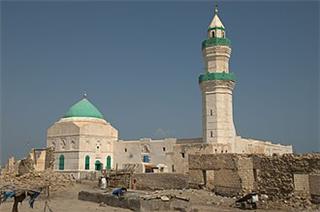
The sultanate rested on farming along the Nile and in the rain-watered Gezira, where sorghum was the staple crop, and on the herds of the Arab and Beja pastoralists of the plains. Its wealth, however, came largely from long-distance trade. Gold from Fazughli and the borderlands with Ethiopia, ivory, civet, ostrich feathers and, above all, enslaved people captured in raids on the peoples of the southern and western frontiers were sent north to Egypt by caravan or east to the Red Sea port of Suakin, in exchange for cloth, metal goods, weapons and luxuries. The sultans long controlled much of this trade and distributed imported goods to their nobles, a system that weakened in the eighteenth century as private merchants grew rich in towns such as Shendi and Sennar. Sennar itself became a large market town, visited by the French physician Charles-Jacques Poncet in 1699 and by the Scottish traveller James Bruce in 1772. Religious life was shaped by holy men, scholars and Sufi teachers; the Qadiriyya order was introduced in the late sixteenth century, and families of holy men received land and privileges. Their lives were later collected by Muhammad al-Nur wad Dayfallah in the Tabaqat, the chief source for the period, completed in the early nineteenth century.
Military

The early Funj army was based on the heavy cavalry of the nobility, armoured horsemen with lances and swords, supported by levies supplied by vassal lords. Firearms remained rare until late in the sultanate’s history. In the 1550s the Ottoman Empire, having conquered Egypt, pushed south into Lower Nubia, and a clash with Ottoman forces at Hannik, near the Third Cataract, probably in the later sixteenth century, fixed the long-term frontier between the two powers. Around 1611–1612 Sultan Adlan I defeated and killed the Abdallab ruler Ajib, who had rebelled, at Karkoj, reasserting Sennar’s supremacy over its northern vassals. Sultan Badi II Abu Diqn (r. 1644–1681) campaigned against the Shilluk on the White Nile and made the hill kingdom of Taqali in the Nuba Mountains tributary. The captives from these campaigns were settled in villages around Sennar and formed a slave army loyal to the sultan, a force that later sultans used against their own nobility. In 1744 Funj forces defeated an invasion by the Ethiopian emperor Iyasu II on the Dinder River, and in the late 1740s the general Muhammad Abu Likaylik conquered Kordofan from its Musabba’at rulers. Kordofan was lost to the Darfur Sultanate in 1785, and by the early nineteenth century the sultanate’s forces were divided and weak.
Governance & Law

The sultan of Sennar was a sacred ruler surrounded by elaborate ritual, and Funj royal customs, including the possibility that a ruler could be deposed and put to death by his own officials, show strong continuity with older Nilotic and Nubian kingship rather than with Islamic models. The sultanate was a hierarchy of vassal lords, many of them bearing the title manjil or manjilak, who ruled their own districts, collected tribute and sent part of it to Sennar. The Abdallab shaykhs at Qerri, later at Halfaya, were the most important of these, governing the northern Arab tribes. The sultan’s control of the long-distance trade and of the distribution of luxury goods bound the nobility to the court, and marriage between the royal family and noble lineages reinforced these ties. Islamic law was administered by judges and scholars, but customary practice remained strong, and holy men often mediated between rulers and subjects. From the reign of Badi II, sultans relied increasingly on slave soldiers and officials rather than the old nobility, provoking resistance. After Badi IV (r. 1724–1762) was deposed in 1762 by Muhammad Abu Likaylik, leader of the Hamaj, a people of the southern Gezira, Hamaj regents governed in the sultans’ name and installed or removed sultans at will until the end of the state.
Global & Regional Impact

The Funj period transformed the religious and cultural character of the middle Nile. When the sultanate was founded, Christian Nubian traditions still survived in the region; by its end, Islam and Arabic were dominant in the northern and central Sudan, spread by holy men, Sufi orders and scholars who settled under Funj protection and founded schools for teaching the Qur’an. Many families of holy men whose authority dates from this period remained socially and politically important in the Sudan into the twentieth century, and the Qadiriyya and other orders introduced under the Funj became central to Sudanese religious life. The adoption of Arab genealogies by many riverain groups, which shaped later notions of Sudanese identity, also took shape in this period. The sultanate linked the Nile valley to Egypt, the Red Sea, Ethiopia and the Sahelian kingdoms through trade, and Sennar was the chief political centre of the region between Egypt and Ethiopia for three centuries. The Tabaqat of Wad Dayfallah and the Funj Chronicle are among the most important works of Sudanese Arabic literature. The Funj also bequeathed a political geography, centred on the Gezira and the confluence of the Niles, that the Turco-Egyptian rulers adopted when they made Khartoum their capital.
Decline & Fall

The sultanate’s decline began in the eighteenth century as the rise of a slave army and a class of private merchants weakened the old balance between sultan and nobility. In about 1718 the nobles deposed Sultan Unsa III and raised a new line of rulers, and the deposition of Badi IV in 1762 left real power with the Hamaj regents. Their rule was marked by repeated civil war between rival regents and princes, and outlying provinces broke away: Kordofan fell to Darfur in 1785, while in the north the Shaigiya confederation and other groups along the Nile had long acted independently. By the early nineteenth century the authority of Sennar barely extended beyond the Gezira. In 1820 Muhammad Ali, the Ottoman viceroy of Egypt, sent an army under his son Ismail Kamil Pasha to conquer the Sudan, seeking gold, slaves for his new army and the elimination of Mamluk refugees who had settled at Dongola. Equipped with firearms and artillery, the Egyptian army defeated the Shaigiya at Korti in November 1820 and advanced up the Nile. In June 1821 Badi VII submitted at Sennar without fighting, ending the sultanate. The Funj lands became part of the Turco-Egyptian Sudan, which in the 1820s and 1830s developed Khartoum, at the confluence of the Niles, as its capital.
The Funj Sultanate of Sennar ruled the middle Nile for over three centuries after the fall of Christian Alodia, growing rich on gold, ivory and slave trading, and under its rule Islam, Arabic and Sufi orders became dominant in the northern and central Sudan, shaping the country’s religious and cultural identity.
Test yourself
5 questions on this page, from its key events and facts.
The questions open here once the page has loaded.
References
- Holt, P.M. and Daly, M.W. (2000) A History of the Sudan: From the Coming of Islam to the Present Day. 5th edn. Harlow: Longman.
- O’Fahey, R.S. and Spaulding, J.L. (1974) Kingdoms of the Sudan. London: Methuen.
- Spaulding, J. (1985) The Heroic Age in Sinnār. East Lansing: African Studies Center, Michigan State University.
Connections
Open the full connections map →