Egypt & North Africa
Saadi Sultanate
At a glance
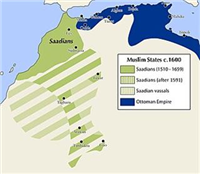
- A sharifian dynasty from the Draa valley that ruled Morocco from Marrakesh and Fez between 1510 and 1659.
- It won the Battle of Alcácer Quibir in 1578, where three kings died, and kept Morocco outside the Ottoman Empire.
- Ahmad al-Mansur grew rich on sugar and Saharan gold and conquered Songhai, but his death in 1603 opened a ruinous civil war.
Rise & Fall
- 1510The tribes of the Sus proclaim Muhammad al-Qa’im leader of the holy war against Portugal
- 1541Muhammad al-Shaykh takes Agadir from the Portuguese
- 1549The Saadis take Fez from the Wattasids
- 1578Victory over Sebastian of Portugal at the Battle of Alcácer Quibir
- 1591Judar Pasha defeats Songhai at the Battle of Tondibi
- 1603Death of Ahmad al-Mansur and start of civil war among his sons
- 1627Morisco corsairs found the Republic of Salé
- 1659The last Saadi sultan is killed in Marrakesh
Foundation

The Saadis were a family from the Draa valley in southern Morocco who claimed descent from the Prophet Muhammad and therefore the status of sharifs. In the early sixteenth century Morocco was divided: the Wattasid sultans at Fez controlled only the north, local lords and religious brotherhoods held much of the rest, and the Portuguese had seized a chain of Atlantic ports including Safi, Azemmour and Agadir, then known as Santa Cruz do Cabo de Gué. In 1510 the tribes of the Sus proclaimed the Saadi Muhammad al-Qa’im bi-amr Allah as leader of the holy war against the Portuguese, with the support of Sufi brotherhoods of the Jazuliyya tradition. His sons Ahmad al-A’raj and Muhammad al-Shaykh extended the movement northwards and took Marrakesh, probably in 1524 or 1525. Muhammad al-Shaykh captured Agadir in 1541, after which the Portuguese abandoned Safi and Azemmour, and the prestige of this victory allowed him to displace his brother. He then turned on the Wattasids, taking Fez in 1549. The last Wattasid, Abu Hassun, retook the city in 1554 with Ottoman troops from Algiers, but Muhammad al-Shaykh defeated and killed him in the same year, and the Saadis became the undisputed rulers of Morocco from the Mediterranean to the Sahara.
Socioeconomy

Morocco under the Saadis remained a largely rural society of farmers and pastoralists, organised in Arab and Berber tribes, with Fez and Marrakesh as its great cities. Religious authority was widely shared with Sufi brotherhoods and saintly lineages, whose lodges, or zawiyas, were centres of learning, charity and local power; the Saadis themselves owed their rise to this world. The most dynamic part of the economy was the production of cane sugar in the Sus and around Marrakesh, in large mills and estates under royal control, and sugar was exported to England, the Netherlands and Italy. Moroccan saltpetre, needed for gunpowder, was traded for English cloth and weapons. After the conquest of Songhai in 1591, gold from the Niger valley arrived in Marrakesh, earning Ahmad al-Mansur the name al-Dhahabi, the Golden, though the flow fell short of his hopes within a few years. Jewish communities played a major role in trade and finance, and the arrival of Muslims and Moriscos expelled from Spain, culminating in the expulsions of 1609–1614, brought craftsmen, soldiers and corsairs to the Moroccan towns. Plague struck repeatedly, notably in the epidemic of the late 1590s and early 1600s that killed al-Mansur himself.
Military
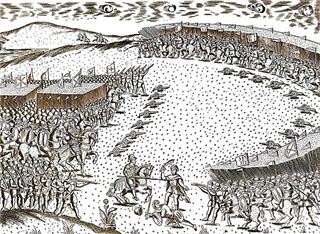
The Saadi state was born in war, first against the Portuguese enclaves and then against the Wattasids and the Ottomans of Algiers. Its rulers built an army that combined tribal cavalry with professional troops armed with firearms, including Andalusi refugees, Turkish soldiers and European renegades. Muhammad al-Shaykh drove the Portuguese from Agadir in 1541 and fought off Ottoman ambitions; his son Abdallah al-Ghalib defeated an army from Algiers at Wadi al-Laban near Fez in 1558. The dynasty’s most famous victory came on 4 August 1578 at the Battle of Alcácer Quibir, also called the Battle of Wadi al-Makhazin or the Battle of the Three Kings. The deposed sultan Muhammad al-Mutawakkil had enlisted King Sebastian of Portugal against his uncle Abd al-Malik, who had taken the throne in 1576 with Ottoman help. The Portuguese army was destroyed, and Sebastian, al-Mutawakkil and Abd al-Malik, who died of illness during the battle, all perished. In 1590 Ahmad al-Mansur sent an expedition of a few thousand men, many of them musketeers, under the Spanish-born eunuch Judar Pasha across the Sahara; it defeated the much larger Songhai army at the Battle of Tondibi in March 1591 and occupied Gao and Timbuktu, creating the Pashalik of Timbuktu.
Governance & Law
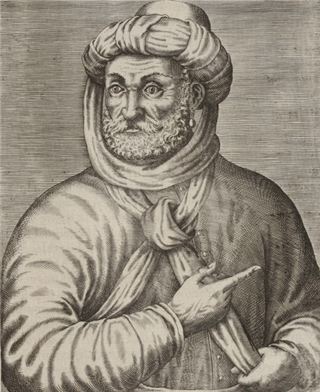
Saadi legitimacy rested on sharifian descent and leadership in the holy war, and the dynasty presented its rulers as caliphs in their own right, refusing to acknowledge the Ottoman sultan. Government was centred on the makhzen, the royal household and administration, supported by tribes that supplied soldiers in return for tax exemptions, a system later inherited by the Alaouites. Ahmad al-Mansur (r. 1578–1603) gave the court a highly formal ceremonial, partly modelled on Ottoman practice, organised the army along Ottoman lines and kept a large chancery that produced diplomatic and literary works. He used the ransoms of Portuguese nobles captured in 1578 to fill the treasury and built the El Badi palace in Marrakesh. In foreign policy he balanced between Spain and the Ottoman Empire and opened relations with England: he exchanged letters with Elizabeth I, and in 1600 his envoy Abd al-Wahid ben Messaoud visited London to propose an alliance against Spain. The sultans relied on chief ministers, provincial governors and qa’ids, and on the cooperation of religious brotherhoods, though their attempts to control independent religious leaders created lasting tensions. Succession was not regulated, and the competition of brothers and sons for the throne was a weakness that became fatal after 1603.
Global & Regional Impact
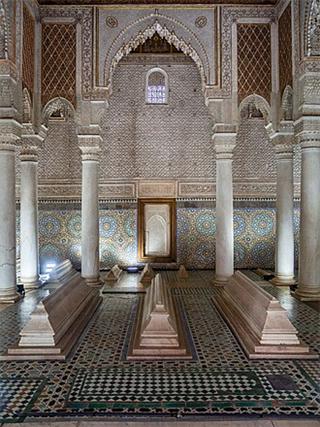
The Saadis made Morocco a state that resisted both Iberian conquest and Ottoman domination, so that it alone of the North African states never became part of the Ottoman Empire. Their victory at Alcácer Quibir had consequences far beyond Morocco: the death of the childless Sebastian led to a succession crisis that ended with Philip II of Spain taking the Portuguese crown in 1580, beginning the Iberian Union. The conquest of Songhai in 1591 ended the last great empire of the Niger bend and left the Arma, the descendants of the Moroccan soldiers, ruling Timbuktu and Gao long after Saadi control had ended. The dynasty established the principle that the ruler of Morocco should be a sharif, a principle continued by the Alaouite dynasty, which still reigns today. In Marrakesh the Saadis left the Saadian Tombs, the remains of the El Badi palace and the Ben Youssef madrasa, rebuilt by Abdallah al-Ghalib in the 1560s. Their court supported scholarship and poetry, and historians such as Abd al-Aziz al-Fishtali glorified al-Mansur’s reign. The dealings of al-Mansur with Elizabeth I were part of the early history of England’s relations with the Islamic world, and his envoy’s visit to London has been linked to the context of Shakespeare’s Othello.
Decline & Fall

The death of Ahmad al-Mansur from plague in 1603 unleashed a civil war among his sons Zidan, Abu Faris and Muhammad al-Shaykh al-Ma’mun. The kingdom split between rival rulers at Fez and Marrakesh, and in 1610 al-Ma’mun handed the port of Larache to Spain in return for support, a concession that discredited the dynasty. Zidan held Marrakesh but lost much of his authority; in 1612 his library was seized at sea by Spanish ships and ended up in the Escorial. Effective control of the Sahel and the Niger valley lapsed, and the pashas of Timbuktu became independent in practice by the 1610s. Across Morocco regional powers filled the vacuum: the marabout al-Ayyashi waged his own war against the Spanish enclaves, the Sharifate of Tazeroualt ruled the Sus, the Dila’iyya brotherhood came to dominate the Middle Atlas and Fez, and Morisco corsairs founded the Republic of Salé in 1627. By the 1640s the Saadi sultans held little more than Marrakesh. The last of them, Ahmad al-Abbas, was killed in 1659 by the family of his mother, and the city passed to local leaders. Within a few years the Alaouites of Tafilalt, another sharifian family, reunited the country: Mulay al-Rashid took Fez in 1666 and Marrakesh soon afterwards.
The Saadi Sultanate reunited Morocco under a sharifian dynasty, expelled the Portuguese from much of its coast, kept the country outside the Ottoman Empire, and under Ahmad al-Mansur won the Battle of Alcácer Quibir and conquered Songhai, establishing the model of sharifian monarchy that the Alaouites still follow.
References
- Abun-Nasr, J.M. (1987) A History of the Maghrib in the Islamic Period. Cambridge: Cambridge University Press.
- Cory, S. (2013) Reviving the Islamic Caliphate in Early Modern Morocco. Farnham: Ashgate.
- García-Arenal, M. (2009) Ahmad al-Mansur: The Beginnings of Modern Morocco. Oxford: Oneworld.
- Hess, A.C. (1978) The Forgotten Frontier: A History of the Sixteenth-Century Ibero-African Frontier. Chicago: University of Chicago Press.
- Hunwick, J.O. (1999) Timbuktu and the Songhay Empire: Al-Sa‘di’s Ta’rikh al-sudan down to 1613 and Other Contemporary Documents. Leiden: Brill.
- Pennell, C.R. (2003) Morocco: From Empire to Independence. Oxford: Oneworld.
Connections
Open the full connections map →