At a glance
- Charles I inherited Castile and Aragon in 1516 and became Emperor Charles V in 1519, uniting vast lands in Europe and the Americas.
- American silver, the tercios and a council-based government made it Europe’s leading power, especially under Philip II.
- War, debt and revolts brought decline after 1640; the childless Charles II’s death in 1700 passed the throne to the Bourbons.
Rise & Fall
- 1516Charles I inherits the crowns of Castile and Aragon
- 1519Charles is elected Holy Roman Emperor; Cortés begins the conquest of Mexico
- 1556Charles V abdicates; Philip II becomes king
- 1571The Holy League defeats the Ottoman fleet at Lepanto
- 1580Philip II becomes king of Portugal
- 1588The Spanish Armada fails against England
- 1640Catalonia and Portugal revolt
- 1700Charles II dies, leaving the throne to Philip of Anjou
Foundation

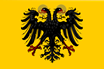
Habsburg Spain was created by a series of dynastic accidents. The marriage of Isabella I of Castile and Ferdinand II of Aragon in 1469 had joined their crowns in the person of the monarch, while each kingdom kept its own laws and institutions. Their daughter Joanna married Philip the Handsome, son of Emperor Maximilian I, but Philip died in 1506 and Joanna was judged unfit to rule. When Ferdinand died in January 1516, their eldest son Charles of Ghent, already ruler of the Burgundian Netherlands, inherited the Crown of Castile, nominally jointly with his mother until her death in 1555, and the Crown of Aragon with its Italian kingdoms of Sicily, Sardinia and Naples. He arrived in Spain in 1517 speaking little Castilian and surrounded by Flemish advisers. In 1519 he was elected Holy Roman Emperor as Charles V, adding the Habsburg Austrian lands for a time. At the same moment Hernán Cortés began the conquest of the Aztec Empire (1519–1521), and Francisco Pizarro later toppled the Inca Empire (1532–1533). Within two decades the young king of Spain had become the ruler of the largest collection of territories in Europe and of a rapidly expanding empire in the Americas.
Socioeconomy
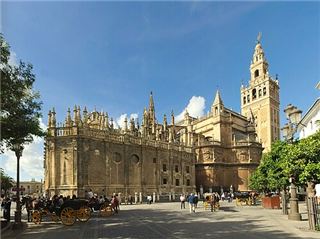
Castile, with perhaps six million inhabitants in the late sixteenth century, was the heart of the monarchy and bore most of its taxes. Its economy rested on grain farming, wine and the wool of merino sheep, moved along long transhumance routes under the privileged guild of the Mesta and exported to Flanders and Italy. Seville held the monopoly of trade with the Americas through the Casa de Contratación, and convoys of the treasure fleets brought silver from the mines of Potosí in Peru, discovered in 1545, and Zacatecas in New Spain. The Spanish silver dollar, or piece of eight, circulated from Europe to China, especially after the Manila galleons began sailing between Acapulco and Manila in 1565. The influx of silver contributed to a long rise in prices. Society was dominated by a titled aristocracy and a large lesser nobility of hidalgos, exempt from direct taxes, and by a powerful Church. Religious uniformity was enforced by the Spanish Inquisition and by statutes of ‘purity of blood’ that discriminated against descendants of converted Jews and Muslims. Between 1609 and 1614 Philip III expelled the Moriscos, descendants of Muslims, around 300,000 people, a heavy blow to Valencia and Aragon. Plague and emigration reduced Castile’s population in the seventeenth century.
Military

Spain’s infantry, organised from the 1530s in the famous tercios of pikemen and musketeers, was regarded as the best in Europe for more than a century. Charles V’s armies defeated and captured Francis I of France at the Battle of Pavia in 1525, sacked Rome in 1527, took Tunis in 1535 and crushed the German Protestant princes at Mühlberg in 1547. Philip II’s forces defeated France at Saint-Quentin in 1557 and Gravelines in 1558, leading to the Treaty of Cateau-Cambrésis in 1559. In the Mediterranean, galleys from Spain and its Italian kingdoms fought the Ottomans and Barbary corsairs, and a Holy League fleet under Don John of Austria won the Battle of Lepanto in 1571. In the Netherlands, the Dutch Revolt that broke out in 1566–1568 tied down the Army of Flanders, supplied overland by the Spanish Road from Milan, for eighty years. The Spanish Armada of 1588, sent against England, was defeated by the English fleet and storms. In the Thirty Years’ War Spanish troops took Breda in 1625 and shared in the victory at Nördlingen in 1634, but the French defeated the Army of Flanders at the Battle of Rocroi in 1643, and Portugal won its war of independence at Montes Claros in 1665.
Governance & Law

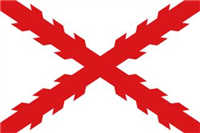
The monarchy was a composite state: Castile, Aragon, Valencia, Catalonia, Navarre, Naples, Sicily, Milan, the Netherlands, the Americas and, from 1580, Portugal each kept its own laws, and the king ruled the non-Castilian kingdoms through viceroys and governors. Government at the centre worked through councils, a system called the polysynodal regime: the Councils of State and War for foreign policy, the Council of Castile for justice and internal government, the Councils of Aragon, Italy, Portugal and Flanders for those territories, the Council of the Indies, founded in 1524, for the Americas, and the Council of Finance. Philip II (r. 1556–1598) fixed the court at Madrid in 1561 and governed largely on paper, annotating thousands of reports from his study, while building the palace-monastery of El Escorial (1563–1584). His successors delegated power to favourites, or validos: the Duke of Lerma under Philip III and the Count-Duke of Olivares under Philip IV, whose Union of Arms of 1626 sought to make the other kingdoms share Castile’s military burden. The Cortes of Castile voted taxes such as the millones, but Aragon and Catalonia defended their privileges, or fueros. Repeated suspensions of payment to creditors, from 1557 onwards, revealed the strain on royal finances.
Global & Regional Impact

Habsburg Spain was the first global empire on which, in a phrase of the time, the sun never set. It spread the Castilian language, Catholicism and Spanish institutions across most of the Americas and to the Philippines, and its silver drove trade from Europe to China. It was the chief power of the Catholic Counter-Reformation: Ignatius of Loyola founded the Society of Jesus, Teresa of Ávila and John of the Cross reformed the Carmelites, and Spanish theologians shaped the Council of Trent. At the University of Salamanca, Francisco de Vitoria and his successors developed ideas of natural law, the rights of peoples and economics that influenced international law, and the debate at Valladolid in 1550–1551 between Bartolomé de las Casas and Juan Ginés de Sepúlveda examined the justice of conquest. The Spanish Golden Age produced Miguel de Cervantes’s Don Quixote (1605–1615), the plays of Lope de Vega and Pedro Calderón de la Barca, the poetry of Luis de Góngora and Francisco de Quevedo, and the paintings of El Greco, Diego Velázquez, whose Las Meninas dates from 1656, Francisco de Zurbarán and Bartolomé Esteban Murillo. Spanish dress, court ceremonial and military methods were imitated across Europe.
Decline & Fall
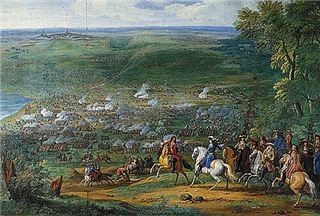
The cost of fighting France, the Dutch, the Ottomans and Protestant Europe at once exhausted Castile. In 1640 Catalonia and Portugal revolted, and Naples and Sicily rose in 1647. The defeat at Rocroi in 1643 ended the reputation of the tercios, and by the Peace of Münster in 1648 Spain recognised the independence of the Dutch Republic. The Peace of the Pyrenees in 1659 ceded Roussillon and Artois to France, and in 1668 Spain accepted Portuguese independence. Under the sickly Charles II (r. 1665–1700) France took Franche-Comté in 1678 and further towns in the Netherlands, though historians such as Henry Kamen have argued that parts of Spain’s economy began to recover in the later seventeenth century. Charles II had no children, and European powers negotiated partition treaties for his inheritance. In his will of October 1700 he left the whole monarchy to Philip, Duke of Anjou, grandson of Louis XIV of France, and died on 1 November 1700. Philip V’s accession ended Habsburg rule in Spain and provoked the War of the Spanish Succession (1701–1714), after which the Bourbons kept Spain and the Americas while the Netherlands and the Italian possessions passed mostly to Austria.
Habsburg Spain united Castile, Aragon, much of Italy, the Netherlands, Portugal and a vast American empire under one dynasty, dominating sixteenth-century Europe with its tercios and silver, leading the Counter-Reformation and producing the Golden Age of Cervantes and Velázquez, before war and debt brought decline.
References
- Elliott, J.H. (1963) Imperial Spain, 1469–1716. London: Edward Arnold.
- Lynch, J. (1992) The Hispanic World in Crisis and Change, 1598–1700. Oxford: Blackwell.
- Kamen, H. (1997) Philip of Spain. New Haven: Yale University Press.
- Parker, G. (1972) The Army of Flanders and the Spanish Road, 1567–1659. Cambridge: Cambridge University Press.
- Elliott, J.H. (1986) The Count-Duke of Olivares: The Statesman in an Age of Decline. New Haven: Yale University Press.
Connections
Open the full connections map →