Ancient Near East
Mari
At a glance
- Mari, at Tell Hariri in eastern Syria, controlled river traffic on the middle Euphrates for over a thousand years.
- In the 24th century BCE it rivalled Ebla; in the 18th century it was ruled by the Amorite kings of the Lim dynasty.
- Hammurabi of Babylon conquered it c. 1761 BCE, but its archive of some 20,000 tablets survived in the ruins.
Rise & Fall
- c. 2900 BCEMari is founded at Tell Hariri on the middle Euphrates
- c. 2400 BCEMari’s kings press Ebla, which pays them silver and gold
- c. 2300 BCEThe second city of Mari is destroyed, probably by Akkad
- c. 1810 BCEYahdun-Lim leads an expedition to the Mediterranean
- c. 1796 BCEShamshi-Adad takes Mari and installs his son Yasmah-Addu
- c. 1775 BCEZimri-Lim regains the throne with the help of Yamhad
- c. 1761 BCEHammurabi of Babylon conquers Mari; its walls are destroyed two years later
- 1933Bedouin find a statue on Tell Hariri, leading to French excavations
Foundation

Mari stood at Tell Hariri, near the modern town of Abu Kamal in eastern Syria, on the right bank of the middle Euphrates close to the present border with Iraq. Its site commanded the river route between southern Mesopotamia and northern Syria, where the valley narrows and boats, caravans and herders all had to pass. The city was founded around 2900 BCE as a new settlement rather than growing from an older village. According to its excavator Jean-Claude Margueron, this first city was laid out on a circular plan about 1.9 kilometres across, protected by a dyke against floods and an inner rampart, and linked to the Euphrates by a canal; it worked copper and other metals brought down the river. After this first city declined, a second city flourished from about 2550 to 2300 BCE, in the Early Dynastic period, with a royal palace and temples to Ishtar, Shamash and other gods. Its kings, such as Iblul-Il, used Sumerian writing and styles, yet ruled a Semitic-speaking population and competed with Ebla for control of the trade routes of Syria. The city’s ancient name had long been known from the Sumerian King List, which counts a dynasty of Mari among the holders of kingship, but its site was found only in 1933.
Socioeconomy
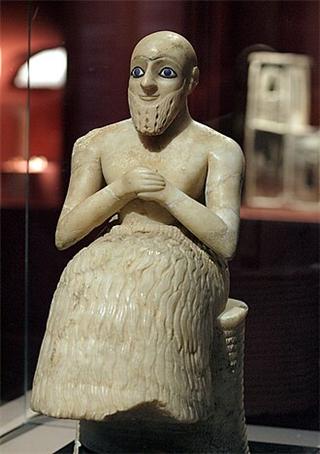
Mari’s wealth came from its position on the river. It levied tolls on boats carrying timber, wine, oil and tin between Syria and Babylonia, and in the early second millennium it was a key relay in the trade in tin from Iran to the west, which bronze-making cities needed. Irrigation canals on the narrow floodplain supported barley and other crops, but farming was limited, and the steppe on either side of the valley was the home of pastoral tribes with large flocks of sheep and goats. Relations between the city and these tribes, such as the Sim’alites and the Yaminites, dominate the royal letters; the king of Mari styled himself king of Mari and of the land of Hana, a term for the tent-dwelling pastoralists. The Old Babylonian archive of about 20,000 tablets, written in Akkadian, records the running of the palace in great detail: rations, textiles, metalwork, banquets, the household of women and musicians, imports of luxury goods and gifts between courts. It also preserves letters in which prophets and ecstatics relayed messages from gods such as Dagan and Addu to the king, and reports by diviners who read the future in the livers of sacrificed sheep. In the third millennium, statues of worshippers from Mari’s temples, such as the official Ebih-Il, show the city’s wealth and artistry.
Military

Mari’s history was shaped by war with its neighbours. In the twenty-fourth century BCE its kings, among them Iblul-Il, campaigned up the Euphrates into territory controlled by Ebla, which for a time paid Mari large amounts of silver and gold; texts from Ebla record that Ebla, allied with Nagar and Kish, later defeated Mari near Terqa. The second city was destroyed around 2300 BCE, probably by Sargon of Akkad, who claimed to have been given Mari by the god Dagan, or by his successors. In the early second millennium Yahdun-Lim of the Lim dynasty fought the tribes of the steppe and neighbouring kings, and led an expedition to the Mediterranean, where he claimed to have washed his weapons in the sea. Soon after his death Mari fell to Shamshi-Adad, ruler of the Kingdom of Upper Mesopotamia, who placed his son Yasmah-Addu on the throne. Zimri-Lim regained Mari around 1775 BCE with the help of Yarim-Lim of Yamhad and fought to control the Khabur plains and the tribes. His troops served with Hammurabi of Babylon against the invading Elamites and against Larsa. Mari’s armies often numbered a few thousand men, combining royal troops, tribal contingents and allies, and its letters give rare detail on recruitment, siege warfare, spies and the movement of armies.
Governance & Law
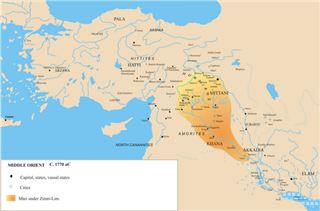
The Mari archive offers the fullest picture of how an Amorite kingdom of the early second millennium was governed. The king ruled from a vast palace of more than 260 rooms covering about 2.5 hectares, which served as residence, administrative centre, storehouse and workshop. He relied on governors of districts such as Terqa and Saggaratum, who reported to him constantly by letter, and on tribal chiefs and assemblies whose consent he needed to raise troops and keep the peace; historians have used this evidence to study collective decision-making in towns and tribes alongside the monarchy. Royal women held real authority: Zimri-Lim’s queen Shibtu, daughter of Yarim-Lim of Yamhad, managed the palace and reported on affairs while he was on campaign, and his daughters were married to vassal kings in the Khabur region to bind them to Mari. Between the Akkadian period and the Lim dynasty Mari had been ruled by military governors called shakkanakku, at first appointed by Akkad but later hereditary rulers in their own right. In foreign affairs Mari was part of a network of competing kingdoms that exchanged envoys, letters, gifts and treaties sealed by oaths to the gods. A letter in the archive observes that no king was strong on his own: ten or fifteen kings followed Hammurabi, and twenty followed Yarim-Lim of Yamhad.
Global & Regional Impact
Mari’s main legacy is its archive. The letters and administrative texts found in the palace from 1933 onwards by the French mission of André Parrot, published in the series Archives royales de Mari, give historians a view of politics, diplomacy, warfare, religion and daily life in the age of Hammurabi that no other site matches. They allow the reigns of Shamshi-Adad, Hammurabi, Rim-Sin of Larsa and Yarim-Lim of Yamhad to be followed almost month by month, and they record the international system of the Middle Bronze Age, in which kings addressed each other as father, son or brother according to their rank. The prophetic letters are among the earliest evidence for prophecy in the Near East and are often compared with the prophets of the Hebrew Bible, while the evidence for pastoral tribes has informed the study of Amorite society and early Israel. Mari’s art also has lasting importance: the third-millennium statues of worshippers, the wall paintings of the palace, including the scene known as the Investiture of Zimri-Lim, and the palace’s architecture are central to the study of Syrian and Mesopotamian culture. Since 2011 the site has suffered heavy looting during the Syrian civil war.
Decline & Fall
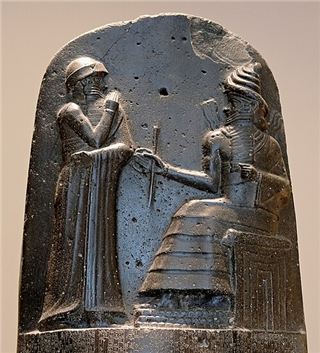
Mari’s end came through the ambitions of a former ally. Zimri-Lim’s kingdom flourished in the 1770s and 1760s, when he visited Ugarit with a large retinue, built at Terqa an ice house that he claimed no earlier king had built, and joined Hammurabi of Babylon in resisting the Elamite invasion of Mesopotamia around 1765 BCE. After Hammurabi had defeated Elam, Eshnunna and Larsa with the help of Mari’s troops, relations between the two kings broke down, perhaps over control of the Euphrates trade and the towns between their kingdoms. Hammurabi defeated Zimri-Lim, and Mari submitted to Babylon around 1761 BCE; Zimri-Lim disappears from the record. Two years later, around 1759 BCE, Babylonian forces destroyed the city’s walls and burned the palace, after scribes had sorted and removed some of the archives. Mari never recovered as a capital. A small settlement remained on the site in later periods, but power on the middle Euphrates passed to the Kingdom of Hana, centred at Terqa upstream. The palace buried under its own ruins was preserved, with its walls standing several metres high, until a group of Bedouin found a statue on the tell in 1933 and set off the excavations that restored Mari to history.
Mari controlled the middle Euphrates route between Mesopotamia and Syria for over a thousand years, and the archive of some 20,000 tablets from its last great king, Zimri-Lim, offers the most detailed view of diplomacy, war, prophecy and palace life in the Near East during the age of Hammurabi.
References
- Heimpel, W. (2003) Letters to the King of Mari: A New Translation, with Historical Introduction, Notes, and Commentary. Winona Lake, IN: Eisenbrauns.
- Fleming, D.E. (2004) Democracy’s Ancient Ancestors: Mari and Early Collective Governance. Cambridge: Cambridge University Press.
- Sasson, J.M. (2015) From the Mari Archives: An Anthology of Old Babylonian Letters. Winona Lake, IN: Eisenbrauns.
- Van De Mieroop, M. (2005) King Hammurabi of Babylon: A Biography. Oxford: Blackwell.
- Akkermans, P.M.M.G. and Schwartz, G.M. (2003) The Archaeology of Syria: From Complex Hunter-Gatherers to Early Urban Societies (c. 16,000–300 BC). Cambridge: Cambridge University Press.
Connections
Open the full connections map →