South & Southeast Asia
Sukhothai Kingdom
At a glance
- A Tai kingdom founded around 1238 when local chiefs expelled the Khmer governor of Sukhothai.
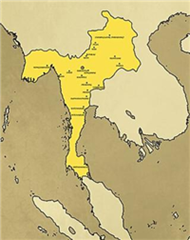
- Under Ram Khamhaeng in the late thirteenth century its overlordship stretched across much of present-day Thailand.
- Ayutthaya made it a vassal in 1378 and absorbed it around 1438, but it became the founding kingdom of Thai history.
Rise & Fall
- c. 1238Bang Klang Hao expels the Khmer governor and becomes king as Si Inthrathit
- c. 1279Ram Khamhaeng becomes king
- 1292Date of the Ram Khamhaeng inscription; embassies to the Yuan court begin about this time
- 1347Li Thai takes the throne and begins a Buddhist revival
- 1351Ayutthaya is founded in the lower Chao Phraya basin
- 1378Sukhothai submits as a vassal of Ayutthaya
- 1438Sukhothai is absorbed into Ayutthaya on the death of Maha Thammaracha IV
Foundation
Sukhothai lies on the Yom River, a tributary of the Chao Phraya, in the plain of north-central Thailand. In the twelfth and early thirteenth centuries it was an outpost of the Khmer Empire, whose laterite temples still stand in the city. As Khmer power weakened after the reign of Jayavarman VII, Tai-speaking groups who had settled in the river valleys began to assert themselves. According to later inscriptions, two Tai chiefs, Pho Khun Bang Klang Hao of Mueang Bang Yang and Pho Khun Pha Mueang of Mueang Rat, joined forces to expel the Khmer governor of Sukhothai. Bang Klang Hao was installed as ruler with the title Si Inthrathit, founding the line later known as the Phra Ruang dynasty. The date is usually given as around 1238, though it is conventional rather than recorded, and some historians prefer a slightly later date in the 1240s. The early state was one of several Tai principalities in the region, alongside Phayao, Nan and the future Lan Na, and it controlled little beyond Sukhothai and the twin city of Si Satchanalai to the north. According to the inscription of his son Ram Khamhaeng, Si Inthrathit's family fought neighbouring rulers to secure the new kingdom, and his elder son Ban Mueang succeeded him before Ram Khamhaeng took the throne, probably around 1279.
Socioeconomy
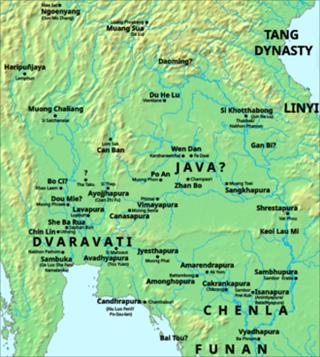
Sukhothai's economy was based on rice farming in the Yom valley, supported by reservoirs and water channels; the earthen dyke known as the Saritphong, west of the city, stored water from the hills. The famous inscription attributed to Ram Khamhaeng describes a land of plenty where "in the water there are fish, in the fields there is rice" and where the king levied no tolls on traders leading cattle or riding horses to market, an idealised picture that reflects royal propaganda as much as reality. Sukhothai and Si Satchanalai became centres of ceramic production, and from the fourteenth century the kilns of Si Satchanalai produced glazed stoneware, including green celadons known as Sawankhalok ware, which were exported across maritime Southeast Asia to the Philippines and Indonesia. Religion shaped daily life and the townscape. The rulers adopted the Theravada Buddhism of Sri Lanka, brought by monks via Nakhon Si Thammarat in the south, and built monasteries such as Wat Mahathat at the centre of Sukhothai and Wat Si Chum with its giant seated Buddha. Sukhothai artists created a distinctive style of Buddha image, including the graceful walking Buddha. Older Khmer Hindu and local spirit cults persisted alongside Buddhism, and the inscriptions mention a guardian spirit of the hill south of the city.
Military
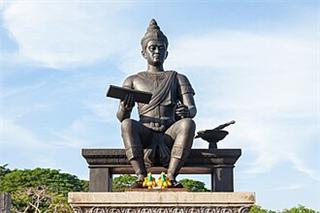
Sukhothai's armies were raised from the free men of its towns and villages under the command of the king and his relatives, and war elephants were the prestige weapon of rulers. Warfare consisted mostly of raids, sieges of walled towns and duels between leaders on elephant-back. The Ram Khamhaeng inscription records that at the age of nineteen the future king fought Khun Sam Chon, ruler of Mueang Chot, on elephants and drove him from the field, earning his name, "Rama the Bold". Sukhothai and Si Satchanalai were enclosed by earthen ramparts and moats, the walls of Sukhothai forming a rectangle about two kilometres by one and a half. Expansion under Ram Khamhaeng in the late thirteenth century relied less on conquest than on the submission of local rulers, who recognised his overlordship as long as he was strong. The kingdom's military position was shaped by wider events: the decline of the Khmer Empire and the Mongol campaigns against Pagan created space for new Tai powers. After Ram Khamhaeng's death, Sukhothai lacked the strength to hold its dependencies. In the 1370s King Borommaracha I of Ayutthaya campaigned repeatedly in the north, besieging Chakangrao (Kamphaeng Phet), and in 1378 Sukhothai's ruler submitted to Ayutthaya.
Governance & Law
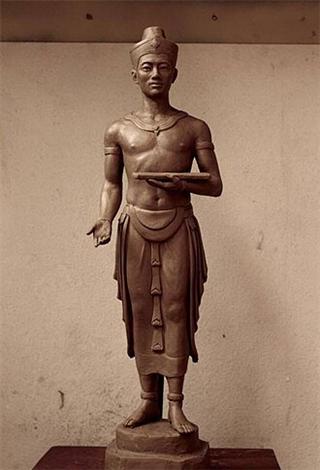
Sukhothai's kings presented themselves as paternal rulers, styled pho khun, "father lord". The Ram Khamhaeng inscription describes a bell hung at the palace gate that any subject could ring to bring a grievance to the king, and claims the king judged disputes fairly and protected inheritance. Whether or not this reflects practice, it became the founding image of Thai kingship. Government was personal rather than bureaucratic. The core of the kingdom, Sukhothai, Si Satchanalai and nearby towns, was ruled directly by the king and his close kin, while more distant mueang kept their own rulers who sent tribute and troops, a pattern often described as a mandala of overlapping loyalties. Royal power could therefore expand quickly under a forceful king and contract just as quickly under a weaker one. In the mid-fourteenth century Li Thai, also known as Maha Thammaracha I, recast kingship in Buddhist terms. The Traiphum Phra Ruang, a treatise on Buddhist cosmology attributed to him, presented the ideal king as a righteous ruler whose merit sustained the world. Li Thai invited a senior monk from Sri Lanka, promoted the ordination lineage of the forest-dwelling monks and spent time in Phitsanulok, which later became the main seat of the dynasty.
Global & Regional Impact

Sukhothai's importance in later history is greater than its political power ever was. Modern Thai historiography, shaped from the nineteenth century by King Mongkut, who found the Ram Khamhaeng inscription in 1833, and by twentieth-century nationalist historians, made Sukhothai the first Thai kingdom and the model of benevolent, Buddhist rule. The inscription, dated to 1292, credits Ram Khamhaeng with inventing the Thai alphabet; whatever its origin, the script used at Sukhothai was ancestral to modern Thai writing. In the late 1980s scholars including Michael Vickery and Piriya Krairiksh questioned whether the inscription was a later composition, possibly of the nineteenth century, and the debate remains unresolved, though many specialists accept it as substantially of the period. Sukhothai's religious legacy is more secure: its patronage of Sri Lankan Theravada Buddhism helped make that tradition dominant in the Thai kingdoms, and its Buddha images, especially the walking Buddha and the Phra Phuttha Chinnarat of Phitsanulok, became models for later art. Its ceramics are found across Southeast Asia. Sukhothai's institutions and religious ideals passed to Ayutthaya, which absorbed it. The ruins of Sukhothai, Si Satchanalai and Kamphaeng Phet were inscribed together as a UNESCO World Heritage Site in 1991.
Decline & Fall

Sukhothai's power depended on the personal authority of Ram Khamhaeng, and after his death, around 1298, many of his vassals broke away. Under his son Loe Thai the kingdom shrank to its core around the Yom and Nan valleys, while new centres rose around it. The most dangerous was Ayutthaya, founded in 1351 by King Uthong in the lower Chao Phraya basin, with access to the sea and the wealth of maritime trade. Li Thai restored some prestige and influence in the 1350s and 1360s, but after his death Borommaracha I of Ayutthaya attacked the northern towns, and in 1378 Sukhothai's ruler, Maha Thammaracha II, submitted as a vassal. For the next sixty years the Phra Ruang kings ruled as subordinate princes, increasingly from Phitsanulok, while Ayutthaya intervened in their affairs; in 1419 it settled a succession dispute between rival Sukhothai princes in favour of its own candidate. When Maha Thammaracha IV died in 1438, King Borommaracha II of Ayutthaya sent his son, the future King Borommatrailokkanat, to govern Phitsanulok, and the former kingdom became part of Ayutthaya's northern provinces. Its cities declined, and the region later became a battleground between Ayutthaya and Lan Na and, in the sixteenth century, the Burmese.
Sukhothai was a modest Tai kingdom that rose as Khmer power waned, but its patronage of Theravada Buddhism, its early Thai script and the idealised image of Ram Khamhaeng's paternal rule made it the founding kingdom of Thai national history and a model for Ayutthaya and Bangkok.
References
- Gosling, B. (1991) Sukhothai: Its History, Culture, and Art. Singapore: Oxford University Press.
- Chamberlain, J.R. (ed.) (1991) The Ram Khamhaeng Controversy: Collected Papers. Bangkok: The Siam Society.
- Reynolds, F.E. and Reynolds, M.B. (1982) Three Worlds According to King Ruang: A Thai Buddhist Cosmology. Berkeley: Asian Humanities Press.
- Wyatt, D.K. (2003) Thailand: A Short History. 2nd edn. New Haven: Yale University Press.
- Baker, C. and Phongpaichit, P. (2009) A History of Thailand. 2nd edn. Cambridge: Cambridge University Press.
Connections
Open the full connections map →