Social ladder · 1588–1672 (the Golden Age of the Dutch Republic)
Social Hierarchy of the Dutch Republic
From Stadtholder to Pauper
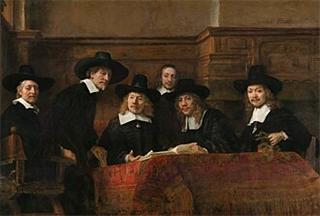
In the 17th-century Dutch Republic social status was largely determined by income. The landed nobility, living mostly in the inland provinces, counted for relatively little; the urban merchant class dominated, and from its richest families came the regents, the closed circle of men who sat, usually for life, on the town councils and through them in the States of the provinces, which held sovereignty. The stadtholder, usually the Prince of Orange, commanded the army but was by law an official of those States. The Reformed Church was the public church, and only those who conformed to it could hold office, so Catholics, Anabaptists and Jews worshipped apart. Below the affluent middle class came farmers, craftsmen and shopkeepers, then labourers, servants and sailors, and at the bottom the paupers. The Republic’s wealth also came from the trade and conquests of the Dutch East India Company and the Dutch West India Company: in 1621 Jan Pieterszoon Coen had almost all the inhabitants of the Banda Islands massacred, and in the Atlantic slave trade Dutch ships carried more than 550,000 people to the Americas in slavery.
Period 1588–1672 (the Golden Age of the Dutch Republic)People 1.5 millionRanks 10Profile Dutch Republic
The ladder
By rank, the ladder is drawn as a pyramid. To scale, each bar is as wide as that rank’s share of the people. Shares marked est. are estimates where no count survives; their boxes and bars are dashed.

Ruler · One ruler
Stadhouder (The stadtholder)
The stadtholder, usually the Prince of Orange, led the army of the Dutch Republic, but the provinces’ assemblies made the laws.
The stadtholder, the “steward”, had once stood in for an absent lord. After the provinces renounced Philip II in 1581, sovereignty and the highest executive and legislative power passed to the States of each province, and the stadtholder became their highest executive official, appointed by each province’s States. The office was open in name to anyone, but most provinces chose the Prince of Orange, so that one man held most of the stadtholderships and acted as head of state. By law he was a mere official. He was Captain-General of the States Army and Admiral-General of the fleet, appointed army officers and sometimes chose burgomasters from the town councils’ lists. Maurice of Orange ruled after 1618 as a military dictator.
Moving in or out. The States appointed him, and nearly always chose a prince of the House of Orange-Nassau, beginning with William the Silent, so that the office became effectively hereditary. The regents could also leave it empty: after William II died in 1650 Holland had no stadtholder for 22 years, until the invasion of 1672, the “Disaster Year”, swept William III to power.
How many? One man, usually the Prince of Orange holding the stadtholderships of most provinces; Friesland and Groningen often had one of their own, and Holland had none from 1650 to 1672.
Nobility and officials · c. 0.3–1% (est.)
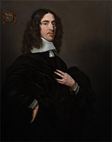
Regenten (Regents and patricians)
vroedschap, burgemeesters, schepenen
Rich merchant families ran the Dutch cities, and their men sat for life on the town councils.
The regents (regenten) were the rulers of the Republic, the men who governed its cities and through them the provinces: not formally a hereditary class, but in practice patricians, from rich merchant families long formed into a closed group. Each city’s council, the vroedschap, filled its own vacancies, its members usually sitting for life; it nominated the burgomasters and schepenen and sent the city’s deputies to the States. Amsterdam was governed by a large but closed oligarchy, which spent heavily on waterways, almshouses, hospitals and churches. The elite wore black as a mark of status. Merchant capital, much of it brought by refugees from Antwerp, went into ventures such as the Dutch East India Company, founded in 1602.
Moving in or out. Only men with enough wealth and long residence in the city could join, and an ambitious merchant family’s first step was a marriage into an old regent family. Everyone who held public office had to conform to the Reformed Church, and upheavals could purge a whole council: the Remonstrant regents in 1618, the Orangists in 1650, the followers of Johan de Witt in 1672.
How many? Estimate: the articles give no count; the regents filled the councils of the cities, eighteen of which voted in the States of Holland, and with the great merchant families who married into them they are taken here as a few thousand people, under one in a hundred.
Nobility and officials · c. 0.05–0.2% (est.)
The landed nobility
ridderschap
There were only a few nobles in the Dutch Republic, and many of them married into rich merchant families.
The landed nobility counted for relatively little in the Republic. Most nobles lived in the less developed inland provinces, and in the provincial States they sat as the ridderschappen, the bodies of nobles that represented the countryside; after the revolt their Catholic members were replaced by supporters of the new religion. Nobles mixed with the other classes for financial reasons: they married their daughters to wealthy merchants, became traders themselves or took public or military office, and their sons, like rich merchants’ sons, made a Grand Tour of Europe’s universities with a tutor. Many rural gentry supported the House of Orange. Because nobles were so few, wealthy merchants rather than aristocrats became the chief patrons of art.
Moving in or out. Birth made a noble, but wealthy merchants bought themselves into the nobility by becoming landowners and acquiring a coat of arms and a seal. This mixing of patricians and aristocrats was greatest in the second half of the century.
How many? Estimate: the articles give no count and describe the nobility as a comparatively small class, living mostly in the inland provinces.
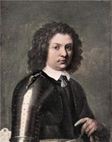
Picture: The nobleman Thomas Walraven van Arkel, about 1650 · Cornelis van Poelenburch · Public domain · Wikimedia Commons
Religious and learned · c. 0.1–0.3% (est.)
Ministers of the Reformed Church
-
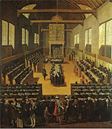
Ministers of the Reformed Church preached in plain churches without statues, and only church members could hold public office.
Calvinism was the state religion, and the Dutch Reformed Church the “public” or “privileged” church: anyone who wished to hold public office had to conform to it and take an oath. The Union of Utrecht let Holland and Zeeland accept one religion only, and Catholic services were soon forbidden in every province. The clergy had little worldly influence, yet in many places the church exercised more social control than the Catholic Church had. Early in the century the church split over predestination, and the Synod of Dort (1618–19) condemned the Remonstrants, who denied it, and banned their faith. Reformed churches, built from 1595, had no statues inside. Ministers ranked with the lawyers and physicians of the middle class.
Moving in or out. Ministers came from the affluent middle class. After the Synod of Dort banned the Remonstrant faith, those who denied predestination had no place in the public church.
How many? Estimate: the articles give no count; the ministers of the Reformed congregations with their families.

Soldiers, merchants and craftsmen · c. 5–10% (est.)
The affluent middle class
-
Lawyers, doctors and small merchants could read, bought paintings and had their portraits painted.
After the aristocrats and patricians came the affluent middle class: Protestant ministers, lawyers, physicians, small merchants, industrialists and the clerks of the large state institutions. The Republic had the highest literacy rates in Europe, and universities became career pathways to public office; the University of Leiden, founded in 1575, drew scholars from all over Europe. Middle-class buyers drove the market for still lifes, landscapes and scenes of everyday life, and the well-to-do met in the town militias (schutterijen), paying to be painted in group portraits; the chambers of rhetoric held contests in poetry and drama. Dutch lawyers such as Hugo Grotius led in international and commercial law, and Antonie van Leeuwenhoek was the first to describe bacteria.
Moving in or out. Wealth and education opened the way: universities led to public office, and a rich family could hope to marry into the regents. Newcomers joined too: many of the Huguenots who came from France after 1685 were shopkeepers or scientists.
How many? Estimate: the articles give no count; the lawyers, physicians, small merchants, industrialists and clerks with their families, in a land where nearly a third of the people (31.7 per cent in 1650) lived in towns.
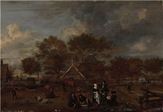
Free commoners · About 38% (the rest, est.)
Farmers, craftsmen and shopkeepers
-
Farmers, craftsmen and shopkeepers grew food, made goods and ran shops, and windmills pumped water off new farmland.
Lower in status came the farmers, craft and tradesmen, shopkeepers and government bureaucrats. Farmers prospered from cash crops for the towns and the seafaring population, and as lakes were turned into polders such as the Beemster, Schermer and Purmer, pumped dry by windmills, local grain and dairy farming soared. Windmills and peat carried by canal gave cheap energy; the wind-powered sawmill let the shipyards build a vast fleet, and sugar refineries grew. Skilled Protestant craftsmen from Antwerp, Bruges and Ghent moved north after Antwerp fell to Spain in 1585. Guilds and town militias had once checked the regents, but in the course of the 15th century the towns’ government became oligarchical.
Moving in or out. Status followed income, so a craftsman or shopkeeper who prospered could rise into the affluent middle class; a skilled tradesman earned about 200 guilders a year.
How many? Everyone else: farmers, craftsmen, tradesmen, shopkeepers and lesser officials with their families, the largest part of the population. The other shares are estimates, so this one is too.
Picture: A farmer and his wife before their farmstead, 1650–1680 (Rijksmuseum) · Jan Pietersz Opperdoes · Public domain · Wikimedia Commons

Free commoners · c. 18–23% (est.)
Catholics
-
Catholics could pray only in hidden house churches and were not allowed to hold public office.
The Catholic Church had been more or less suppressed since the war with Spain began, and Catholic services were soon forbidden in every province. Personal freedom of religion remained, but public office was out of the question. Money could overcome intolerance: Catholics bought the privilege of holding services in a conventicle, a house doubling inconspicuously as a church, while in 17th-century Leiden anyone opening a home to services could be fined 200 guilders and banned from the city. Catholics tended to keep to their own section of each town: the painter Johannes Vermeer lived in the “Papist corner” of Delft. Cities with a mainly Catholic background, such as Utrecht and Gouda, did not share in the Golden Age.
Moving in or out. Birth into a Catholic family decided it, and the way to office lay only through conforming to the Reformed Church. Wealth and status belonged almost exclusively to Protestants.
How many? Estimate: Catholics were 18 per cent of the population at the start of the 18th century and 23 per cent at its end; the articles give no figure for the 17th century, when they were already “one of the largest single denominations”.

Free commoners · c. 0.2–0.6% (est.)
Jews
-
Jewish families who had fled Spain and Portugal could live and pray openly in Amsterdam.
The Republic drew Portuguese and Spanish Jews fleeing the Inquisitions of Iberia in the 16th and 17th centuries, and later poorer German Jews. The Portuguese community had many wealthy merchants, who lived openly as Jews and took part in trade on a par with wealthy Dutch merchants. Amsterdam welcomed the Sephardic Jews and granted them all privileges except citizenship, but its tolerance served the city’s convenience: poor Ashkenazi Jews from Eastern Europe were far more carefully vetted, and those who came to depend on the city were encouraged to move on. Like the Catholics and the Anabaptists, Jews kept to their own section of each town and were barred from public office.
Moving in or out. Birth into the community decided it. A Sephardic merchant could grow as rich as any Dutch merchant, but Amsterdam’s citizenship stayed closed to him.
How many? Estimate: the articles give no count; the Portuguese and Spanish Jewish community and the poorer German Jews who came later lived mostly in Amsterdam.
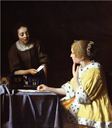
Free commoners · c. 20–30% (est.)
Skilled labourers, servants and sailors
-
Sailors, maids and workers earned more in the Dutch Republic than in most of Europe.
Below the craftsmen stood skilled labourers, maids, servants, sailors and others employed in the service trades. Dutch workers were generally paid better than in most of Europe and enjoyed relatively high living standards, though they paid higher taxes than usual. Between 1570 and 1620 the non-agricultural workforce grew by 3 per cent a year, and real wages for unskilled labourers were 62 per cent higher in 1615–19 than in 1575–79. Many were newcomers: nearly half of Amsterdam’s people were first-generation immigrants, from the Protestant parts of Germany and elsewhere, and in Amsterdam there was always work. Sailors manned the largest merchant fleet of any nation, and by the 1680s nearly 1,000 Dutch ships entered the Baltic each year.
Moving in or out. Work drew migrants from the Dutch countryside and from abroad, where many people were poor and unemployed. Since status followed income, better pay could lift a family.
How many? Estimate: the articles give no count; the skilled workers, maids, servants, sailors and other service workers of a land where nearly a third of the people lived in towns, and the crews of the largest merchant fleet of any nation.
Picture: Johannes Vermeer, Mistress and Maid, about 1666–1667 · Johannes Vermeer · Public domain · Wikimedia Commons
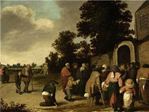


Serfs and dependants · c. 5–10% (est.)
Paupers
-
The poorest people begged or worked by the day, and the towns built almshouses for the old.
At the bottom of the pyramid stood the paupers: impoverished peasants, many of whom tried their luck in a city as beggars or day labourers. Amsterdam’s regents paid for municipal almshouses for the elderly, hospitals and churches, and the heads of orphanages and other charities were called regents too. But the city’s tolerance was practised for its own convenience: in 1681 it made provision for housing Huguenot refugees, yet gave no encouragement to the dispossessed Dutch from the countryside or other towns of Holland, and poor Jews who came to depend on it were encouraged to move on. In the 18th century a large underclass of unemployed lived on government and private charity.
Moving in or out. Poverty drove peasants off the land into the towns, where a beggar might find work as a day labourer; the cities did little for the dispossessed who came from the countryside.
How many? Estimate: the articles give no count; the impoverished peasants who came to the towns as beggars or day labourers, and the poor who lived on almshouses and charity.
Picture: Pieter de Bloot, Outside an Almshouse (Fitzwilliam Museum) · Pieter de Bloot · Public domain · Wikimedia Commons

Born into history
Where would you have stood? Chance places you on the ladder, as birth placed most people: weighted by how many each rank held.
Moving up and down
In the Dutch Republic status was largely determined by income. Wealthy merchants bought themselves into the nobility by becoming landowners and acquiring a coat of arms and a seal, while nobles married their daughters to merchants, became traders or took office; merchants in turn came to value public office, and universities became career pathways to it. The top of the ladder was harder to reach. Only men with enough wealth and long residence could join a city’s regents, a marriage into an old regent family was the usual first step, and the councils filled their own seats for life. Upheavals could replace a whole regent elite: Maurice’s coup of 1618, the death of William II in 1650 and the Disaster Year of 1672 each brought new men in. Later in the century William III encouraged the regents to promise one another’s families the offices, in “contracts of correspondence”, which closed the oligarchy further in the 18th century, when the regents became rentiers living on the public debt. Lower down, the Republic lived on newcomers: nearly half of Amsterdam’s people were first-generation immigrants, and real wages for unskilled labourers rose by 62 per cent in forty years. Religion set a limit no income removed: Catholics, Anabaptists and Jews could not hold public office.
Women on the ladder
The home was a woman’s sphere and an integral part of Dutch public life, a microcosm of the Republic whose good order reflected the state’s. The husband held authority in the public realm and controlled a small front room, the voorhuis, where he did his work or business; the wife ran the kitchens and family rooms, supervised the maids, cooked, cleaned, sewed and spun, went to market and kept some financial control over the household, and in some cases a wife held considerable control in the family business. Calvinist writers such as Jacob Cats stressed equality and companionship between husband and wife, though women were still held to be the weaker sex. Married women could publicly shame husbands who used brothels and could refuse their husbands if there was reason to fear venereal disease; women took communion alongside men, and widows could inherit property and keep control of their finances. Burgher girls were taught household duties and reading by their mothers, and travellers wrote of the freedom young women enjoyed in courtship. Mothers were urged to breastfeed rather than use a wet nurse. Noble families married their daughters to wealthy merchants, joining the two elites.
Compare with another society
Test yourself
5 questions on the ladder of the Dutch Republic.
The questions open here once the page has loaded.
Sources and further reading
- Israel, J. I. (1995) The Dutch Republic: Its Rise, Greatness and Fall, 1477–1806. Oxford University Press.
- Price, J. L. (1998) The Dutch Republic in the Seventeenth Century. New York: St. Martin's Press.
- Schama, S. (1987) The Embarrassment of Riches: An Interpretation of Dutch Culture in the Golden Age. New York: Alfred Knopf.
- de Vries, J. and van der Woude, A. (2010) The First Modern Economy: Success, failure, and perseverance of the Dutch economy, 1500–1815. Cambridge University Press.
- Helmers, H. J. and Janssen, G. H., eds. (2018) The Cambridge Companion to the Dutch Golden Age. Cambridge University Press.
The shares are of the whole population, children included. Where a scholar has counted or estimated a rank, its share follows that work, named on the rank; where no count survives, the share is an estimate, marked est. and drawn dashed, made from what the rank was and did, from related figures and from the same rank in comparable societies, and its note says what it rests on. Population: "around 1.5 million inhabitants", as the Dutch Republic article gives it, without a named estimate behind the figure.
Cite this page
- APA
- The Epoch Institute. (2026). Social Hierarchy of the Dutch Republic. In Social Ladders. https://the-epoch-institute.org/societies/dutch-republic
- MLA
- “Social Hierarchy of the Dutch Republic.” Social Ladders, The Epoch Institute, 2026, https://the-epoch-institute.org/societies/dutch-republic. Accessed .
- Chicago
- The Epoch Institute. “Social Hierarchy of the Dutch Republic.” Social Ladders. 2026. https://the-epoch-institute.org/societies/dutch-republic.
- Harvard
- The Epoch Institute (2026) ‘Social Hierarchy of the Dutch Republic’, Social Ladders. Available at: https://the-epoch-institute.org/societies/dutch-republic (Accessed: ).