Europe
Dutch Republic
At a glance
- A federation of seven sovereign provinces, formed in the revolt against Philip II of Spain and governed from The Hague.
- Its Baltic trade, East India Company and Amsterdam bank made it Europe’s leading commercial power in the 17th century.
- Rembrandt, Vermeer, Spinoza and Grotius worked there; wars and British rivalry wore it down until France conquered it in 1795.
Rise & Fall
- 1579The northern provinces form the Union of Utrecht
- 1581The Act of Abjuration renounces Philip II of Spain
- 1602The Dutch East India Company (VOC) is founded
- 1609The Twelve Years’ Truce with Spain begins; the Bank of Amsterdam opens
- 1648Spain recognises Dutch independence in the Peace of Münster
- 1672Disaster Year: France and England invade and the de Witt brothers are lynched
- 1688Stadtholder William III invades England and becomes its king
- 1795French armies overrun the Republic and the Batavian Republic is proclaimed
Foundation
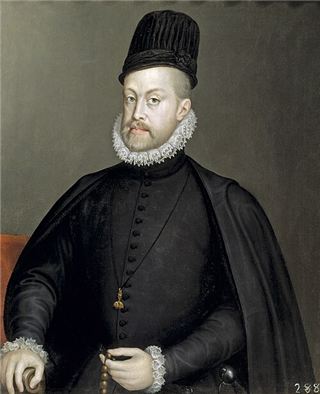
The Dutch Republic grew out of the Dutch Revolt against Philip II of Spain, ruler of the seventeen provinces of the Habsburg Netherlands. Opposition to heavy taxation, centralisation and the persecution of Protestants hardened after the Duke of Alba arrived with a Spanish army in 1567 and set up the Council of Troubles. William the Silent, Prince of Orange and stadtholder of Holland, Zeeland and Utrecht, led armed resistance from 1568, and in 1572 the capture of Brielle by the Sea Beggars allowed the rebels to take most towns of Holland and Zeeland. The northern provinces bound themselves together in the Union of Utrecht in January 1579, a defensive alliance that served as the Republic’s constitution in all but name. By the Act of Abjuration of 26 July 1581 the States General renounced Philip II as their sovereign. The rebels offered sovereignty first to Francis, Duke of Anjou, and, after William the Silent was assassinated at Delft in 1584, to Elizabeth I of England, who declined it but sent troops under the Earl of Leicester. After Leicester left in 1587 the States General stopped seeking a monarch and governed as a republic of seven provinces, Holland, Zeeland, Utrecht, Gelderland, Overijssel, Friesland and Groningen, with conquered lands to the south ruled in common as the Generality Lands.
Socioeconomy
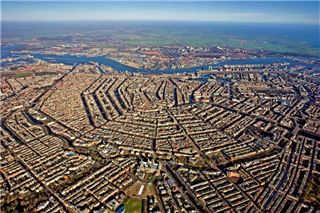
The Republic was the most urbanised society in Europe: by the later seventeenth century more than half the people of Holland lived in towns. Its prosperity rested on the ‘mother trade’ with the Baltic, which brought grain and timber in exchange for herring, salt, wine and textiles, and on a large merchant fleet built cheaply in the Zaan shipyards around the fluyt, a cargo ship that needed only a small crew. The Dutch East India Company (VOC), founded in 1602, and the Dutch West India Company, founded in 1621, extended this commerce to Asia, Africa and the Americas, including the Atlantic slave trade. Amsterdam became the staple market of European trade and finance, with the Bank of Amsterdam (1609) and an exchange where company shares were bought and sold. Agriculture was commercial and specialised, and land was won from lakes and the sea by windmill drainage, as in the Beemster polder of 1612. The Dutch Reformed Church was the public church, but Catholics, Mennonites, Lutherans and Jews could worship privately, and Sephardic Jews from Portugal settled in Amsterdam. Immigrants from the southern Netherlands, especially after the fall of Antwerp in 1585, brought capital and skills to Leiden’s textile industry and Amsterdam’s trade, and prosperous burghers sustained a large open market for paintings.
Military
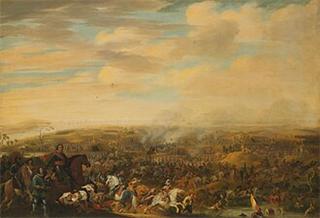
The Eighty Years’ War against Spain lasted, interrupted by the Twelve Years’ Truce of 1609–1621, until 1648. Maurice of Nassau, stadtholder from 1585, and his cousin William Louis reformed the army with regular pay, smaller units, constant drill and volley fire, and with the engineer Simon Stevin they recaptured towns such as Breda in 1590 and won the Battle of Nieuwpoort in 1600. Frederick Henry continued the war of sieges, taking ’s-Hertogenbosch in 1629 and Maastricht in 1632, and Dutch fortification with earthen bastions and moats was copied across Europe. At sea, Piet Heyn of the West India Company captured the Spanish silver fleet off Matanzas in Cuba in 1628, and Maarten Tromp destroyed a Spanish armada at the Battle of the Downs in 1639. Commercial rivalry with England produced three Anglo-Dutch Wars (1652–1654, 1665–1667 and 1672–1674); in 1667 Michiel de Ruyter raided the Medway and towed away the English flagship Royal Charles. In 1672 France, England, Münster and Cologne attacked together, and the Republic survived by flooding the Holland Water Line. Under William III it then led coalitions against Louis XIV in the Nine Years’ War and the War of the Spanish Succession, wars whose cost left Holland heavily indebted.
Governance & Law
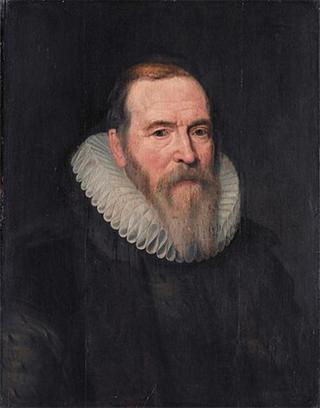
The Republic was a confederation in which each of the seven provinces was sovereign. Provincial States, dominated in Holland by the regents of the voting towns alongside a delegation of nobles, sent deputies to the States General at The Hague, which handled foreign policy, war and the Generality Lands; each province had one vote, and major decisions required unanimity. Holland paid over half of the common budget, and its chief legal officer, the Land’s Advocate, later called the Grand Pensionary, often directed policy, as Johan van Oldenbarnevelt did until his execution in 1619 after a clash with Maurice over the Remonstrant controversy in the Reformed Church. The princes of Orange-Nassau held the provincial office of stadtholder in most provinces and the command of the army, which gave them a quasi-monarchical standing. The rivalry between these two centres produced the First Stadtholderless Period after William II died in 1650, when Johan de Witt led the Republic as Grand Pensionary until the crisis of 1672, in which he and his brother Cornelis were lynched in The Hague. A Second Stadtholderless Period followed William III’s death in 1702 and ended in 1747, when William IV became hereditary stadtholder of all the provinces. Towns governed themselves through closed oligarchies of regent families.
Global & Regional Impact
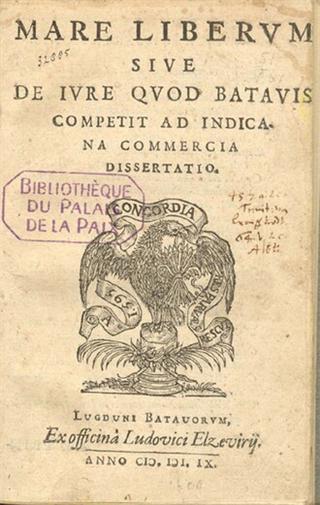
The Republic showed that a federal, mercantile republic could defeat a great monarchy and act as a great power, and its institutions were studied across Europe. The Bank of Amsterdam, the transferable shares of the VOC and a public debt that Holland serviced at low rates of interest influenced English finance, especially after William III brought Dutch advisers and practices to London in 1688. Hugo Grotius’s Mare Liberum (1609) and De jure belli ac pacis (1625) laid foundations of modern international law. Relative freedom of the press made Leiden and Amsterdam centres of European publishing, where René Descartes, Baruch Spinoza and John Locke lived and wrote, while Christiaan Huygens, Antonie van Leeuwenhoek and the Leiden medical school of Herman Boerhaave advanced science. The painting of the Dutch Golden Age, by Rembrandt van Rijn, Johannes Vermeer, Frans Hals and many others, developed landscape, still life and scenes of everyday life as independent genres. Overseas, the VOC’s posts at Batavia, in Ceylon and at the Cape and the West India Company’s colonies in New Netherland, Suriname and the Caribbean left lasting marks, including New York, founded as New Amsterdam, and the Afrikaans-speaking population of South Africa. Dutch slave trading and the VOC’s violence in Asia, as in the Banda Islands in 1621, are part of the same legacy.
Decline & Fall
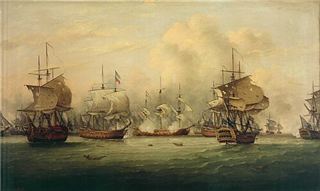
From about 1720 the Republic fell behind Britain and France. Debts from the wars against Louis XIV absorbed much of Holland’s revenue, the army and navy shrank, and the Republic stayed neutral in most mid-century conflicts. Dutch trade did not collapse, and Amsterdam remained a leading capital market, but rivals’ protectionism and the growth of British shipping eroded its share, while industries such as Leiden’s textiles declined sharply. The Fourth Anglo-Dutch War (1780–1784), provoked by Dutch trade with the American rebels, devastated shipping and exposed the navy’s weakness. Defeat fed the Patriot movement, which demanded reform and attacked the powers of the stadtholder William V. When the Patriots gained control of several towns and provinces, Prussia invaded in 1787 to restore William V, whose wife Wilhelmina was the Prussian king’s sister, and many Patriots fled to France. In the winter of 1794–1795 French revolutionary armies crossed the frozen rivers; William V fled to England in January 1795, and Dutch revolutionaries proclaimed the Batavian Republic, a French client state. The old federation of sovereign provinces gave way to the unitary constitution of 1798, and after Napoleonic rule the Netherlands re-emerged in 1815 as a kingdom under William V’s son, William I.
The Dutch Republic, a federation of seven provinces born of the revolt against Spain, became the leading commercial and financial power of seventeenth-century Europe, pioneered the joint-stock trading company and cheap public credit, and sheltered an exceptional flowering of painting, science and philosophy before British competition and French conquest ended it in 1795.
References
- Israel, J.I. (1995) The Dutch Republic: Its Rise, Greatness, and Fall, 1477–1806. Oxford: Clarendon Press.
- Price, J.L. (1998) The Dutch Republic in the Seventeenth Century. Basingstoke: Macmillan.
- de Vries, J. and van der Woude, A. (1997) The First Modern Economy: Success, Failure, and Perseverance of the Dutch Economy, 1500–1815. Cambridge: Cambridge University Press.
- Schama, S. (1987) The Embarrassment of Riches: An Interpretation of Dutch Culture in the Golden Age. New York: Knopf.
- Parker, G. (1977) The Dutch Revolt. London: Allen Lane.
- Boxer, C.R. (1965) The Dutch Seaborne Empire, 1600–1800. London: Hutchinson.
Connections
Open the full connections map →