South & Southeast Asia
Later Le dynasty
At a glance
- Founded by Lê Lợi, who ended twenty years of Ming occupation in 1428, it was Vietnam's longest-reigning dynasty.
- Under Lê Thánh Tông (1460–1497) it became a Confucian bureaucratic state and conquered the Cham capital Vijaya in 1471.
- From the 1530s the emperors were figureheads while the Trịnh lords ruled the north and the Nguyễn lords the south.
Rise & Fall
- 1418Lê Lợi launches his revolt against Ming rule at Lam Sơn
- 1428Lê Lợi takes the throne as Lê Thái Tổ at Thăng Long
- 1471Lê Thánh Tông captures Vijaya, the capital of Champa
- 1527Mạc Đăng Dung seizes the throne and founds the Mạc dynasty
- 1592Lê and Trịnh forces retake Thăng Long from the Mạc
- 1627War between the Trịnh and Nguyễn lords begins; a truce follows in 1672
- 1786The Tây Sơn overthrow the Trịnh lords
- 1789Quang Trung defeats the Qing at Đống Đa; Lê Chiêu Thống flees to China
Foundation

The Later Lê dynasty arose from resistance to Chinese rule. In 1407 the armies of the Ming Yongle Emperor overthrew the short-lived Hồ dynasty and annexed Đại Việt as the province of Jiaozhi, imposing heavy taxes and labour levies and carrying books and craftsmen off to China. In 1418 Lê Lợi, a wealthy landowner from Lam Sơn in the hill country of Thanh Hóa, raised a revolt and proclaimed himself Bình Định Vương, the 'Pacifying King'. Advised by the scholar Nguyễn Trãi, he waged a guerrilla war from the mountains for several years, then moved south to Nghệ An and back north to besiege the Ming in their provincial seat at Đông Quan. In 1427 his forces destroyed a Ming relief army at Chi Lăng, where its commander Liu Sheng was killed, and the Ming commander Wang Tong agreed to withdraw. In 1428 Lê Lợi took the throne as Lê Thái Tổ at Thăng Long, restoring the name Đại Việt, and Nguyễn Trãi's Bình Ngô đại cáo ('Great Proclamation on the Pacification of the Wu') announced the victory as a declaration of independence. The dynasty is called 'Later' to distinguish it from the Early Lê of 980–1009. Legend holds that Lê Lợi returned his magic sword to a golden turtle in a lake of Thăng Long, now Hoàn Kiếm Lake.
Socioeconomy
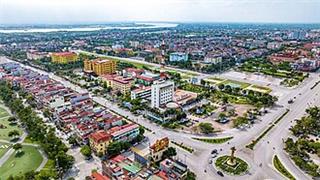
Đại Việt under the Lê was an agrarian society centred on wet-rice cultivation in the Red River delta and the coastal plains of Thanh Hóa and Nghệ An. The village, with its communal lands, headman and communal house, was the basic unit of life, and the state periodically redistributed public land among villagers under the equal-field (quân điền) rules issued under Lê Thánh Tông, in return for taxes, labour and military service. Lê Lợi resettled refugees, reclaimed abandoned fields and sent many soldiers back to farming. Neo-Confucian learning became the ideology of the court and elite, while Buddhism, ancestor worship and the cults of village guardian spirits remained central to popular religion. Trade grew in the seventeenth century as the Trịnh-ruled north exported silk and imported silver, copper, weapons and saltpetre; Chinese, Japanese, Portuguese, Dutch and English merchants traded at Phố Hiến and Thăng Long, and the Dutch East India Company kept a post in Tonkin from 1637 to 1700. Catholic missionaries, among them Alexandre de Rhodes, who worked in Tonkin in 1627–1630, won many converts, and the Latin-based script they developed later became the modern Vietnamese alphabet. The eighteenth century brought population pressure, the concentration of land in private hands, famine and widespread peasant revolt.
Military
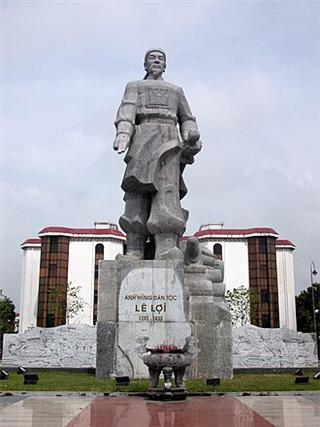
The dynasty was born of war and kept a large army. Lê Lợi's forces combined guerrilla tactics, ambushes in mountain passes and sieges of Ming fortresses, and after victory he kept a standing force while rotating most soldiers between service and farming. Lê Thánh Tông reorganised the army into regional commands and used it to expand. In 1471 he led a great expedition against Champa, captured its capital Vijaya and its king, and annexed the northern Cham lands, leaving a much reduced Champa in the south. In 1479 his armies invaded the Lao kingdom of Lan Xang and briefly occupied its capital, Luang Prabang, before withdrawing with heavy losses. After 1527 Lê loyalists fought the Mạc dynasty for six decades, retaking Thăng Long in 1592 under Trịnh command. From 1627 to 1672 the Trịnh fought seven major campaigns against the Nguyễn lords in the south, using war elephants, large infantry forces and fleets of galleys; the Nguyễn held them off behind fortified walls near Đồng Hới and with cannon cast with Portuguese help, and in 1643 they defeated a Dutch squadron sent to aid the Trịnh. The long truce after 1672 left both sides heavily armed. In 1774–1775 Trịnh forces took the Nguyễn capital Phú Xuân, but in 1786 their army was routed by the Tây Sơn.
Governance & Law
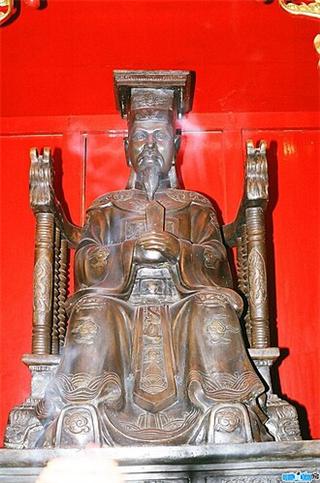
Lê Thái Tổ and his successors built a centralised monarchy on Chinese models. Lê Thánh Tông (r. 1460–1497) carried this furthest: he divided the realm into thirteen provinces, set up six ministries and a censorate, reduced the power of the great military families and staffed the bureaucracy through regular civil service examinations held every three years. From 1484 the names of successful doctoral candidates were carved on stone stelae at the Temple of Literature in Thăng Long, many of which survive. The legal code known as the Hồng Đức code, traditionally associated with his reign and named after its era, combined Tang and Ming models with Vietnamese custom; it is noted for allowing daughters to inherit and for protecting wives' property. After the restoration of 1533 the emperors became figureheads. Real power in the north passed to the Trịnh lords, beginning with Trịnh Kiểm, who ruled through a parallel administration, the lord's palace (phủ chúa), controlling the army, finances and appointments, while the Lê emperors performed state rituals and conferred legitimacy, including in relations with China. In the south the Nguyễn lords, nominally Lê subjects, built a separate state from 1558. The Lê thus survived as a ceremonial dynasty presiding over a divided country for more than two centuries.
Global & Regional Impact

The Later Lê shaped the Vietnamese state more than any earlier dynasty. Lê Lợi's war against the Ming became a founding story of national resistance, and Nguyễn Trãi's proclamation of 1428 is still read as a classic statement of Vietnamese sovereignty. Lê Thánh Tông's Confucian bureaucracy, examinations and law served as models for later governments, including the Nguyễn dynasty of the nineteenth century. The Đại Việt sử ký toàn thư, the national chronicle completed by Ngô Sĩ Liên in 1479 and later extended, became the standard history of early Vietnam. Literature in classical Chinese and in the vernacular chữ Nôm script flourished, from Lê Thánh Tông's own poetry to the encyclopaedic works of the eighteenth-century scholar Lê Quý Đôn. The conquest of Vijaya in 1471 began the decisive phase of the southern advance (Nam tiến), which the Nguyễn lords continued into the Mekong delta and which gave Vietnam its present elongated shape. The division between Trịnh and Nguyễn, meanwhile, created distinct northern and southern political traditions that outlasted the dynasty. The Latin-based script developed by missionaries in this period, chữ Quốc ngữ, became the national writing system in the twentieth century.
Decline & Fall
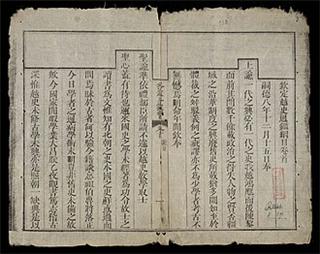
The Later Lê declined in two stages. After Lê Thánh Tông and his son Lê Hiến Tông (r. 1497–1504), weak and violent rulers such as Lê Uy Mục and Lê Tương Dực provoked revolts, and in 1527 the general Mạc Đăng Dung forced the reigning emperor to abdicate and founded the Mạc dynasty. Loyalists led by Nguyễn Kim enthroned a Lê prince in exile in 1533, and after Nguyễn Kim's death in 1545 his son-in-law Trịnh Kiểm took control of the restored court. The Lê regained Thăng Long in 1592, but as figureheads, and the country was soon split between the Trịnh in the north and the Nguyễn in the south. In the eighteenth century peasant risings, famine and court intrigue weakened the Trịnh. The Tây Sơn rebellion, which broke out in the Nguyễn domain in 1771, destroyed the Nguyễn lords, and in 1786 its leader Nguyễn Huệ marched north and overthrew the Trịnh while professing loyalty to the Lê. The last emperor, Lê Chiêu Thống, who came to the throne that year, appealed to the Qing; a Qing army occupied Thăng Long in late 1788, but Nguyễn Huệ, proclaimed emperor as Quang Trung, crushed it at Ngọc Hồi and Đống Đa early in 1789. Lê Chiêu Thống fled to China and died in Beijing in 1793.
The Later Lê dynasty, founded by Lê Lợi after expelling the Ming in 1428, built Vietnam's most complete Confucian state under Lê Thánh Tông and conquered the Cham heartland in 1471, then reigned for more than two centuries as figureheads while the Trịnh and Nguyễn lords divided the country.
Test yourself
5 questions on this page, from its key events and facts.
The questions open here once the page has loaded.
References
- Dutton, G. (2006) The Tây Sơn Uprising: Society and Rebellion in Eighteenth-Century Vietnam. Honolulu: University of Hawai'i Press.
- Hoang Anh Tuan (2007) Silk for Silver: Dutch-Vietnamese Relations, 1637–1700. Leiden: Brill.
- Li Tana (1998) Nguyễn Cochinchina: Southern Vietnam in the Seventeenth and Eighteenth Centuries. Ithaca: Cornell Southeast Asia Program.
- Nguyen Ngoc Huy and Ta Van Tai (1987) The Lê Code: Law in Traditional Vietnam. Athens, OH: Ohio University Press.
- Taylor, K.W. (2013) A History of the Vietnamese. Cambridge: Cambridge University Press.
Connections
Open the full connections map →