
Religion · Ancient Near East
Mesopotamian religion
At a glance
- Every city had its patron god, among them Enki at Eridu, Enlil at Nippur, Marduk at Babylon and Ashur at Assur, and each god lived in a temple run as a household, its image fed, dressed and served.
- Priests read the will of the gods in entrails, birds, the sky and dreams, and ordinary people prayed to a personal god and warded off demons with incantations.
- It left the oldest body of recorded religious literature, from the Epic of Gilgamesh to the Enuma Elish, and many biblical stories were possibly based on its myths.
Timeline
- c. 3500 BCEWriting is invented in Mesopotamia, bringing the first evidence of a recognisably Mesopotamian religion
- c. 2600 BCEA Sumerian list of about 560 deities, found at Fara and Tell Abu Salabikh, ranks five gods above the rest
- c. 2335 BCESargon of Akkad unites Mesopotamia, and Sumerian and Akkadian gods are increasingly identified with one another
- 18th century BCEHammurabi of Babylon raises Marduk to supremacy alongside Anu and Enlil in southern Mesopotamia
- c. 12th century BCEThe Enuma Elish tells how Marduk made the heavens and the earth from the body of Tiamat
- 539 BCEThe Achaemenid Empire of Cyrus the Great conquers Mesopotamia but leaves its native religion undisturbed
- 2nd century BCEUnder the Parthians a revival in Assyria dedicates temples once more to Ashur, Sin, Shamash, Hadad, Bel and Ishtar
- c. 400–500The old religion has almost completely died out, its people having largely become Syriac Christians
Spread through the centuries
Where it began, how it spread, and where it was a main faith (a bright glow) or held communities (a faint one), century by century to its last places. Press Play or move the slider, turn the globe, and tap a glow or a mark to read about it.
The map opens here once the page has loaded.
Origins
The earliest undercurrents of Mesopotamian religious thought are believed to have arisen in the first half of the 6th millennium BCE, when people first settled permanently in Mesopotamia thanks to improved irrigation. What they believed is unknown, since it came before writing, though Sumerian and Akkadian speakers worshipped a mother goddess, Ninhursag, from the Ubaid period (c. 5500–3700 BCE). The first evidence of a recognisably Mesopotamian religion comes with the invention of writing around 3500 BCE, and it shows the worship of the forces of nature as providers of sustenance.
Two peoples shaped it: the Sumerians, who spoke a language isolate and by historical times lived mostly in the south, and the East Semitic speakers of Akkadian, believed to have entered the region between 4000 and 3000 BCE. In the 3rd millennium BCE the objects of worship were personified as a large cast of gods with their own functions. After Sargon of Akkad united Mesopotamia around 2335 BCE, Sumerian and Akkadian gods were increasingly identified with one another, the Akkadian speakers preferring to worship fewer deities raised to greater power.
Scholars once argued that no single Mesopotamian religion could be defined. Others answer that a broadly shared religious system lasted through the succession of states: a consistent tradition, little changed by the movements of peoples, that adapted to its followers’ needs over millennia.
Beliefs & Practice
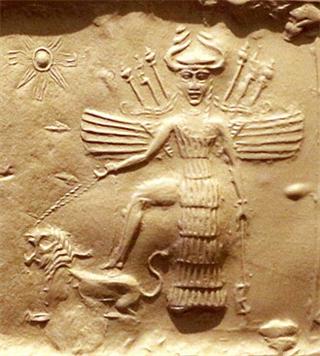
Mesopotamian religion was polytheistic and also henotheistic: the people of a city held its tutelary god above the others, as Enki at Eridu, Enlil at Nippur, Ishtar at Arbela, Marduk at Babylon and Ashur at Assur. K. Tallqvist counted about 2,400 known deities, most with Sumerian names. The gods were thought humanlike but more powerful, all-knowing and immortal, wrapped in a terrifying brightness, melammu. Among the greatest were Enlil, king of the gods, An (Akkadian Anu), Enki (Ea), the moon god Nanna (Sîn), the sun god Utu (Shamash) and Inanna, goddess of sex and war. The historian Jean Bottéro held that the gods were masters to be obeyed and feared rather than loved.
Humanity was believed to have been created to serve the gods. Each god lived in a temple in its city, often a stepped ziggurat, present in a cult image to which banquets were served twice a day and before which incense was burned. Divination read the gods’ will in the entrails of sacrificial animals, the flight of birds, oil dropped on water, the sky and dreams.
Sin was above all rebellion and was punished by sickness or misfortune, even for sins committed unknowingly. After death everyone, whatever their status or deeds, went to the underworld, known as Arallû, Ganzer or Irkallu, where the dead lived as weak ghosts in darkness, with dust for food and clay for nourishment.
Texts & Teachers
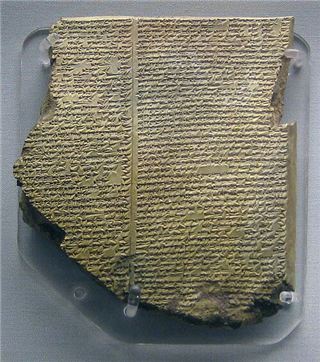
Mesopotamian religion has the oldest body of recorded literature of any religious tradition. Its myths, prayers, incantations and lists of gods were written in cuneiform on clay tablets, in Sumerian, Akkadian or Aramaic. A Sumerian list of about 560 deities from Fara and Tell Abu Salabikh, of around 2600 BCE, already ranks five of them above the rest. The Enuma Elish (c. 12th century BCE), the only surviving text to set out a cosmology systematically, tells how Marduk killed Tiamat, the mother of the gods, and made heaven and earth from the two halves of her body.
Perhaps the most significant legend to survive is the Epic of Gilgamesh, the story of the heroic king Gilgamesh, his wild friend Enkidu and his search for immortality, which holds the earliest reference to the Great Flood. The myth of Ishtar’s descent into the underworld describes the dead, the Adapa myth tells why all people must die, and How Erra Wrecked the World tells how Erra tricked Marduk into leaving his statue. Prayers exalt their god above all others, and the Šurpu incantation series lists the duties owed to other people. Many myths tell how rituals, the property of the gods, passed to other gods or to humankind.
Much later Berossus reported in his Babyloniaca that the world was to last “twelve times twelve sars”, 518,400 years. The modern study of these texts, Assyriology, began only in the mid-19th century.
Spread
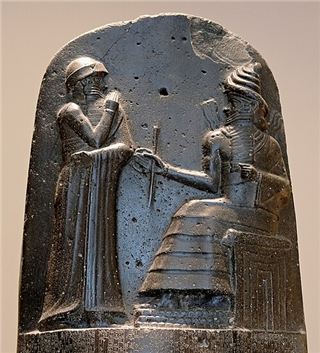
Each city honoured its patron god, and as kingdoms and empires rose, their gods rose with them. When the Babylonians came to power in the 18th century BCE, King Hammurabi raised Marduk, until then of little importance, to supremacy alongside Anu and Enlil in southern Mesopotamia. In the 2nd and 1st millennia BCE the gods were ordered as a monarchy, the national god of each state at the head of its pantheon, and personal religion gained weight.
Ashur, patron of the city of Assur from the late Bronze Age, was promoted to overlord of the Assyrian domain, which reached from the Caucasus and Armenia to Egypt, Nubia and Arabia and from Cyprus to central Iran, and worship was conducted in his name throughout the lands the Assyrians ruled. He was in constant rivalry with Babylonia’s Marduk.
In 539 BCE the Achaemenid Empire of Cyrus the Great conquered Mesopotamia, ending more than 3,000 years of Mesopotamian dominance of the Near East, but the Persians did not interfere with its religion. Alexander the Great took the region in 330 BCE, and the Seleucids brought Hellenistic influence. Under the Parthians a revival in Assyria, from the 2nd century BCE to the 4th century CE, dedicated temples once more to Ashur, Sin, Shamash, Hadad, Bel and Ishtar. Christianity was introduced from the 2nd century CE, and by about 400–500 CE the old religion had almost completely died out.
Community & Society
In theory the king was the religious leader of the cult, the enu or šangū, with many duties in the temple. Around him worked specialists who mediated between people and gods: a supervising priest, the šešgallu; the āšipu, who purified people against demons and magicians; the mašmašu, who purified the temple; the kalū, who soothed the gods’ anger with song and music; singers, craftsmen, masters of divination (bārû) and lower ecstatic seers (mahhu). The temple was the god’s household, with kitchens, bedrooms, a courtyard and a stable for the god’s chariot.
Religion and rule were bound together. In early Assyria, an oligarchy with an assembly of elders, a hereditary ruler and a yearly eponym, the title šarrum, king, was reserved for the city god Ashur; the ruler, his high priest, was only “steward of Assur”. The Neo-Assyrian king was not a god but the chief servant of Ashur, his authority absolute so long as the high priest assured the people that the god was pleased. The gods were thought to give kings power so that they might uphold justice and righteousness, mēšaru and kettu.
Ordinary people revered a personal god, who from the 2nd millennium BCE was thought to protect them, and their names were often devoted to a deity. Marriages were usually arranged by parents, with contracts on clay tablets, and became legal when the groom delivered a bridal gift to the bride’s father.
Legacy
Mesopotamian religion had almost completely died out by about 400–500 CE, after its people had largely become Syriac Christians; Assyria became a centre of the Church of the East. In the 3rd century CE Manichaeism drew on local Mesopotamian religion among other traditions. The Assyrian people are still present today.
The religion is thought to have influenced later faiths, among them Canaanite and Israelite, Aramean and ancient Greek religion. Many biblical stories found in Judaism, Christianity, Islam and Mandaeism were possibly based on earlier Mesopotamian myths: the creation, the Garden of Eden, the Flood, the Tower of Babel, figures such as Nimrod and Lilith, and the Book of Esther. In the early 20th century Hugo Winckler’s school of Panbabylonism held that the religions of the Near East, the Hebrew Bible included, were rooted in Babylonian astral science; its tenets were dismissed as pseudoscientific, though scholars recognise an indirect Babylonian influence on Jewish mythology. The Book of Revelation associates Babylonian religion with apostasy of the lowest order.
Archaeology keeps adding to what is known: in March 2020 archaeologists announced a 5,000-year-old cultic area at Girsu dedicated to Ningirsu, with more than 300 broken ceremonial cups, bowls and jars and a duck-shaped bronze figurine thought to be dedicated to Nanshe. The religion has also inspired contemporary neo-pagan groups.
Mesopotamian religion was the polytheistic tradition of Sumer, Akkad, Assyria and Babylonia, attested from the invention of writing around 3500 BCE. Its city gods lived in temples as in households, served with food, incense and ritual, while priests read their will in omens. It faded as its people became Syriac Christians, almost vanishing by 400–500 CE, but its myths left traces in the Bible.
References
- Jean Bottéro, Religion in Ancient Mesopotamia (University of Chicago Press, 2001)
- Tammi Schneider, An Introduction to Ancient Mesopotamian Religion (Eerdmans, 2011)
- Helmer Ringgren, Religions of the Ancient Near East (Westminster Press, 1974)
- Mark W. Chavalas, Mesopotamia and the Bible (Continuum, 2003)
- Betty De Shong Meador, Inanna, Lady of Largest Heart (University of Texas Press, 2000)