
Religion · Ancient Near East
Canaanite religion
At a glance
- The Canaanites honoured a pantheon headed by El and his consort Asherah, with Baal Hadad, the storm god who brought the rain, and Anat, Astarte, Dagon and Resheph among the other deities.
- Most of what is known comes from the clay tablets of Ugarit, dated around 1275 BCE, which preserve the Baal Cycle and other myths with hymns, prayers and ritual texts.
- In the first millennium BCE its branches lived on among Phoenicians, Arameans and Moabites, many scholars count Israelite Yahwism among them, and Phoenician settlers carried it west as the Punic religion.
Timeline
- 3rd millennium BCEThe Ebla tablets from Tell Mardikh in Syria list offerings to El, Baal and Dagon, the earliest evidence of Canaanite religion
- 15th century BCEInscriptions of Idrimi, king of Alalakh, shed further light on Canaanite religion
- c. 1275 BCEThe Ugaritic texts, more than three hundred of them on Canaanite myths, rites and prayers, date from about this time
- c. 1200 BCEUgarit is destroyed
- 9th century BCEPhoenicians found Carthage and other Punic communities in the western Mediterranean
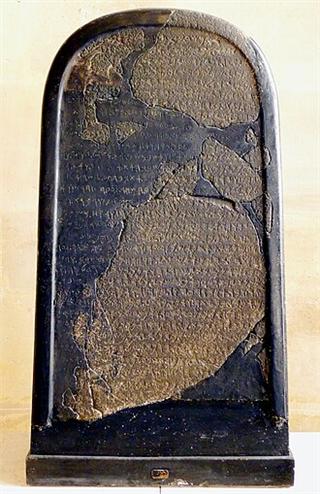
- c. 850 BCEThe Mesha Stele is set up in Moab, one of the few sources for religion in the southern Levant beyond Israel and Judah
- 3rd–2nd century BCEThe Roman Republic conquers the Punic lands, where Punic religious practice continues
- 4th century CEThe last Punic religious practices die out
Spread through the centuries
Where it began, how it spread, and where it was a main faith (a bright glow) or held communities (a faint one), century by century to its last places. Press Play or move the slider, turn the globe, and tap a glow or a mark to read about it.
The map opens here once the page has loaded.
Origins
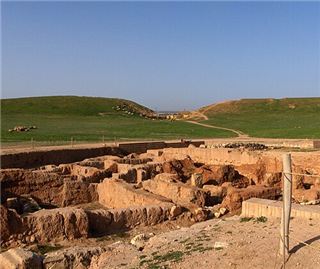
Canaanite religion was the religion of the peoples of the land of Canaan in the southern Levant during approximately the first three millennia BCE. Knowledge of it is fragmentary, too thin for a complete, continuous account. Until Levantine archaeology began in the late 19th and early 20th centuries, it was known mostly from the Hebrew Bible and from later Greek writers: Lucian’s On the Syrian Goddess, fragments of the Phoenician History of Philo of Byblos, and Damascius.
The earliest evidence comes from the Ebla tablets, clay texts found at Tell Mardikh in Syria and dated to the second half of the 3rd millennium BCE, which list offerings to the chief Canaanite gods El, Baal and Dagon. In the late 3rd and early 2nd millennia BCE the same gods appear in the personal names of the Amorites, whose homeland lay in the middle Euphrates and lower Khabur regions. Early Bronze Age layers at Tell es-Safi hold donkeys, sheep and goats imported from Egypt to be sacrificed; a complete donkey beneath a building’s foundations may have been a foundation deposit.
The religion grew among more powerful and populous neighbours and shows the clear influence of Mesopotamian and Egyptian practice. Robert G. Boling argued that Canaan had no “local pantheon”: on a land bridge between Asia and Africa, its people chose the most important and interesting gods of their neighbours, gave them several names and dropped their places of origin.
Beliefs & Practice

The Canaanites honoured gods in a four-tier hierarchy headed by El, also called Elyon, “Most High”, god of creation, and his consort Asherah (Athirat). Among the others were Baal Hadad, lord of storms, thunder and lightning and king of the gods; Anat, virgin goddess of war; Astarte, goddess of war, hunting and love; Dagon, god of grain and father of Baal; Resheph, god of plague and of healing; Yam, god of the sea and rivers; the sun goddess Shapash; the moon god Yarikh; the craftsman Kothar-wa-Khasis; and Mot, Death, who was given no worship or offerings. Families focused on veneration of the dead through household gods and goddesses, the Elohim.
No cosmology survives from Ugarit. In the later account of Philo of Byblos, said to come from Sanchuniathon of Berytus, the creator Elion was father of the gods and married Beruth, “the city”, as other gods were linked with theirs: Melqart with Tyre, Chemosh with Moab, Tanit and Baal Hammon with Carthage. Pairs of mountains recur in the myths.
Images of gods such as Baal stood in shrines, often on hilltops or “high places” among groves of trees, with standing stones or pillars, as the Hebrew Bible condemns. Animals were sacrificed. After death the npš, usually translated “soul”, departed to the land of Mot. The dead were buried with grave goods and given food and drink so that they would not trouble the living, and dead relatives were venerated and sometimes asked for help.
Texts & Teachers
By far the richest source is the Ugaritic texts, clay tablets found since 1928 near Ras Shamra in Syria, ancient Ugarit, a city destroyed around 1200 BCE; they are dated around 1275 BCE. More than three hundred of them preserve key myths and legends, with incantations, prayers, hymns, votive texts, lists of gods and sacrifices, festival catalogues, ritual prescriptions, liturgies and omen texts. Further light comes from the inscriptions of Idrimi, the 15th-century BCE king of Alalakh, and the tablets of Emar of the 14th and 13th centuries BCE.
The best-known myth is the Baal Cycle. Baal Hadad defeats the sea god Yam with two magic weapons, “Driver” and “Chaser”, made by Kothar-wa-Khasis, and with the help of Athirat and Anat persuades El to let him have a palace. From its window he challenges Mot, who swallows him and takes him to the underworld; drought follows, until Anat grinds Mot to pieces and Baal returns with the rain.
The first millennium BCE left inscriptions: the Mesha Stele of Moab (c. 850 BCE) and the Deir Alla inscription (c. 700 BCE); Aramean texts such as the Tell Fekherya bilingual, the Stele of Zakkur (c. 775 BCE) and the Sefire steles; Phoenician ones such as the Yehimilk inscription and the Karatepe bilingual (c. 720 BCE); and the Punic Carthage and Marseille Tariffs (c. 200 BCE). Philo of Byblos (c. 64–141 CE), known through Eusebius, wrote after much Greek and Roman influence, so it is hard to tell what shaped his account.
Spread
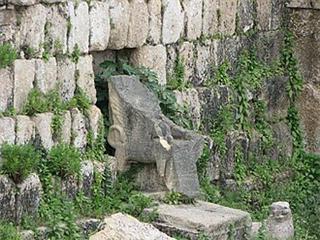
Through the Bronze Age the religion took in the gods of its neighbours. In the Hyksos period, when chariot-mounted maryannu ruled Egypt from Avaris, Baal was identified with the Egyptian god Set and was thereafter shown wearing the crown of Lower Egypt, while Asherah, Astarte and Anat were given Hathor-like wigs. In the Middle and Late Bronze Age Hurrian and Mitannian influence was strong: the Hurrian goddess Hebat was worshipped in Jerusalem, and Baal was held equivalent to the Hurrian storm god Teshub and the Hittite Tarhunt. Baal Hadad and El can be distinguished among the Amorites, who invaded Mesopotamia at the end of the Early Bronze Age.
In the Iron Age, as Egyptian power over Canaan declined, peoples and cities formed regional and national cults round a patron god: Chemosh of the Moabites, Milcom of the Ammonites, Qos of the Edomites, Yahweh of the Israelites, Melqart of Tyre and Eshmun of Sidon. Several branches persisted through the first millennium BCE, among them Aramean and Phoenician religion.
From the 9th century BCE Phoenicians founded Carthage and other Punic communities in North Africa, southern Spain, Sardinia, western Sicily and Malta, where Punic religion continued the Phoenician branch with local differences. In the Hellenistic period Greek religion spread alongside Canaanite traditions in the non-Jewish parts of Canaan, and Canaanite gods took the names of their Greek equivalents. Rome conquered the Punic lands in the 3rd and 2nd centuries BCE, but Punic practices continued, in some places until the 4th century CE.
Community & Society
“At the center of Canaanite religion,” in one scholar’s summary, “was royal concern for religious and political legitimacy and the imposition of a divinely ordained legal structure, as well as peasant emphasis on fertility of the crops, flocks, and humans.” Kings played an important religious role and, in ceremonies such as the sacred marriage of the New Year, may have been revered as gods. In the Iron Age, cults of patron gods bound together the new political and communal identities of cities and peoples.
Family duty carried religious weight. Children were expected to care for their parents, and sons were responsible for burying them and keeping up their tombs. Funerary rites honoured the dead and fed the npš on its way to the land of Mot, with incense, libations, music and devotional songs, and sometimes trance rituals, oracles and necromancy. Graves at Tel Megiddo held many wine vessels and jars of beeswax, animal fat, olive oil, resin and even vanilla, perhaps for a funerary feast or as offerings, and evidence of opium use comes from a Late Bronze Age site in the southern Levant.
A clear picture of practice is almost impossible to reconstruct, but surrounding peoples knew of Canaanite child sacrifice. K. L. Noll writes that in military crisis human sacrifice was offered to the patron god of a besieged city, and prisoners of war to the victorious god. Ronald Hendel holds that the Israelites disparaged Canaanite religion because they wished to set themselves apart from their Canaanite ancestors and form a new national identity.
Legacy
Canaanite religion ended with its last branch, the Punic religion of the western Mediterranean, which outlived the Roman conquest and survived in some places until the 4th century CE. In the east its gods had already blended with Greek ones in the Hellenistic period, taking Greek names.
Its influence ran in several directions. Carried west by Phoenician sailors, Canaanite ideas can be seen in Greek mythology: the division of the world between Zeus, Poseidon and Hades mirrors that between Baal, Yam and Mot, and the Labours of Hercules mirror the stories of Tyre’s Melqart, who was often equated with Heracles. Words and places kept its traces too: the npš of the funerary rites is the origin of the Hebrew word נפש, Bethoron in ancient Israel takes its name from the underworld god Horon, and Jericho was likely the cult centre of the moon god Yarikh.
The Hebrew Bible distinguishes the Yahwism of Israel and Judah from Canaanite religion, but many scholars count it among the Canaanite religions and the Israelites as a Canaanite people. Scholars still debate details, such as the claim that Asherah was considered Yahweh’s consort: Edward Lipiński argues that the asherah of the inscriptions was a holy place rather than a goddess. Most of what is known today comes from archaeology, above all the tablets of Ugarit.
Canaanite religion was the polytheistic religion of the southern Levant during about three millennia BCE, its pantheon headed by El and Asherah, with Baal, Anat and Astarte. Known chiefly from the tablets of Ugarit, it honoured the dead, worshipped on high places and took in its neighbours’ gods. Phoenicians carried it west, where its Punic branch lasted until the 4th century CE.