Central & East Asia
Yuezhi
At a glance
- A nomadic people of the Gansu corridor, strong enough in the 3rd century BCE to hold the Xiongnu prince Modu hostage.
- Defeated by the Xiongnu, they migrated west to the Ili valley and then took Bactria, probably in the 130s BCE.
- Zhang Qian's mission to them opened Han China to the West, and their Guishuang chiefs founded the Kushan Empire.
Rise & Fall
- 209 BCEModu, once a hostage of the Yuezhi, seizes power among the Xiongnu
- c. 176 BCEThe Xiongnu defeat the Yuezhi in the Gansu corridor
- c. 160s BCEThe Greater Yuezhi move west and drive the Saka from the Ili valley
- c. 130s BCEThe Wusun expel the Yuezhi, who move south and take Bactria
- c. 128 BCEThe Han envoy Zhang Qian reaches the Yuezhi court
- c. 30 CEKujula Kadphises unites the five xihou and founds the Kushan Empire
Foundation

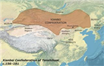
The Yuezhi first appear in Chinese sources as a powerful pastoral people of the north-western frontier. According to the Shiji of Sima Qian, which draws on the report of the envoy Zhang Qian, they originally lived between Dunhuang and the Qilian Mountains in the Gansu corridor, and in the late third century BCE they were strong enough to look down on the Xiongnu. Their origins are obscure. Many scholars identify them with speakers of the Tocharian languages, an early branch of Indo-European later attested in the Tarim Basin, and link them to the Tochari whom Greek writers name among the conquerors of Bactria; others are cautious, since no Yuezhi text survives. Some also connect them with the 'Yuzhi' named as suppliers of jade in early Chinese texts, which would make them middlemen in the jade trade from Khotan, but this too is uncertain. Archaeologists have sought their homeland among the cultures of the Gansu corridor and the eastern Tianshan without reaching consensus. What is clear is that by about 300 BCE a Yuezhi confederation controlled the pastures and routes of the corridor and dominated its neighbours. The Xiongnu ruler Touman even sent his son Modu to them as a hostage, a sign of Yuezhi superiority at the time.
Socioeconomy
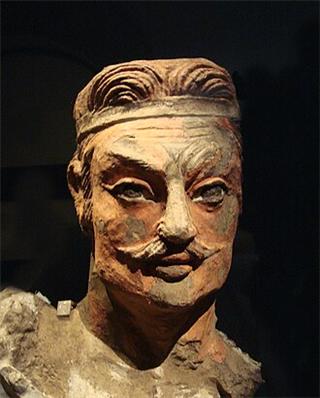
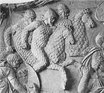
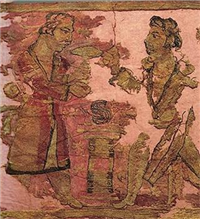
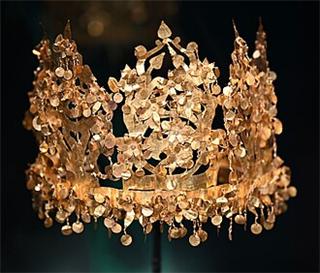
The Yuezhi were mounted herders who, in the words of the Shiji, moved about with their animals and shared the customs of the Xiongnu. Horses, cattle and sheep were their wealth, and the mountain pastures of the Qilian range and the oases of the Gansu corridor allowed seasonal movement between highland and lowland grazing. Their position on the corridor made them intermediaries between China and the lands to the west, through which horses, jade and Chinese goods passed. After their migration to Central Asia they ruled the settled, urbanised population of Bactria, with its irrigated farmland, Greek-founded cities and markets. Zhang Qian described Daxia, as the Chinese called Bactria, as a land of walled towns and skilled merchants without a strong ruler, and noted that the Yuezhi lived north of the Gui, the Amu Darya, and treated Daxia as a subject people. The Yuezhi elite gradually adopted the urban culture of their subjects. Their early coinage imitated Greco-Bactrian issues, and at Khalchayan in southern Uzbekistan a palace or hall was decorated with painted clay sculptures of nomad aristocrats in Hellenistic style. Rich graves at Tillya Tepe in northern Afghanistan, with some 20,000 gold objects, probably belonged to nomad nobles of the same period, whether Yuezhi or Saka.
Military

Like the Xiongnu, the Yuezhi fought as mounted archers, and the Shiji credits them with between 100,000 and 200,000 archers, a figure that conveys their reputation rather than an exact count. Their wars were dominated by the rise of the Xiongnu. Modu escaped from captivity among them, seized power among the Xiongnu in 209 BCE and turned on the Yuezhi; around 176 BCE a Xiongnu letter to the Han court boasted that they had been crushed. The chanyu Laoshang later killed the Yuezhi king and made his skull into a drinking cup. The main body, afterwards called the Greater Yuezhi, then moved west to the Ili valley and Zhetysu, where they defeated the Saka and drove their king south. There they were attacked by the Wusun under their ruler, the kunmo, whose father had been killed, according to the Han shu, by the Yuezhi. Defeated again, they marched south-west through Fergana and, probably in the 130s BCE, crossed into Bactria, overwhelming what remained of Greek rule north of the Hindu Kush. When Zhang Qian reached them, sent by Emperor Wu of Han to propose an alliance against the Xiongnu, they had no wish for revenge and declined. Their later wars are almost invisible until the Kushan conquests.
Governance & Law

Little is known of Yuezhi government before their migration beyond the existence of a king, whose death at Xiongnu hands broke the confederation. Zhang Qian, who reached them around 129–128 BCE after ten years as a captive of the Xiongnu, found a ruler set up after the king's death, his heir according to the Shiji or his widow according to the Han shu, holding court north of the Amu Darya, while Bactria to the south was a tributary land. The Han shu later names a capital, Jianshi. The same history and the Hou Han shu describe the Yuezhi in Bactria as divided into five xihou, a Chinese rendering of the title yabgu, usually understood as princely chiefs: Xiumi, Shuangmi, Guishuang, Xidun and, in the Hou Han shu, Dumi, where the Han shu has Gaofu. Whether these were Yuezhi clans or Bactrian principalities under Yuezhi overlordship is debated. The arrangement suggests a loose confederation in which a paramount ruler coexisted with powerful regional lords, each controlling towns, valleys and the routes through the Pamirs and Hindu Kush. Coins issued in the name of a ruler called Heraios, probably in the late first century BCE or early first century CE and inscribed in Greek, show that some of these lords presented themselves in Hellenistic style; their relation to the later Kushan kings is uncertain.
Global & Regional Impact
The Yuezhi had an outsized effect on Eurasian history. Their flight from the Xiongnu set off a chain of migrations that drove the Saka into Bactria, Iran and India and helped end Greek rule in Bactria. The search for them also opened China to the West: Zhang Qian's mission, though it failed to secure an alliance, gave the Han court its first detailed knowledge of Fergana, Sogdiana, Bactria, Parthia and India, and encouraged Emperor Wu of Han to push Chinese power into the Western Regions. It is commonly taken as the beginning of official Chinese contact along the routes that modern writers call the Silk Road. In Bactria the Yuezhi elite fused steppe traditions with Hellenistic and Iranian urban culture, a synthesis visible at Khalchayan and Tillya Tepe and carried forward by their Kushan successors, whose empire sponsored Gandharan Buddhist art and helped Buddhism travel to Central Asia and China. If the Yuezhi spoke a Tocharian language, as many scholars believe, they are also connected with the Tocharian Buddhist texts of Kucha and Turfan, written between about the sixth and eighth centuries CE. Chinese writers continued to call the Kushans Yuezhi, and the name survived in Chinese records long after the confederation itself had disappeared.
Decline & Fall

The Yuezhi confederation did not collapse so much as transform. For more than a century after settling in Bactria the Greater Yuezhi remained divided among the five xihou, and Chinese sources say little of them. According to the Hou Han shu, more than a hundred years after the conquest of Bactria the xihou of Guishuang, Qiujiuque, known from his coins as Kujula Kadphises, attacked and destroyed the other four, made himself king and took the name Guishuang, which Greek and Indian sources render as Kushan. He then invaded Parthian territory, took the region of Gaofu, usually identified with Kabul, and conquered Puda and Jibin in the borderlands of north-western India. The date of Kujula's unification is uncertain: most scholars place it in the first half of the first century CE, often around 30 CE, and the Hou Han shu says he died at more than eighty years of age. With his rise the Yuezhi state became the Kushan Empire, which under his successors extended deep into northern India. Meanwhile the Lesser Yuezhi, who had stayed behind in the Qilian Mountains after the great migration, lived among the Qiang peoples, adopted many of their customs and gradually merged with them during the Han period, so that their separate identity faded.
The Yuezhi, nomads of the Gansu corridor driven west by the Xiongnu, set off migrations that reshaped Central Asia, conquered Bactria, drew the Han envoy Zhang Qian on the journey that opened China's contacts with the West, and gave rise to the Kushan Empire.
References
- Benjamin, C.G.R. (2007) The Yuezhi: Origin, Migration and the Conquest of Northern Bactria. Turnhout: Brepols.
- Harmatta, J. (ed.) (1994) History of Civilizations of Central Asia, Vol. II: The Development of Sedentary and Nomadic Civilizations, 700 B.C. to A.D. 250. Paris: UNESCO Publishing.
- Hill, J.E. (2009) Through the Jade Gate to Rome: A Study of the Silk Routes during the Later Han Dynasty, First to Second Centuries CE. Charleston: BookSurge.
- Mallory, J.P. and Mair, V.H. (2000) The Tarim Mummies: Ancient China and the Mystery of the Earliest Peoples from the West. London: Thames & Hudson.
- Sima Qian (1993) Records of the Grand Historian: Han Dynasty II, rev. edn, trans. B. Watson. New York: Columbia University Press.
Connections
Open the full connections map →