Great work · Europe

Iliad

Periodc. 725 BCE – present
Made byAttributed to Homer, whose authorship, like the poem's composition and historicity, is extensively debated in the Homeric Question; shaped by a tradition of oral, formulaic poetry and performed by professional reciters, the rhapsodes, at festivals such as the Panathenaia.
FormAn epic poem in Homeric Greek, a literary mixture of Ionic and other dialects, in dactylic hexameter; 24 books and 15,693 lines in its standard edition.
Where it is nowMore than 2000 manuscripts of Homer, among them Venetus A (Venetus Graec. 822), the earliest complete text, copied in the 10th century, Venetus B of the 11th century and the Ambrosian Iliad; papyri such as Papyrus Oxyrhynchus 20 and 21; a fragment found in an Egyptian mummy of around 400 CE.
Known forthe wrath of Achilles; his quarrel with Agamemnon over Briseis; Hector's farewell to Andromache; the death of Patroclus; the shield made by Hephaestus; the killing of Hector; Priam's plea for his son's body; kleos, timē and fate

6 min read · Last reviewed October 2026

At a glance

  • Attributed to Homer, whose authorship is debated in the Homeric Question, the Iliad was composed in the dactylic hexameter of Homeric Greek, probably in the late 8th century BCE, and runs to 24 books and 15,693 lines.
  • It covers weeks near the end of the ten-year siege of Troy, from Achilles's quarrel with Agamemnon to his killing of Hector and the return of Hector's body to Priam; it does not depict the fall of Troy.
  • Recited by rhapsodes and taught in Greek schools, it shaped Greek education and ideas of war, and through Latin versions, translations and retellings it has stayed central to European literature.

Timeline

  1. late 8th century BCEThe Iliad is composed, by the mostly held scholarly view, though some scholars favour a 7th-century date
  2. 630 BCEBy this date, the latest possible for its composition, the poem is reflected in art and literature
  3. c. 54–65 CEPublius Baebius Italicus is credited with the Ilias Latina, a shortened Latin version later read as a basic school text in the medieval West
  4. 10th centuryVenetus A, the earliest complete textual witness of the Iliad, is copied in the Byzantine world with its scholia
  5. 1489The first printed edition, edited by Demetrios Chalkokondyles, is published in Florence
  6. 1598George Chapman begins to publish his English translation in fourteeners
  7. 1904Suleyman al-Boustani publishes his complete translation, the first of the Iliad into Arabic
  8. 1920sMilman Parry launches the study of the poem's formulae as artifacts of oral tradition

Origins

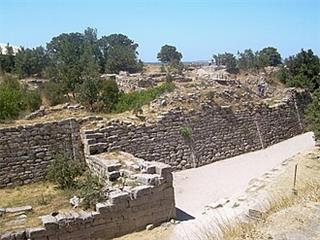
Troy
TroyCherryX, CC BY-SA 3.0

The Iliad is set towards the end of the Trojan War, a 10-year siege of Troy by a coalition of Mycenaean Greek states. Its historical backdrop is the time of the Late Bronze Age collapse in the early 12th century BCE, so Homer is separated from his subject by about 400 years, the period known as the Greek Dark Ages. Scholars have long debated which parts of the poem preserve genuine traditions of the Mycenaean period. The Catalogue of Ships stands out because its geography shows Greece not as it was in the Iron Age, Homer's time, but as it was before the Dorian invasion, and the poem's picture of the gods may mix Mycenaean and Dark Age mythologies.

The poem grew out of a tradition of oral poetry. Its stock epithets and repeated phrases, such as “resourceful Odysseus”, are formulae easily fitted to the hexameter line. The war was also told elsewhere: the fall of Troy and the Trojan Horse, absent from the Iliad, come from later sources, and the homecomings of the heroes were explored in other Greek literature, above all the Odyssey. The ancients themselves placed the poet early: Herodotus, having consulted the Oracle at Dodona, put Homer and Hesiod about 400 years before his own time, which would be around 850 BCE.

What It Is

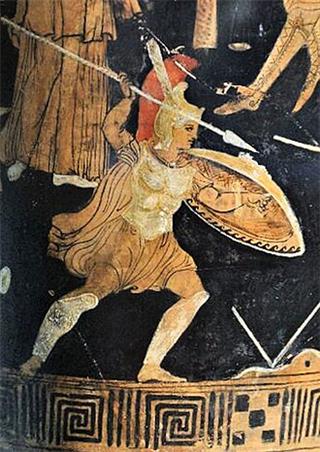
Achilles
AchillesJona Lendering, CC0

The poem opens with an invocation to the Muse, and its first word, mēnin, “wrath”, names its theme, the wrath of Achilles. After nine years of fighting, Agamemnon, king of Mycenae and commander of the Achaeans, takes the captive Briseis from Achilles, the Achaeans' greatest warrior, who withdraws from the fighting and asks his mother Thetis to have Zeus let the Trojans drive the Achaeans back to their ships. Duels and battles follow, with the gods taking sides; Hector, prince and hero of Troy, bids farewell to his wife Andromache and his son Astyanax on the walls, and the Trojans break through the Achaean wall to the ships.

Achilles lets his companion Patroclus fight in his armour, and Hector kills him. In grief Achilles returns to battle in new armour made by Hephaestus, its shield bearing an image of the stars at its centre, kills Hector and drags his body behind his chariot. At the end King Priam comes unnoticed into the Achaean camp, clasps Achilles by the knees and begs for his son's body; Achilles is moved to tears, gives it back and grants the Trojans twelve days to bury Hector. The poem's themes include kleos (glory), timē (honour), fate, pride and the cost of war, and it has moments of comedy as well.

How It Was Made

Diomedes
DiomedesCopy of Nausykles or Kresilas (?), Public domain

The poem's composition, historicity and authorship are extensively debated in what is called the Homeric Question; scholars also disagree on whether the Iliad and the Odyssey were composed independently, and whether they survived through an oral or also a written tradition. Both were likely composed in Homeric Greek, a literary mixture of Ionic and other dialects, sometime between the late 8th and early 7th centuries BCE. Scholarly consensus mostly places the Iliad in the late 8th century, some favour a 7th-century date, and its reflection in art and literature makes 630 BCE the latest possible date. Hans van Wees argues that its warfare can be pinned down to the first half of the 7th century BCE.

The poem is divided into 24 books of dactylic hexameter, with 15,693 lines in its standard edition. By the 1920s Milman Parry had launched a movement claiming that its formulae are artifacts of oral tradition; with his assistant Albert Lord he studied the oral-formulaic composition of Serbian oral poetry in Yugoslavia, and their thesis established oral tradition studies. A two-word stock epithet can fill half a line, freeing the poet to compose the rest, and small inconsistencies, such as Aphrodite remaining “laughter-loving” after Diomedes has painfully wounded her, may be effects of that tradition. Lord's The Singer of Tales (1960) compared the story of Patroclus with that of Enkidu in the Epic of Gilgamesh.

Reception

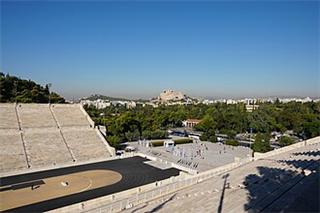
Panathenaea
PanathenaeaGeorge E. Koronaios, CC BY-SA 4.0

The Iliad was widely esteemed by the ancient Greeks and formed part of their standard education. Rhapsodes performed it at festivals such as the Panathenaia, and its blend of regional dialects and its picture of Greek factions uniting against Troy gave it resonance across the Hellenistic world. By the end of the 5th century BCE it was widely known, and it was then “the sign of a man of standing” to be able to recite the Iliad and Odyssey by heart. Gregory Nagy writes that the ancient Greeks venerated the two poems “as the cornerstone of their civilization”. It can be argued that its warfare left traces in later Greek fighting, in the heroic ideal of holding one's place in the phalanx and in commanders' regard for stratagem.

The poem remained popular through the Hellenistic, Roman and Byzantine periods. In the medieval West, where the Greek text was little read, the Ilias Latina, a shortened Latin version credited to the Roman senator Publius Baebius Italicus, was a basic school text, and readers preferred the supposed eyewitness accounts of Dares and Dictys Cretensis, late antique forgeries that fed the chivalric romances of Benoît de Sainte-Maure and Guido delle Colonne. According to Suleyman al-Boustani, the epic may have circulated in Syriac and Pahlavi translations in the early Middle Ages, the Syriac credited to Theophilus of Edessa. The full text returned to Italy and Western Europe from the 15th century, mainly through translations into Latin and the vernacular languages.

Survival & Rediscovery

Homer
HomerPhotograph by Mike Peel (www.mikepeel.net)., CC BY-SA 4.0

More than 2000 manuscripts of Homer survive. Papyri such as Papyrus Oxyrhynchus 20 and 21 preserve parts of the text, and in May 2026 a fragment of the Iliad was found placed inside an Egyptian mummy of around 400 CE, the first such text known from a funerary context. The earliest complete textual witness is Venetus A, a Byzantine manuscript copied in the 10th century. Besides the text and glosses it carries the “A scholia”, critical and explanatory notes excerpted mainly from lost works of the grammarians Aristonicus, Didymus, Herodian and Nicanor; it supplies many ancient readings not found elsewhere and is of critical importance for restoring the text. Other notable witnesses include a manuscript of 870 to 890, Venetus B of the 11th century, the Ambrosian Iliad and the Codex Nitriensis, a palimpsest.

The first printed edition, the editio princeps, was edited by Demetrios Chalkokondyles and published in Florence in 1489 by Bernardus Nerlius and Demetrius Damilas. Translations carried the poem further. In English George Chapman's version in fourteeners began to appear in 1598, Alexander Pope's heroic couplets in 1715 and William Cowper's blank verse in 1791, and Matthew Arnold's lectures On Translating Homer (1861) set out the qualities a translator must render. Suleyman al-Boustani's complete Arabic translation of 1904 was the first full epic poem translated into Arabic from a foreign language, and in 2015 Caroline Alexander published the first full-length English translation by a woman.

Legacy

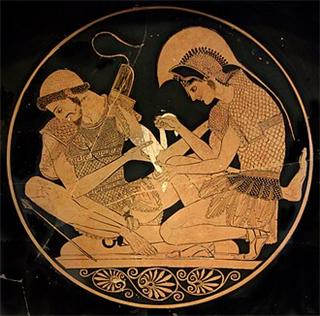
Trojan War
Trojan WarSosias (potter, signed). Painting attributed to the Sosias Painter (name piece for Beazley, overriding attribution) or the …, Public domain

Homer again came to be of great influence in European culture with the Renaissance, and the Iliad remains the first and most influential work of the Western canon. Even without Homer, the Trojan War stayed central to medieval European literature and its sense of identity: most nations and several royal houses traced their origins to heroes of the war, and the romances it inspired led to the first printed English book, the Recuyell of the Historyes of Troye of 1473. Aeschylus's Oresteia follows Agamemnon after his return, and William Shakespeare used the plot for Troilus and Cressida. Readers have used it to think about war: Simone Weil's essay “The Iliad or the Poem of Force” (1939) describes how force reduces victim and aggressor alike, and the psychiatrist Jonathan Shay related it to the trauma of combat veterans in Achilles in Vietnam (1994).

Its depiction of women, mainly as valuable property whose possession causes strife, is now a common subject of study, and translations differ: three male translators rendered a term meaning “dog-faced” in Helen's words about herself with misogynistic slang, which the more literal versions of Caroline Alexander (2015) and Emily Wilson (2023) avoid. Retellings from the point of view of its women have become a popular sub-genre, from Christa Wolf's Cassandra (1983) to Pat Barker's The Silence of the Girls (2018) and Natalie Haynes's A Thousand Ships (2019), alongside Christopher Logue's War Music, Alice Oswald's Memorial and Madeline Miller's The Song of Achilles.

The Iliad, attributed to Homer and probably composed in the late 8th century BCE, tells in 24 books of dactylic hexameter how the wrath of Achilles shaped the last weeks of the Trojan War. Recited and taught across the Greek world, kept in more than 2000 manuscripts and translated again and again, it remains a foundation of European literature.

Test yourself

5 questions on this page, from its key events and facts.

The questions open here once the page has loaded.

References

  • Albert Lord, The Singer of Tales (1960)
  • Matthew Arnold, On Translating Homer (1861)
  • Simone Weil, “The Iliad or the Poem of Force” (1939)
  • Jonathan Shay, Achilles in Vietnam: Combat Trauma and the Undoing of Character (1994)