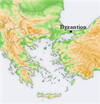
Europe
Rhodes
At a glance
- A single city-state created in 408 BCE by the union of the three old cities of Rhodes: Ialysos, Kamiros and Lindos.
- Its skilled navy policed the eastern Mediterranean and protected the grain trade, making it the leading Hellenistic sea power.
- Rome’s punishment in 167 BCE broke its economy, and it lost its freedom to Claudius and finally to Vespasian.
Rise & Fall
- 408 BCEIalysos, Kamiros and Lindos unite to found the city of Rhodes
- 305–304 BCERhodes withstands the siege of Demetrius Poliorcetes
- c. 280 BCECompletion of the Colossus of Rhodes by Chares of Lindos
- c. 227 BCEAn earthquake ruins the city and topples the Colossus
- 190 BCEThe Rhodian fleet defeats a Seleucid squadron under Hannibal off Side
- 188 BCEThe Treaty of Apamea gives Rhodes Lycia and much of Caria
- 167 BCERome takes Lycia and Caria and makes Delos a free port
- 43 BCEGaius Cassius captures and plunders Rhodes
Foundation
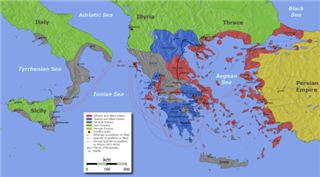
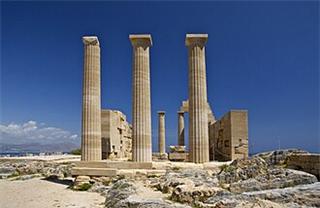
Before the late fifth century BCE the island of Rhodes, off the south-west coast of Asia Minor, was divided between three Dorian cities, Ialysos, Kamiros and Lindos, which with Kos, Knidos and Halicarnassus had formed an old Dorian league. All three belonged to the Athenian-led Delian League, but in 411 BCE, as Athenian power faltered in the Peloponnesian War, they went over to Sparta. In 408–407 BCE the three cities joined in a synoecism and founded a single new city of Rhodes at the northern tip of the island, where natural harbours faced the sea route linking the Aegean with Cyprus, the Levant and Egypt. The new city was laid out on a regular grid of streets, a plan later attributed to Hippodamus of Miletus, although that attribution is doubtful on chronological grounds. Ialysos, Kamiros and Lindos survived as districts of the unified state, keeping their sanctuaries, such as the temple of Athena Lindia on the acropolis of Lindos, and some local institutions. The new city grew quickly, drawing people from all three towns and traders from abroad, and by the end of the fourth century BCE it was among the largest and richest cities of the Greek world, with strong walls, dockyards and shipsheds around its harbours.
Socioeconomy
Rhodes lived by the sea. Its position made it the main entrepôt between the Aegean and the eastern Mediterranean, above all for grain shipped from Egypt and the Black Sea, and after 323 BCE its close friendship with Ptolemaic Egypt made it a hub of that trade. Rhodian wine travelled in distinctive amphorae whose stamped handles, naming an annual priest of Helios and a maker, have been found in huge numbers from the Black Sea to Egypt and allow trade to be traced and dated. The state taxed goods passing through its harbours, probably at two per cent, and Polybius reports that these dues once yielded a million drachmas a year. Banking, shipbuilding and the hire of ships and crews also brought wealth. Society was led by a wealthy class of shipowners and merchants, while resident foreigners were numerous, and many inscriptions record their associations. Strabo observed that although the Rhodian constitution was not a democracy, the wealthy looked after the poor by ancestral custom, supplying them with grain through public services so that the city never lacked men, especially for the fleet. The chief cult of the new city was that of the sun god Helios, whose festival, the Halieia, drew competitors from across the Greek world, while Athena Lindia remained a famous sanctuary.
Military

Rhodian power rested on its navy, modest in numbers but famous for its skill. The fleet usually counted a few dozen warships, mostly quadriremes and light, fast ships such as the trihemiolia, a type probably developed at Rhodes, and its commanders, the navarchs, and many of its crews were drawn from the citizen body and highly trained. The fleet policed the sea against pirates and protected the grain routes. On land the city relied on strong walls and mercenaries. Its greatest test came in 305–304 BCE, when Demetrius Poliorcetes besieged Rhodes for about a year to force it to abandon its neutrality and its friendship with Ptolemy I. Demetrius used huge siege engines, including the armoured tower known as the helepolis, but the Rhodians, supplied by Ptolemy, held out until a settlement left them free. In 220 BCE Rhodes went to war with Byzantium to force the abolition of tolls on ships passing the Bosporus. Against Philip V of Macedon it fought at Chios and Lade in 201 BCE, and in the war against Antiochus III its fleet under Eudamus defeated a Seleucid squadron commanded by Hannibal off Side in 190 BCE. In 88 BCE Rhodes withstood a siege by land and sea by Mithridates VI of Pontus.
Governance & Law
The unified Rhodian state was governed by an assembly of citizens, a council and a board of prytaneis, chief magistrates elected for six-month terms. Other officials managed finance, the harbours and the navy, and the navarchs were among the most powerful men in the state. Ancient writers describe the constitution as a moderate democracy dominated in practice by the wealthy, and it proved unusually stable: Rhodes avoided the tyrannies and violent revolutions common in Greek cities during the Hellenistic period. Citizens were registered through the three old cities, which kept local assemblies and priesthoods. Beyond the island Rhodes governed the Peraea, a strip of the Carian mainland opposite, part of which was incorporated into the state while other districts were held as subject territory, and it controlled neighbouring islands such as Karpathos and Syme. The Treaty of Apamea in 188 BCE added Lycia and much of Caria, which Rhodes ruled as subject lands until Rome took them away in 167 BCE. Foreign policy aimed at independence, freedom of the seas and a balance between the great kingdoms. The maritime customs of Rhodes were respected far beyond the island, and Roman law later preserved the Lex Rhodia on sharing the loss when cargo was thrown overboard to save a ship.
Global & Regional Impact

Hellenistic Rhodes showed that a single city could remain a major independent power in a world of great kingdoms. Its armed neutrality, naval policing and defence of free trade made it the guardian of commerce in the eastern Mediterranean for more than a century, and when an earthquake around 227/226 BCE ruined the city, rulers including Ptolemy III, Seleucus II and Hiero II of Syracuse sent gifts to help rebuild it, as Polybius records. The Colossus of Rhodes, a bronze statue of Helios by Chares of Lindos, said to have been paid for by selling the siege engines left by Demetrius Poliorcetes, stood at the harbour from about 280 BCE until the earthquake brought it down; it was counted among the Seven Wonders of the World. Rhodes was also a centre of learning and art. The orator Aeschines is said to have taught there in exile, the Stoic philosophers Panaetius and Posidonius were closely associated with the island, and Apollonius Molon taught rhetoric to Cicero. Rhodian sculptors developed a dramatic Hellenistic style, and Pliny the Elder names three Rhodians, Hagesander, Polydorus and Athenodorus, as the makers of the Laocoön group. The Lex Rhodia passed into Roman and Byzantine maritime law and from there into later European traditions.
Decline & Fall
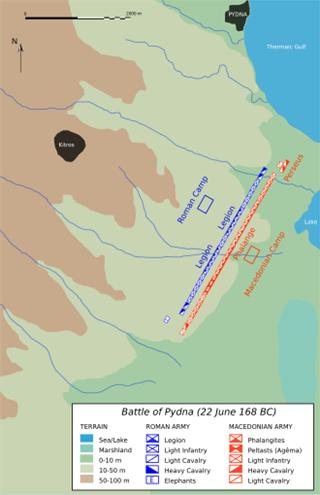
The alliance with Rome against Philip V and Antiochus III brought Rhodes its greatest gains but also its downfall. During the Third Macedonian War (171–168 BCE) Rhodian envoys tried to mediate between Rome and Perseus of Macedon, which the Senate took as disloyalty. After the Battle of Pydna Rome stripped Rhodes of Lycia and Caria in 167 BCE and made Delos a free port under Athenian control. According to Polybius, Rhodian harbour revenues fell from a million drachmas a year to 150,000. In 164 BCE Rhodes obtained a formal treaty of alliance with Rome, but it was now a dependent ally. The city remained wealthy and cultured, and its resistance to Mithridates VI in 88 BCE was rewarded by Rome. In the civil wars after Caesar’s murder, however, Rhodes refused to support his assassins, and in 43 BCE Gaius Cassius defeated its fleet, took the city and seized its ships and treasures. It remained a free city under Augustus and a favoured retreat of Romans such as the future emperor Tiberius, who lived there from 6 BCE to 2 CE. In 44 CE Claudius withdrew Rhodian freedom after Roman citizens were executed there; it was restored in 53 CE but lost for good under Vespasian, when Rhodes was absorbed into the Roman provincial system.
Rhodes, created by the union of three island cities in 408 BCE, became the leading naval and commercial power of the Hellenistic eastern Mediterranean, defending free navigation between the great kingdoms, producing famous art and learning and leaving a maritime law that passed into Roman and later European law.
References
- Berthold, R.M. (1984) Rhodes in the Hellenistic Age. Ithaca: Cornell University Press.
- Gabrielsen, V. (1997) The Naval Aristocracy of Hellenistic Rhodes. Aarhus: Aarhus University Press.
- Polybius, The Histories, trans. W.R. Paton, revised by F.W. Walbank and C. Habicht (2010–2012). Cambridge, MA: Harvard University Press (Loeb Classical Library).
- Diodorus Siculus, Library of History, Books XIX.66–XX, trans. R.M. Geer (1954). Cambridge, MA: Harvard University Press (Loeb Classical Library).
Connections
Open the full connections map →