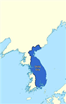
Central & East Asia
Northern Wei
At a glance
- Tuoba Gui broke the Later Yan at the Battle of Canhe Slope in 395 and his successors conquered the Helian Xia, Northern Yan and, in 439, the Northern Liang, uniting the north and ending the Sixteen Kingdoms period.
- Empress Dowager Feng's reforms of 485–486, the equal-field landholding system and the three-elders system, redistributed land against tax and labour obligations and registered the population, doubling the registered households to more than five million; the equal-field system lasted until the mid-8th century.
- Emperor Xiaowen moved the capital to Luoyang in 494, changed the imperial surname to Yuan, encouraged marriage with Chinese families and abandoned Xianbei customs; the rift between this sinicised court and the steppe soldiers of the Six Garrisons brought the rebellions of 523 and the dynasty's collapse.
Rise & Fall
- 386Tuoba Gui reasserts Tuoba independence as Prince of Dai and then Prince of Wei, as Former Qin breaks apart after the Battle of Fei River.
- 395Tuoba Gui inflicts a heavy defeat on the Later Yan crown prince Murong Bao at the Battle of Canhe Slope; the Central Plains are overrun and Yan splits in two.
- 439Emperor Taiwu conquers the Northern Liang in the Hexi Corridor, unifying northern China and ending the Sixteen Kingdoms period.
- 450Emperor Wen of Liu Song's great invasion is lured across the Yellow River and destroyed; Wei armies devastate the provinces to the south until January 451.
- 485–486Empress Dowager Feng introduces the equal-field landholding system and the three-elders system, breaking the local aristocrats' hold on the rural population.
- 494Emperor Xiaowen moves the capital from Pingcheng to Luoyang and pursues systematic sinicisation; the Tuoba take the surname Yuan.
- 528Empress Dowager Hu poisons the young Emperor Xiaoming; the warlord Erzhu Rong butchers some 2,000 courtiers in the Heyin massacre and throws her into the Yellow River.
- 534–535Emperor Xiaowu flees Gao Huan for Yuwen Tai's west; the dynasty splits into Eastern Wei and Western Wei.
Foundation
The Tuoba, or Tabgach, were a clan of the Xianbei confederation, whose state modern historians see as a synthesis of Chinese and nomadic traditions that rapidly sinicised. The Jin dynasty allied with them against the Xiongnu state of Han-Zhao, and in 315 the chief Tuoba Yilu was made Prince of Dai; Dai stagnated after him and fell to Former Qin in 376. When Fu Jiān's bid to unify China broke at the Battle of Fei River, Tuoba Gui, son or grandson of the last Prince of Dai, reasserted Tuoba independence in 386, first as Prince of Dai and then as Prince of Wei, whence the state's name.
The young state leaned on the stronger Later Yan of the Murong Xianbei while subjugating the Tiefu and Rouran, until in 391 Tuoba Gui refused further tribute after the Murong detained his brother. In 395 the Yan emperor Murong Chui sent his crown prince Murong Bao with a massive punitive army, and Tuoba Gui crushed it at the Battle of Canhe Slope. When he invaded in turn, Murong Bao's decision to hold only his capital and major cities let the Wei overrun the Central Plains, and the Battle of Baisi drove Later Yan back to Liaoning. In 398 Tuoba Gui moved his capital to Pingcheng, and in 399 he took the title Emperor of Wei. To break the autonomy of the tribes he reorganised his people into eight artificial tribes settled around the capital as military units and removed their traditional leaders, making them the emperor's own professional military caste.
Socioeconomy
The Northern Wei began as a steppe polity ruling a Chinese countryside. Its officials drew no salaries until Empress Dowager Feng's time, and conquered populations were deported wholesale, some 460,000 to the capital under Emperor Daowu. Local society was ruled by military clientage: Han commoners served aristocratic magnates in fortified villages as armed retainers (buqu), and the Wei emperors made such magnates governors of their own fiefs. Nobles and generals received bondservants from war captives, who came to form much of the farming population, and an attempt to conscript free Han subjects in 473 only drove more into the magnates' clientage, leaving the state short of soldiers and taxes.
Empress Dowager Feng's reforms of 485–486 answered this. The equal-field system (juntian zhi) redistributed uncultivated land to commoners against obligations of grain, cloth and labour: open land for each adult male and half as much for each female, with inheritable mulberry or hemp land for textiles and sale forbidden. The three-elders system (sanzhang zhi) of 486 grouped households into neighbourhoods, villages and wards under appointed elders, to register the population and levy taxes and corvée. The magnates' shelter from taxation was broken and the registered population doubled to more than five million households. Trade grew with conquest: in 439 the Wei carried the Sogdian merchants of Wuwei to Datong, and caravans came from Khotan, Kashmir and Persia.
Military

The Tuoba army was a hereditary caste of Xianbei horsemen settled around the capital, and it conquered the north. Emperor Taiwu, enthroned in 423, attacked the Tiefu-led Helian Xia in 426 and took its capital Tongwancheng in 427; the Northern Liang in the Hexi Corridor submitted as a vassal, the Northern Yan fell in 436, and in 439 Taiwu conquered the Northern Liang outright, uniting the north and closing the Sixteen Kingdoms period. The northern frontier was the Rouran, former subjects who built a khaganate on the steppe by 402; their raids were constant, and in 423 a wall over 2,000 li (1,080 kilometres) was built from Chicheng in Hebei to Wuyuan in Inner Mongolia, the first Great Wall since the Han, and a second in 446.
Against the south the Wei fought the Liu Song, Southern Qi and Liang in turn. In 422–423 Emperor Mingyuan took Luoyang, Xuchang and Hulao and most of Henan and western Shandong; Emperor Wen's great invasion of 450 was lured across the Yellow River, flanked and destroyed, and Wei armies laid waste the provinces to the south before withdrawing in January 451. In 466–467 the Song governors of Xu and Yan provinces surrendered the populous lands around Pengcheng to the Wei. War with the Southern Qi from 479 achieved little before the peace of 490. Against the Liang the Wei took Xinyang and Hanzhong by 505, but Wei Rui took Hefei in 506 and with Cao Jingzong destroyed the Wei at the Battle of Zhongli, ending large-scale war for years.
Governance & Law
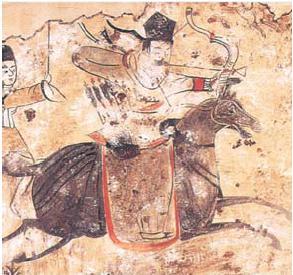
The Wei court kept Xianbei customs that struck Chinese observers as strange: empresses chosen by forging a golden statue, a single braid worn by every man, and the rule that the mother of a newly named crown prince must kill herself, so that emperors, motherless, honoured their wet nurses as 'Nurse Empress Dowager'. Cui Hao (381–450), adviser at the Datong court, introduced Han administrative methods and penal codes and built a Taoist theocracy that lasted until 450. The emperors claimed descent from the Yellow Emperor, sacrificed to Confucius and enfeoffed his descendants in 472 and 495.
The great reformers were Empress Dowager Feng (438–490), regent for her grandson Emperor Xiaowen, who brought Han aristocrats into government and in 485–486 built the fiscal structure of a centralised Chinese-style empire, and Xiaowen himself. In 494 he moved the capital from Pingcheng to Luoyang and made sinicisation systematic: Xianbei traditions were largely abandoned, the imperial family took the surname Yuan, marriage with Chinese families was encouraged, and the Xianbei noble clans took Chinese names. Buddhist temples rose everywhere and displaced Taoism as the state religion. The weakness lay in regency: Emperor Xiaoming inherited as an infant, Empress Dowager Hu ruled in his name for over a decade and poisoned him in 528, and thereafter emperors were puppets of Erzhu Rong, Gao Huan and Yuwen Tai, chosen, deposed and executed at will.
Global & Regional Impact

The Northern Wei was the longest-lived and most powerful of the Northern dynasties, and historians generally credit it with laying the foundation of China's reunification under the Sui in 589. Its reforms reversed the devolution of power to local strongmen; the equal-field system outlived the dynasty to the mid-8th century, and Ray Huang has called these reforms the 'infrastructure of a regenerated empire' whose agricultural resources and peasant manpower Yang Jian inherited to unite China. Chen Yinke saw the institutional and aristocratic origins of the Sui and Tang as rooted in the multi-ethnic legacy of the Northern dynasties, the Tuoba Wei above all.
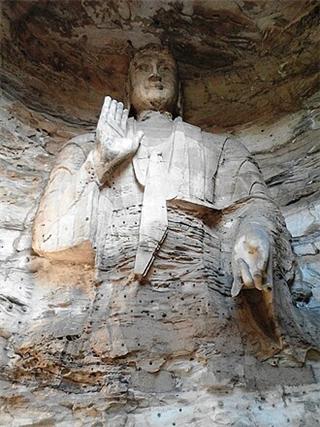
Under the Wei Buddhism, a foreign idea, became firmly established in China. The emperors converted and became great patrons of Buddhist art, influenced through the trade routes by India and Central Asia: the Yungang Grottoes near Datong were cut in the mid-to-late 5th century and the Longmen Grottoes outside Luoyang towards the dynasty's end, holding more than 30,000 Buddhist images of the period, and the Shaolin Monastery and the Songyue Pagoda were Wei foundations. The age produced the Qimin Yaoshu on agriculture, the Commentary on the Water Classic, a monumental geography, and the legend of Hua Mulan. The ethnic integration pursued under Xiaowen made the Northern Wei the model of the 'Northern Dynasty' synthesis of steppe and China on which the Tang was built.
In the Research Series
Decline & Fall

The dynasty broke along the line its success had drawn, between a governing aristocracy that had moved to Luoyang and adopted Han-style sedentary life and the nomadic tribal armies of the Six Garrisons on the northern frontier. In 523, when drought and famine drove the Rouran to raid in April, the people of a frontier town killed their commander and rebellion spread: Poliuhan Baling took Woye, Mozhe Dati rose in Qinzhou, Hu Chen made himself King of Gaoping and Ge Rong in Hebei proclaimed himself Emperor of Qi; Baling fell in 525, but the risings lasted until 530.
At court Empress Dowager Hu, who had ruled for more than ten years for the infant Emperor Xiaoming, poisoned him in 528 as he reached eighteen and prepared to take power. The general Erzhu Rong summoned the officials of Luoyang and butchered them, some 2,000 courtiers, throwing the empress dowager and her child puppet Yuan Zhao into the Yellow River: the Heyin massacre of 528. His emperor, Xiaozhuang, killed Erzhu Rong in a palace ambush in 530, only to be overthrown by the Erzhu clan in 531. Gao Huan raised Han and non-Han troops against the clan, took Luoyang in 532, deposed two emperors and enthroned Xiaowu, who fled west to the warlord Yuwen Tai. In 534–535 the empire split into Eastern Wei and Western Wei under the same house, and in 550 and 557 the Northern Qi and Northern Zhou took their places, until Yang Jian founded the Sui in 581.
The Northern Wei, founded by the Tuoba Xianbei chief Tuoba Gui in 386, unified northern China in 439 and ruled it from Pingcheng and then Luoyang. Empress Dowager Feng's equal-field reforms, Emperor Xiaowen's sinicisation and the grottoes of Yungang and Longmen outlasted the dynasty, which split in 534–535 after the Six Garrisons rebelled and the Heyin massacre destroyed its court.
Test yourself
5 questions on this page, from its key events and facts.
The questions open here once the page has loaded.
References
- Scott Pearce, Northern Wei (386–534): A New Form of Empire in East Asia (Oxford University Press, 2023)
- Jennifer Holmgren, Annals of Tai: Early T'o-pa History according to the First Chapter of the Wei-shu (Australian National University Press, 1982)
Connections
Open the full connections map →