Sub-Saharan Africa
Uganda
At a glance
- Uganda became independent in 1962 as a quasi-federal state built around Buganda and the other Great Lakes kingdoms.
- Obote abolished the kingdoms in 1967, and Idi Amin’s rule of 1971–1979 killed an estimated 100,000 or more people.
- Yoweri Museveni, in power since 1986, restored order and growth and brought back the kingdoms as cultural institutions in 1993.
Rise & Fall
- 1962Uganda becomes independent on 9 October under Prime Minister Milton Obote
- 1966Troops under Idi Amin storm the Kabaka’s palace at Mengo
- 1967A republican constitution abolishes the kingdoms
- 1971Idi Amin seizes power in a military coup
- 1972Amin expels the country’s Asian community
- 1979Tanzanian forces and Ugandan exiles take Kampala and overthrow Amin
- 1986The National Resistance Army takes Kampala and Museveni becomes president
- 1993The kingdoms are restored as cultural institutions
Foundation
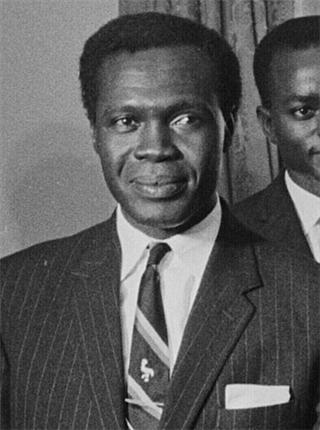
Uganda became independent from Britain on 9 October 1962. The Uganda Protectorate had been built around the Kingdom of Buganda, whose chiefs had helped the British extend their rule under the Uganda Agreement of 1900, and it also included the kingdoms of Bunyoro, Toro and Ankole, the Busoga states and the peoples of the north and east. This history made the place of the kingdoms the central question of independence. The constitution of 1962 gave Buganda federal status with its own parliament, the Lukiiko, and lesser autonomy to the other kingdoms. Milton Obote, leader of the Uganda People’s Congress, became prime minister through an alliance with the Buganda royalist movement Kabaka Yekka, defeating the Democratic Party of Benedicto Kiwanuka, who had led the government during the brief period of internal self-government. In October 1963 Uganda replaced the British monarch as head of state with a president of its own, and the Kabaka of Buganda, Sir Edward Mutesa II, was elected to the largely ceremonial office. The alliance soon broke down over the ‘lost counties’, territory that Buganda had gained from Bunyoro with British help in the 1890s: a referendum in 1964 returned two of them to Bunyoro, and Mutesa and Obote became open rivals.
Socioeconomy
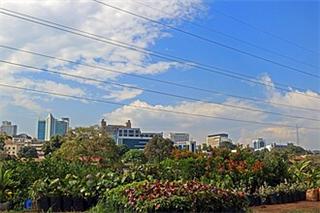
Uganda is a fertile, well-watered country around Lake Victoria and the upper Nile, and most Ugandans have always lived by farming. Coffee has been the main export since the colonial period, alongside cotton in the early decades and tea, tobacco, fish and later gold, while bananas, millet, cassava and maize feed the population. At independence much of the country’s commerce was in the hands of a South Asian minority. In 1972 Idi Amin ordered the expulsion of the Asian community, commonly estimated at around 80,000 people, and handed their businesses to supporters; together with the violence of his regime this ruined the economy, which shrank sharply through the 1970s. From 1987 Yoweri Museveni’s government adopted reforms backed by the International Monetary Fund, liberalised the coffee trade and invited expelled Asians to reclaim their property, and Uganda achieved some of the fastest growth in Africa during the 1990s. It also became known for an early and open response to HIV/AIDS, which helped reduce infection rates in that decade. The population has grown from about 7 million at independence to over 45 million, one of the youngest in the world. Oil found near Lake Albert in 2006 is being developed with a pipeline to the Tanzanian coast. Most Ugandans are Christians, with a sizeable Muslim minority, and Makerere University in Kampala remains a leading East African institution.
Military
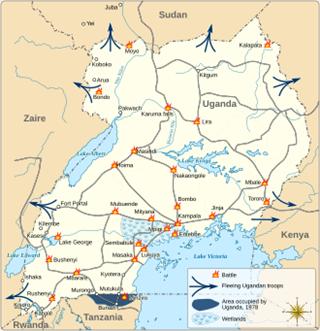
The army has been the decisive force in Ugandan politics. In January 1964 soldiers of the Uganda Rifles mutinied over pay and Africanisation, and British troops restored order at Obote’s request. Obote then promoted Idi Amin, who in May 1966 led the assault on the Kabaka’s palace at Mengo that drove Mutesa II into exile. On 25 January 1971 Amin seized power while Obote was at a Commonwealth conference in Singapore and purged the army of Acholi and Langi soldiers. In July 1976 Israeli commandos freed hostages held at Entebbe airport, humiliating his regime. Amin’s invasion of the Kagera Salient of Tanzania in late 1978 provoked the Uganda–Tanzania War: Tanzanian forces and Ugandan exiles, opposed by Libyan troops sent to help Amin, took Kampala on 11 April 1979. The Bush War of 1981–1986 between Obote’s Uganda National Liberation Army and Museveni’s National Resistance Army devastated the Luwero Triangle north of Kampala. The NRA became the national army, later renamed the Uganda People’s Defence Force, which fought the Lord’s Resistance Army of Joseph Kony in the north for some two decades, intervened in the Congo wars from 1996 to 2003, and since 2007 has provided the largest contingent of the African Union mission in Somalia.
Governance & Law

Independent Uganda has seen few peaceful transfers of power. In February 1966 Obote suspended the constitution, after parliament had moved to investigate gold and ivory smuggling from Congo involving Amin, and imposed an interim constitution that made him executive president. The republican constitution of 1967 abolished the kingdoms and created a unitary state, and in 1969 Obote banned the opposition parties. Amin ruled by decree from 1971 to 1979 through the army and security agencies such as the State Research Bureau. After his fall, short-lived governments under Yusuf Lule, Godfrey Binaisa and a military commission led to the disputed election of December 1980, which returned Obote to power. Museveni, sworn in on 29 January 1986, introduced a ‘no-party’ Movement system based on elected resistance councils from village level upward, confirmed by a new constitution in 1995. In 1993 the kingdoms were restored as cultural institutions without political power, and Ronald Muwenda Mutebi II was crowned Kabaka of Buganda. Multi-party politics returned after a referendum in 2005, the same year parliament removed presidential term limits, and the presidential age limit was abolished in 2017. Museveni has won every election since 1996 against challengers such as Kizza Besigye and Robert Kyagulanyi, known as Bobi Wine, amid complaints of repression and irregularities.
Global & Regional Impact

Uganda’s history after independence shaped wider African debates about state power, ethnicity and the military. The fate of the Kingdom of Buganda showed how hard it was to fit precolonial monarchies into new national states, and the restoration of the kingdoms in 1993 as cultural institutions offered one compromise. Idi Amin’s regime, with its mass killings, the murder of Archbishop Janani Luwum in 1977 and the expulsion of the Asians, became one of the best-known examples of post-colonial dictatorship; many expelled Ugandan Asians settled in Britain and Canada and built prominent communities there. The overthrow of Amin by Tanzania in 1979 was a rare case of an African state removing a neighbouring government by war. Museveni’s National Resistance Army served as a model and a training ground for movements across the region: Rwandan exiles who had fought in it, among them Fred Rwigyema and Paul Kagame, led the Rwandan Patriotic Front, which invaded Rwanda from Uganda in 1990. Ugandan forces have since been involved in the wars of the Democratic Republic of the Congo, the conflicts of South Sudan and the African Union mission in Somalia. The country also hosts one of the largest refugee populations in Africa, admitted under a relatively open policy that gives refugees land and freedom of movement.
Into the Present

The Uganda created at independence, a quasi-federal union of kingdoms and districts under a parliamentary system, did not survive its first decade. Obote’s centralisation in 1966–1967, Amin’s dictatorship and the wars that followed killed hundreds of thousands of people and wrecked the economy: estimates for those killed under Amin usually range from about 100,000 to 300,000, and the Bush War cost many more lives. Obote was overthrown a second time in July 1985 by his own commanders, Bazilio Olara-Okello and Tito Okello, whose military government signed a peace agreement in Nairobi in December 1985 but was driven from Kampala by the NRA in January 1986. Museveni’s government restored order in the south and centre, rebuilt the economy and the state, and in the 2000s ended the war in the north, where the Lord’s Resistance Army had abducted tens of thousands of children before leaving Uganda around 2006. The International Criminal Court issued warrants for Kony and other LRA commanders in 2005. Today Uganda is a republic of over 45 million people with its capital at Kampala, a member of the East African Community with one of the fastest-growing populations in the world, governed under a dominant-party system by a president in office since 1986.
Uganda’s passage from a federation of old Great Lakes kingdoms through the dictatorship of Idi Amin and civil war to the long rule of Yoweri Museveni made it a defining case of post-colonial Africa’s struggles over power, ethnicity and the army, and a major military actor in the Great Lakes region.
References
- Kasozi, A.B.K. (1994) The Social Origins of Violence in Uganda, 1964–1985. Montreal: McGill-Queen’s University Press.
- Mamdani, M. (1976) Politics and Class Formation in Uganda. New York: Monthly Review Press.
- Mutibwa, P. (1992) Uganda since Independence: A Story of Unfulfilled Hopes. London: Hurst.
- Reid, R.J. (2017) A History of Modern Uganda. Cambridge: Cambridge University Press.
Connections
Open the full connections map →