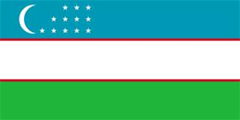
Central & East Asia
Uzbekistan
At a glance
- Uzbekistan declared independence on 31 August 1991 after the failed coup in Moscow, and Islam Karimov, Communist first secretary since 1989, ruled it as an authoritarian president until his death in September 2016.
- The economy rests on commodities: in 2011 Uzbekistan was the world's seventh-largest producer and fifth-largest exporter of cotton and its seventh-largest gold producer, while Soviet-era plants and ample gas make it the largest electricity producer in Central Asia.
- Shavkat Mirziyoyev, president from December 2016, made the currency fully convertible in September 2017, abolished Soviet-style exit visas and mended relations with every neighbour, though V-Dem still classed the state a closed autocracy in 2024.
Rise & Fall
- 1991Uzbekistan declares independence on 31 August after the failed coup in Moscow; Islam Karimov is elected president on 29 December.
- 1994The Oliy Majlis replaces the Supreme Soviet, the Republican Stock Exchange opens and Uzbekistan applies to join the World Trade Organization.
- 2001After the 11 September attacks Uzbekistan grants the United States access to the Karshi-Khanabad airfield for operations in Afghanistan.
- 2005Government troops fire into crowds of protesters in Andijan, killing 187 by official count and several hundred by witness accounts; the United States is ordered to leave Karshi-Khanabad.
- 2011The Afrosiyob high-speed train between Tashkent and Samarkand, the first in Central Asia, makes its first trip on 26 August.
- 2016Karimov dies on 2 September; Prime Minister Shavkat Mirziyoyev is elected president with 88.6 percent of the vote and sworn in on 14 December.
- 2017In September the som becomes fully convertible at market rates, ending the chief barrier to foreign business.
- 2020The United Nations announces 'major progress' against forced labour in the cotton harvest, with 94 percent of pickers working voluntarily.
Foundation
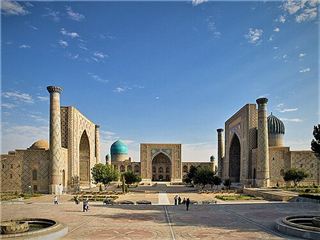
The land between the Amu Darya and Syr Darya was settled by Scythian nomads, and its cities, Bukhara and Samarkand, grew rich as Sogdian merchants carried the silk trade. Conquered by the Arabs in the eighth century, Transoxiana became a focal point of the Islamic Golden Age under the Samanids, was razed by the Mongols in the thirteenth century and flowered again under Timur, whose Samarkand became a centre of science under his grandson Ulugh Beg. Uzbek tribes from north of the Aral Sea invaded in 1501, and before the Russians arrived the country was divided between the Emirate of Bukhara and the khanates of Khiva and Kokand. The Russian Empire absorbed Central Asia in the nineteenth century, making Tashkent the centre of Russian Turkestan.
On 27 October 1924 the national delimitation created the Uzbek Soviet Socialist Republic. In the Second World War 1,433,230 people from Uzbekistan fought in the Red Army and 263,005 died; about 65,000 Uzbek troops later fought in the Soviet–Afghan War. Soviet planning made the republic a leading producer of cotton while draining the Aral Sea for irrigation. Islam Karimov became first secretary of the Communist Party in 1989 and president of the Uzbek SSR in 1990, the year the republic declared sovereignty on 20 June. After the failed coup in Moscow Uzbekistan declared independence on 31 August 1991, keeping 1 September as National Independence Day, and Karimov was elected president of the new republic on 29 December.
Socioeconomy

With more than 39 million people, nearly half of Central Asia's total, Uzbekistan is the region's most populous country. Uzbeks form 89.4 percent of the population, with a Russian minority that fell from 1.7 million in 1990 to about 700,000 in 2022. Agriculture employs 27 percent of the labour force, and in 2011 the country was the world's seventh-largest producer and fifth-largest exporter of cotton. The cost has been ecological and human: the Aral Sea has shrunk to a tenth of its area, leaving salt and dust over Karakalpakstan, and the state long forced employees and children to pick cotton, boycotted by Western retailers until the United Nations reported in 2020 that 94 percent of pickers worked voluntarily.
Beneath the fields lie 80 tonnes of gold a year, the seventh-largest output in the world, and gas production of 60 to 70 billion cubic metres, which with Soviet-built plants makes Uzbekistan the largest electricity producer in Central Asia. Independence brought inflation of around 1,000 percent a year in 1992–1994, tamed with IMF guidance to 22 percent by 2002, and a gradualist 'Uzbekistan Economic Model' of state control and import substitution that kept foreign investment the lowest per head in the CIS. Growth ran at 7–8 percent a year after 2003, the currency became fully convertible in September 2017, and by 2024 information technology made 2.1 percent of GDP, with Uzum the first Uzbek company valued over $1 billion.
Military
With 120,000 servicemen Uzbekistan has the largest armed forces in Central Asia, equipped with post-Soviet stock supplemented by new Russian and some American material; the state spends about 3.7 percent of GDP on them. The government took on the arms-control obligations of the Soviet Union, acceded to the Nuclear Non-Proliferation Treaty as a non-nuclear state. It withdrew from the CIS collective security arrangement in 1999, joined the Collective Security Treaty Organization on 23 June 2006 and suspended that membership in June 2012, while hosting the Shanghai Cooperation Organisation's Regional Anti-Terrorist Structure in Tashkent.
The army's defining use has been at home and in alliance politics rather than in war. After the attacks of 11 September 2001 Karimov offered the United States the Karshi-Khanabad airfield for operations in Afghanistan, and Washington gave half a billion dollars in aid in 2004. In May 2005 government troops fired into crowds of protesters in Andijan, killing 187 by the official count and several hundred by witness accounts; when the United States joined calls for an independent investigation, Uzbekistan ordered it out of the base within 180 days, and the last American troops left in November 2005. Islamist activity has risen slightly since 2015, with small groups such as the Islamic Movement of Uzbekistan declaring allegiance to Daesh, but the threat inside the country remains low.
Governance & Law
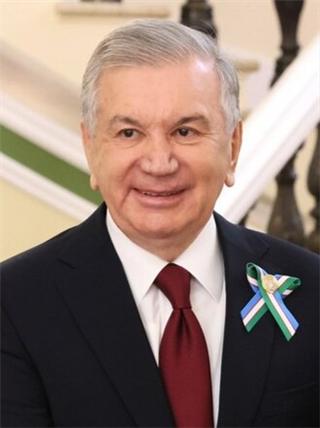
Uzbekistan is a secular state with a semi-presidential government. Islam Karimov, elected president on 29 December 1991, had his term extended to 2000 by referendum and was re-elected in 2000, 2007 and 2015 with over 90 percent each time, in votes most international observers dismissed as failing democratic standards. The Oliy Majlis, which replaced the Supreme Soviet in 1994, has a 150-member Legislative Chamber and, since 2002, a 100-member Senate. The country is divided into twelve regions, Tashkent City and the autonomous republic of Karakalpakstan. Human Rights Watch, Amnesty International and the US State Department have described the state as authoritarian with limited civil rights, citing torture, arbitrary arrests, restrictions on religion, speech, press and assembly, and reports of forced sterilisation of rural women; homosexuality is a crime.
Karimov died on 2 September 2016. Prime Minister Shavkat Mirziyoyev became interim president, won the December election with 88.6 percent and was sworn in on 14 December. He replaced most of Karimov's officials, abolished exit visas, reduced sentences and founded an Anti-Corruption Agency on 29 June 2020; commentators spoke of an 'Uzbek Spring'. He won a second term in a landslide on 6 November 2021, but V-Dem still classed Uzbekistan a closed autocracy in 2024, weakest in judicial independence and free parties.
Global & Regional Impact
Uzbekistan joined the Commonwealth of Independent States in December 1991 and the United Nations on 2 March 1992, and belongs to the OSCE, the Organisation of Islamic Cooperation, the Organisation of Turkic States and the Shanghai Cooperation Organisation; it joined GUAM in 1999 and left in 2005, and founded the Central Asian Union with Kazakhstan and Kyrgyzstan. Its alignment has swung. Close to Washington after 2001, Karimov turned towards Russia and China after the 'colour revolutions' in Georgia and Ukraine and the Western response to Andijan, though the European Union eased sanctions from 2006. Under Mirziyoyev relations with Kyrgyzstan, Tajikistan and Afghanistan improved drastically, and ties with China, Turkey, Russia, India, South Korea, Japan, the UAE and the West have grown.
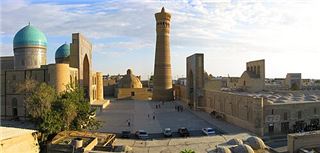
The country's reach is felt through its people and its goods. Almost a tenth of the labour force works abroad, mostly in Russia and Kazakhstan; Uzbek cotton is used for South Korea's banknotes, and after February 2022 exports of cotton pulp and nitrocellulose to Russia, components of explosives, drew the scrutiny of the OCCRP. Samarkand, Bukhara, Khiva and Shakhrisyabz are World Heritage sites, and the Latin alphabet adopted in 1993 marked a turn from the Soviet past even as Russian remains the language of business. The chess team won the Chess Olympiad twice, the second time as hosts in Samarkand, and five Uzbek boxers took gold at the 2024 Olympics.
Into the Present

Uzbekistan today is a state in transition from the system Karimov built. Since 2016 Mirziyoyev has opened the economy, making the som convertible, courting foreign companies and reviving a World Trade Organization accession stalled for fifteen years; HSBC counts the country among the 26 fastest-growing economies of the coming decades, and IT services exported about $1 billion in 2024. Yet the state keeps its grip: the government controls the main television channels and newspapers, journalists face harassment and self-censorship, corruption permeates society and the schools, and rural underemployment is estimated at a fifth of the workforce.
The gravest threats are environmental. The Aral Sea's desiccation, counted among the world's worst environmental disasters, has salted the soil of Karakalpakstan; farming takes 84 percent of the water; the collapse of the Sardoba Reservoir dam in May 2020 flooded 35,000 hectares, killed six people and drove 111,000 from their homes. Tashkent ranks among the most polluted cities in the world, its air more than six times the WHO's recommended level, and the World Bank reckons that by 2030 some 8 million people will live in areas of very high climate risk, with cotton and fruit crops expected to suffer while the country lacks an overarching climate policy. Mirziyoyev's second term, begun in November 2021, will be judged by whether reform reaches these problems too.
Uzbekistan, independent since 31 August 1991 and heir to Samarkand and Bukhara, is Central Asia's most populous state: Islam Karimov ruled it for 25 years on cotton, gold and gas behind closed borders and the massacre at Andijan, and Shavkat Mirziyoyev has since opened its currency, markets and frontiers while the Aral Sea's ruin and Tashkent's air mark the price of the Soviet inheritance.
Test yourself
5 questions on this page, from its key events and facts.
The questions open here once the page has loaded.
References
- Bohdan Nahaylo and Victor Swoboda, Soviet Disunion: A History of the Nationalities Problem in the USSR (1990)
- Ahmed Rashid, The Resurgence of Central Asia: Islam or Nationalism? (2017)
- Graham Smith (ed.), The Nationalities Question in the Soviet Union (2nd ed., 1995)
- Nancy Lubin, 'Uzbekistan', in Glenn E. Curtis (ed.), Kazakhstan, Kyrgyzstan, Tajikistan, Turkmenistan, and Uzbekistan: Country Studies (Federal Research Division, Library of Congress, 1997)
- Richard Foltz, 'The Tajiks of Uzbekistan', Central Asian Survey 15 (2), 1996
Connections
Open the full connections map →