Sub-Saharan Africa
Zulu Kingdom
At a glance
- Shaka turned a small chiefdom into the strongest state in southeastern Africa between 1816 and 1828.
- Its power rested on age-regiments (amabutho) of young men bound to the king and on royal control of cattle.
- The Zulu routed a British force at Isandlwana in 1879 but were defeated at Ulundi, and Britain annexed Zululand in 1887.
Rise & Fall
- 1816Shaka seizes leadership of the Zulu chiefdom with Mthethwa support
- c. 1819Shaka defeats the Ndwandwe at the Mhlatuze river
- 1828Shaka is assassinated at Dukuza by his half-brothers Dingane and Mhlangana
- 1838Boer forces defeat Dingane’s army at the Battle of Blood River
- 1856Cetshwayo defeats his brother Mbuyazi at the Battle of Ndondakusuka
- 1879The Zulu win at Isandlwana but are defeated at Ulundi
- 1883Cetshwayo is restored to part of Zululand; civil war follows
- 1887Britain annexes Zululand as a British colony
Foundation

At the start of the nineteenth century the Zulu were a small Nguni-speaking chiefdom on the White Mfolozi river, one of many in the land between the Phongolo and Thukela rivers in what is now KwaZulu-Natal. The region was dominated by two larger powers, the Mthethwa Paramountcy of Dingiswayo and the Ndwandwe Kingdom of Zwide, competing for land, cattle and control of trade with the Portuguese at Delagoa Bay. Shaka, a son of the Zulu chief Senzangakhona born around 1787, grew up in exile and rose as a warrior in Dingiswayo’s army. When Senzangakhona died in 1816, Shaka seized the chieftaincy with Mthethwa support, displacing the designated heir. Around 1818 Dingiswayo was captured and killed by Zwide, leaving Shaka to take over the leadership of the former Mthethwa alliance. He resisted Ndwandwe attacks, traditionally at the Battle of Gqokli Hill, and around 1819 defeated the main Ndwandwe army at the Mhlatuze river, after which Zwide’s people withdrew northwards. Shaka then absorbed the Mthethwa, Qwabe and many smaller chiefdoms, incorporating their young men into his regiments and their leaders into his court. Within a few years the Zulu chiefdom had become a kingdom ruled from KwaBulawayo, the largest and most centralised state in southeastern Africa.
Socioeconomy

Zulu society was organised in homesteads, imizi, each headed by a married man with his wives and children, who herded cattle and cultivated sorghum, millet, maize and pumpkins. Women did most of the farming, while men herded, hunted and served the king. Cattle were central to wealth and status: they were exchanged as ilobolo bridewealth, sacrificed to the ancestors and used by the king to reward followers. The royal herds, enlarged by raiding and confiscation, were kept at military homesteads across the kingdom and formed the economic base of royal power. Because regiments could marry only with the king’s permission, often in their late thirties, the king controlled the formation of new households and the labour of young men and women. Religious life centred on ancestral spirits, honoured by the king on behalf of the nation, and on the annual first-fruits ceremony, umkhosi, which renewed royal power and reviewed the regiments. Trade with Delagoa Bay and, from 1824, with British traders such as Francis Farewell and Henry Francis Fynn at Port Natal brought beads, brass and cloth in exchange for ivory and cattle. Praise poetry, izibongo, preserved the deeds of kings and chiefs and remains a major oral literature in isiZulu.
Military

The Zulu army was built from age-regiments, amabutho, which gathered young men of the same age from across the kingdom regardless of their chiefdom, quartered them at royal homesteads, and bound them to the king. Shaka is traditionally credited with introducing the short stabbing spear, the iklwa, the large cowhide shield and the encircling “horns of the bull” formation, in which a central body pinned the enemy while flanking horns surrounded it; historians now see some of these as developments of older practice. Under Shaka the army raided far beyond the kingdom, and his campaigns, together with drought and the slave trade from Delagoa Bay, are associated with the wider upheavals known as the Mfecane, a term whose interpretation is debated. In 1838 Zulu forces fought the Voortrekkers, and at the Battle of Blood River on 16 December a Boer laager under Andries Pretorius repulsed Dingane’s army with heavy losses. The army’s greatest victory came on 22 January 1879 at the Battle of Isandlwana, where some 20,000 Zulu overran a British camp and killed more than 1,300 soldiers and auxiliaries. Defeats at Rorke’s Drift, Kambula and Gingindlovu followed, and on 4 July 1879 Lord Chelmsford’s force broke the Zulu army at the Battle of Ulundi.
Governance & Law
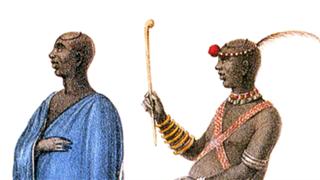
Power was concentrated in the king, who controlled the army, the royal herds and the right of life and death. Shaka placed his own relatives, especially royal women, in charge of military homesteads, and appointed loyal men as izinduna, officials who commanded regiments and administered districts. Conquered chiefs often kept their positions if they submitted, but their authority was overlaid by royal appointees and the regimental system. Shaka ruled harshly, and the massacres that followed the death of his mother Nandi in 1827 alienated many followers. In September 1828 he was assassinated at his capital Dukuza by his half-brothers Dingane and Mhlangana. Dingane (r. 1828–1840) ruled from uMgungundlovu and in February 1838 had the Voortrekker leader Piet Retief and his party killed. His half-brother Mpande, with Boer support, overthrew him in 1840 and ruled for more than three decades, a period of relative stability in which the kingdom accepted the loss of land south of the Thukela to the British Colony of Natal. A succession war between Mpande’s sons ended in 1856 at the Battle of Ndondakusuka, where Cetshwayo defeated his brother Mbuyazi. Cetshwayo (r. 1872–1879) revived the regimental system and built his capital at Ulundi.
Global & Regional Impact

The Zulu Kingdom became one of the best-known African states in the world. Shaka’s career made him a figure of legend, portrayed as a military genius, a tyrant or a national founder depending on the writer, and the historian Carolyn Hamilton has shown how these images were shaped by both Zulu tradition and colonial writers. The kingdom’s rise reshaped southern Africa: groups fleeing Zulu expansion or breaking away from it founded new states, among them the Ndebele Kingdom of Mzilikazi, while the Gaza kingdom of Soshangane emerged from the defeated Ndwandwe. Zulu military organisation was imitated by neighbouring kingdoms. The Anglo-Zulu War of 1879, and especially Isandlwana and Rorke’s Drift, became famous in Britain and later in film, and it forced a reassessment of British confidence in colonial warfare. The Battle of Blood River became a central symbol in Afrikaner nationalism, its anniversary later commemorated as the Day of the Vow and now observed in South Africa as the Day of Reconciliation. Zulu identity, language and royal tradition remained powerful in twentieth-century South African politics, from the Zulu cultural organisation Inkatha to the present monarchy. Today isiZulu is the most widely spoken home language in South Africa.
Decline & Fall
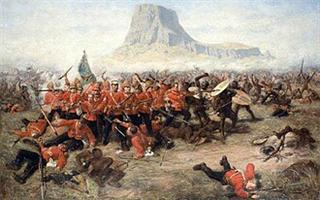
The kingdom’s end came from British imperial policy in the late 1870s. The high commissioner Sir Henry Bartle Frere, seeking a confederation of southern African states, regarded the Zulu army as a threat and in December 1878 issued an ultimatum demanding its disbandment. When Cetshwayo did not comply, British forces invaded in January 1879. Despite the Zulu victory at Isandlwana, the army was defeated at Ulundi in July, and Cetshwayo was captured in August and sent into exile. Sir Garnet Wolseley divided Zululand among thirteen appointed chiefs, including the trader John Dunn and the Zulu chiefs Zibhebhu and Hamu, a settlement designed to prevent the revival of royal power. Rivalries between royalists, the uSuthu, and the appointed chiefs led to civil war. Cetshwayo, after visiting London in 1882, was restored to part of his kingdom in 1883 but was defeated by Zibhebhu and died at Eshowe in 1884. His son Dinuzulu won Boer help against Zibhebhu at the price of land on which the Nieuwe Republiek was founded. In 1887 Britain annexed the remainder as the colony of Zululand, which was incorporated into Natal in 1897. The Zulu monarchy survives today as a traditional institution within South Africa.
The Zulu Kingdom, created by Shaka from a small chiefdom after 1816, became the most powerful state of southeastern Africa through its regimental army, and its defeat of a British force at Isandlwana in 1879 before its destruction at Ulundi made it a lasting symbol of African resistance to colonial conquest.
Test yourself
5 questions on this page, from its key events and facts.
The questions open here once the page has loaded.
References
- Guy, J. (1979) The Destruction of the Zulu Kingdom: The Civil War in Zululand, 1879–1884. London: Longman.
- Hamilton, C. (1998) Terrific Majesty: The Powers of Shaka Zulu and the Limits of Historical Invention. Cambridge, MA: Harvard University Press.
- Knight, I. (1995) The Anatomy of the Zulu Army: From Shaka to Cetshwayo, 1818–1879. London: Greenhill Books.
- Laband, J. (1995) Rope of Sand: The Rise and Fall of the Zulu Kingdom in the Nineteenth Century. Johannesburg: Jonathan Ball.
- Morris, D.R. (1965) The Washing of the Spears: A History of the Rise of the Zulu Nation under Shaka and Its Fall in the Zulu War of 1879. New York: Simon and Schuster.
Connections
Open the full connections map →