Social ladder · 1858–1947 (Crown rule in India, around 1900)
Social Hierarchy of British India
From Viceroy to Indentured Labourer
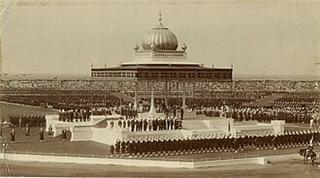
British India was ranked by race and caste as well as by wealth and office. The viceroy governed in the Crown’s name, and a little over a thousand men of the Indian Civil Service, almost all of them British, ran the districts; Indians held the lower posts. Nearly 600 princes ruled their states under British paramountcy, and the zamindars held the great estates of the north and east: both were rewarded for keeping out of the rebellion of 1857. Colonial rule also made caste a central mechanism of administration. From 1881 the census ranked thousands of jatis by their supposed purity, administrative jobs went only to the upper castes, and the Criminal Tribes Act of 1871 declared whole communities criminal by birth. Most Indians were peasants, who paid the land tax on which the Raj’s finances rested and died in the tens of millions in the famines of the later 19th century; the communities treated as untouchable stood outside the caste order altogether, and more than 1.6 million Indians were shipped overseas as indentured labourers.
Period 1858–1947 (Crown rule in India, around 1900)People c. 250–300 million (est.)Ranks 12Profile British Raj
The ladder
By rank, the ladder is drawn as a pyramid. To scale, each bar is as wide as that rank’s share of the people. Shares marked est. are estimates where no count survives; their boxes and bars are dashed.
Ruler · One ruler
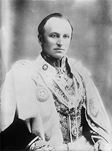
Viceroy
governor-general
The viceroy ruled India for the British queen or king, who lived far away in Britain.
After 1858 the governor-general of India was more commonly called the viceroy, from his second role as the Crown’s representative to the princely states. Appointed by the Crown, he headed the Government of India from Calcutta with an Executive Council whose members each ran a department, and he answered to the Secretary of State for India in London and through him to Parliament. Laws made in India needed the Secretary of State’s assent, which led Sir Charles Wood to call the Government of India “a despotism controlled from home”. Lord Curzon (1899–1905) reformed everything from irrigation and the police to the universities and in 1905 divided Bengal. In 1911 a move of the capital to Delhi was announced.
Moving in or out. The Crown appointed him, for no fixed term though typically for five years. Curzon resigned in 1905 after a dispute with his military chief, Lord Kitchener.
How many? One man, appointed by the Crown, typically for five years; the monarch, proclaimed Empress or Emperor of India, remained in Britain.
Nobility and officials · Fewer than 1 in 1,000
British officials and residents
Civilians, covenanted civil service
A small group of British officials, chosen by exams held in London, ran the districts of British India.
British control in the districts rested on the Indian Civil Service (ICS), whose members, the “Civilians”, were at first almost all British and educated in the best British schools. A little over a thousand of them oversaw all government in some 250 districts, each with an average of 300,000 subjects. They entered by a competitive examination, open from 1853 to British subjects without distinction of race but held only in London. The higher, covenanted service was British; the uncovenanted service let Indians in at the lower rungs. Early in the 20th century 8,000 European officials earned £13.9 million between them, and 130,000 Indians in government service £3.3 million. Until the 1930s the railways hired only European supervisors and engineers.
Moving in or out. A candidate had to be aged 18 to 23 and pass a horse-riding test; after probation at Oxford, Cambridge, London or Dublin, an Assistant Commissioner began on about £300 a year, served at least 25 years and retired on a pension of £1,000. The examination was at first held only in London; from 1922 Indian candidates could sit it in Delhi.
How many? Roughly: the census of 1861 counted 125,945 English people in India, about 84,000 of them officers and men of the army and some 42,000 civilians; against the 255 million of the census of 1881, about 0.05 per cent. The Indian Civil Service itself was a little over a thousand men.
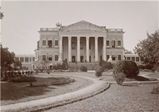
Picture: The British Residency at Hyderabad, about 1900 · Unknown author · Public domain · Wikimedia Commons

Nobility and officials · Fewer than 1 in 1,000 (est.)
The princes
maharaja, raja, nawab, nizam
Indian princes still ruled hundreds of states, big and small, but Britain controlled their armies and their dealings with other countries.
Nearly 600 princely states, covering 40 per cent of the land and 23 per cent of its people in 1947, were ruled by Indian princes under British paramountcy. By treaty Britain controlled their external affairs, defence and most communications, and a British resident or agent watched over them; the princes could not deal with foreign states or fight one another, and their armies served for ceremony and policing. The British translated every title, maharaja, nawab or nizam, as “prince”, so that no ruler seemed a king equal to the British monarch, and ranked the rulers by gun salutes, from 3 guns to 21. Many states were tiny: some two hundred covered less than 25 square kilometres.
Moving in or out. A prince inherited his throne, but the British could grant or withhold recognition. The doctrine of lapse, under which the East India Company had annexed states whose ruler died without a natural heir, ended in 1858. Princes who had kept out of the rebellion of 1857 had their territories guaranteed, and their sons were schooled at Mayo College and Aitchison College on the model of the English public schools.
How many? Estimate: the ruling houses of nearly 600 states (565 were recognised in 1947) with their families; the Imperial Gazetteer counted some 2,000 ruling chiefs with the title raja or maharaja.
Nobility and officials · c. 1–2% (est.)
Zamindar (Zamindars and great landholders)
zamindari
Zamindars were rich landowners who paid the government a fixed sum each year for their great estates.
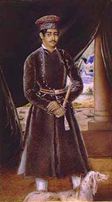
The zamindars held the great estates of the north and east. Under the Mughals zamindars had not owned the land, only the right to collect its revenue, but in 1793 the Permanent Settlement made the zamindars of Bengal, Bihar and Orissa proprietors of their land in return for a fixed annual rent. If a zamindar could not pay by sunset, parts of his estate were auctioned, which created a new class of zamindars. After 1857 their armies were abolished, save a few forces for policing. Most of the great zamindars were of the Hindu high castes, Brahmin, Rajput, Bhumihar or Kayastha, and the British gave loyal ones titles such as Raja, Rai Bahadur, Nawab or Khan Bahadur.
Moving in or out. An estate passed by descent or adoption, and a lawfully wedded wife could inherit it if the zamindar named her heir; the British rewarded some supportive zamindars by recognising them as princes. Because many peasants had fought for their former landlords in 1857, the British made no more land reforms for 90 years, and Bengal and Bihar remained realms of large landholdings.
How many? Estimate: the zamindars, great and small, with their families; the articles give no count. The Imperial Gazetteer reckoned some 2,000 ruling chiefs with royal titles and ten times as many holders of lesser noble titles, and the princely states held thousands of zamindari estates and jagirs besides.

Religious and learned · c. 4–7% (est.)
Brahmin
varna
Brahmins were the priestly caste, ranked highest in old Hindu writings, and the British gave government jobs to the upper castes.
The varna scheme of the ancient texts placed the Brahmins, the priests, at the head of four orders, above the Kshatriyas (rulers and warriors), the Vaishyas (traders) and the Shudras (labourers), with Dalits and Adivasis outside. Scholars of the Vedas call it “a social ideal rather than a social reality”, but colonial rule made caste central to administration. Under East India Company rule, Brahmins became the authorities on Hindu law; the census from 1881 ranked thousands of jatis by supposed purity; and between 1860 and 1920 the Raj gave administrative jobs and senior appointments only to the upper castes. After 1857 the Brahmin and Muslim units of the United Provinces, the core of the rebellion, were disbanded.
Moving in or out. Birth into a Brahmin jati decided it. Lower castes sought Brahmin or Kshatriya status for whole communities, a process called Sanskritisation; the upper castes had resisted such claims before British rule, but they spread under it.
How many? Estimate: the articles give no count for the period; at the present day the forward castes, of whom the Brahmins are one, are estimated at 26 per cent of India’s Hindus.
Soldiers, merchants and craftsmen · c. 0.5–1% (est.)
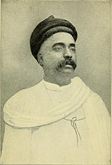
The educated middle class
bhadralok (Bengal)
Indians who studied at the new universities became lawyers and officials, and some started the Indian National Congress.
By 1880 a new middle class had arisen across the country. The universities of Calcutta, Bombay and Madras opened in 1857, and by 1890 some 60,000 Indians had matriculated, chiefly in arts or law; a third entered public administration and another third became lawyers. In 1887 Hindus and Muslims held 52 per cent of 21,000 mid-level civil service posts, but almost none of the thousand at the top. Racial discrimination angered them, and the partial reversal in 1883 of the Ilbert Bill, which would have put Indian judges in Bengal on an equal footing with British ones, turned discontent into politics: in December 1885 seventy of them, many familiar with British political thought, founded the Indian National Congress.
Moving in or out. Education was the way in: matriculation, a degree in arts or law, and a post in the administration or at the bar. Few climbed higher, since almost all the top posts went to Britons, typically with an Oxford or Cambridge degree.
How many? Estimate: some 60,000 Indians had matriculated by 1890, and in 1911 the colleges enrolled 36,000 students; with the clerks, teachers and lawyers of the towns and their families, perhaps one person in a hundred or two hundred.
Soldiers, merchants and craftsmen · c. 2–4% (est.)
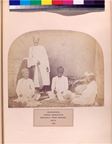
Merchants, bankers and moneylenders
-
Merchants and bankers traded and lent money, and some Indians built cotton mills and a great steelworks.
In the varna scheme trade belonged to the Vaishyas. As railways carried cotton and grain to the ports for export, many small farmers dependent on faraway markets lost their land, animals and equipment to moneylenders. Indians also built industry: in 1877 Jamsetji Tata began a spinning and weaving company in Bombay whose finer yarn, spun from Egyptian cotton on American ring spindles, could compete with British imports, and in 1908 his son’s Tata Iron and Steel Company began a steelworks at Jamshedpur, its surplus steel promised a buyer in the Raj. Yet the government’s Stores Policy shut most Indian firms out of railway contracts. Most big businessmen were nationalists who distrusted the Congress as too socialist.
Moving in or out. Wealth could buy land, but in the north-west the Land Alienation Act of 1900 listed the castes that could own land and barred its transfer to non-agricultural castes. The reforms of 1909 favoured rich landowners and businessmen, and those of 1919 reserved seats for businessmen.
How many? Estimate: the articles give no count; taken here at about the share estimated for the merchants and bankers of Mughal India.
Picture: Marwari merchants in Delhi, 1868 · New York Public Library · Public domain · Wikimedia Commons
Free commoners · About 63% (the rest, est.)
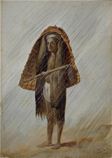
Ryot (Peasants)
Most Indians were farmers who paid taxes on their land, and millions died when terrible famines came.
Most Indians were peasants, the ryots, living at subsistence level. The Raj’s finances rested on the land tax, collected through the zamindars in the north and, in the south, under the ryotwari system, from cultivators the government treated as landowners. Taxpayers, chiefly farmers and farm labourers, also bore the railways’ £50 million of risk. Many small farmers lost their land to moneylenders, and great famines struck: the Great Famine of 1876–1878 killed 6.1 to 10.39 million people while, as Mike Davis notes, wheat exports to Britain went on unchecked, and the famine of 1899–1900 between 1.25 and 10 million. From 1880 the Famine Codes set out relief; in the newly irrigated Punjab a more prosperous peasantry grew.
Moving in or out. Peasant castes tried to rise as groups: under British rule pastoral communities such as the Ahirs took the name Yadav, and tilling castes such as the Kurmis formed caste associations claiming higher status. In 1917 Gandhi took up the cause of tenant farmers in Champaran, forced to grow indigo for British planters.
How many? Everyone else: the peasants who tilled the land, with their families, the great majority of the people. The other shares are estimates, so this one is too.
Picture: A Kunbi cultivator of the Konkan, a watercolour by Frank James, about 1870 · Captain Cornelius Francis (Frank) James · Public domain · Wikimedia Commons
Free commoners · c. 8–12% (est.)
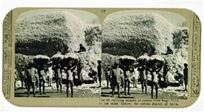
Artisans, mill hands and labourers
-
Many weavers lost their work to cheap British cloth, while others worked in new cotton mills and on the railways.
Cheap British cloth, imported under the “free trade” Britain imposed on India, shrank its largest industry: imports of cotton cloth rose from about a million yards in 1814 to 2,050 million in 1890, and by 1870–1880 Indian producers made only 25 to 45 per cent of the cloth India used. The iron industry declined still further. New work came in the mills, on the tea plantations of Assam and on the railways, where hard physical labour was left to Indians and their deaths, the historian Headrick shows, were “either ignored or merely mentioned as a cold statistical figure”. In 1918 Gandhi fasted to support low-paid workers striking at an Indian-owned mill in Ahmedabad, which won a settlement.
Moving in or out. Weavers and ironworkers lost their trades to imports, while others found work in the mills and on the railways, where Indians were kept to unskilled work: in 1920 they held only ten per cent of the railways’ superior posts.
How many? Estimate: the articles give no count; the weavers and other craftspeople, the mill, railway and plantation workers and the labourers of the towns with their families, taken as about one in ten.
Picture: Labourers carrying baskets of cotton to the mills, Indore, about 1900 · Unknown author · Public domain · Wikimedia Commons
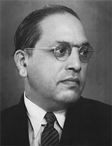
Outcast groups · c. 12–18% (est.)
Castes treated as untouchable
untouchables, Depressed Classes
People of the castes called untouchable were kept apart, even at the village well, and reformers like Ambedkar fought for their rights.
Outside the four varnas stood the communities treated as untouchable, the Dalits. Caste rules held them apart: the dominant caste lived at the centre of a village and others on its edges, there were minute rules on the food and drink the upper castes would accept from lower castes, and a caste considered impure might not draw water from a well used by others. By the late 19th century the Criminal Tribes Act reached most untouchable castes, such as the Chamars. Jyotirao Phule rejected every claim that caste was natural or ordained by the Creator, and Gokhale’s Servants of India Society worked among them. From the 1920s the government reserved a share of its jobs for the lower castes.
Moving in or out. Birth decided it, and conversion did not undo it: in Kerala the Protestant Dalit Christians of the missions were still treated as lower castes. B. R. Ambedkar, born into a caste classified as untouchable, became a leader of human-rights campaigns; at his request the Communal Award of 1932 gave the depressed classes separate electorates, which he gave up in the Poona Pact after Gandhi’s hunger strike.
How many? Estimate: the articles give no count for the period; in 2001 the Scheduled Castes, the communities once treated as untouchable, were 16.2 per cent of India’s population.
Outcast groups · c. 0.5–2% (est.)
Castes and tribes declared criminal
criminal tribes
A British law of 1871 labelled whole castes as born criminals and limited where their members could go.
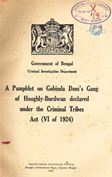
The Criminal Tribes Act of 1871 declared that all who belonged to certain castes were born with criminal tendencies. It first covered castes such as the Ahirs, Gurjars and Jats, and by the late 19th century its enforcement reached most Shudras and untouchables, Sannyasis and hill tribes. Castes suspected of rebellion, such as the Kallars and Maravars of the south, once ruling families, were called “predatory and barbarian”, some with no record of crime, only forefathers who had risen against the Mughals or the British. Registered members were restricted in where they could go and with whom they could mix; in some regions whole caste groups were arrested, their children taken from them, and held in penal colonies without conviction.
Moving in or out. Birth and the census register decided it. The practice was disputed among British officials, and in a few cases it was reversed early in the 20th century on the ground that people “could not be incarcerated indefinitely on the presumption of [inherited] bad character”; elsewhere the lists grew through the 1930s.
How many? Estimate: the articles give no count; hundreds of communities came under the Criminal Tribes Act, 237 castes and tribes in the Madras Presidency alone by 1931.
Picture: A government pamphlet on a "gang" under the Criminal Tribes Act, 1942 · Unknown author · Public domain · Wikimedia Commons


Serfs and dependants · Fewer than 1 in 1,000 (est.)
Indentured labourers
girmit
Many poor Indians were sent to work on sugar farms on faraway islands, often after being tricked by recruiters.
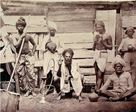
From 1834, when the ship Atlas carried 36 labourers from Calcutta to Mauritius, more than 1.6 million Indians were shipped to European colonies whose planters wanted cheap labour after slavery was abolished, from Trinidad to Fiji. Officials called it “free” migration, but many recruits were deceived, coerced or kidnapped. A labourer bound himself for five years: under the agreement of 1912 he worked nine hours a day, five days a week, and five on Saturdays, cutting cane and digging channels, for a shilling a day, a woman for nine pence. In British Guiana absence from work was a crime punishable by prison, and overseers flogged and beat. Historians such as Hugh Tinker call it “a new form of slavery”.
Moving in or out. A recruit had to appear before a magistrate of his district, and a free passage home came only after ten years’ residence. Labourers resisted by slowdowns, strikes, sabotage and desertion; many stayed, and Trinidad gave five acres and £5 to those who gave up their passage. Indenture to Natal ended in 1911, after Gokhale’s bill, and to the other colonies in 1917.
How many? Estimate: they lived overseas, outside India’s population; 525,482 Indians emigrated to British and French colonies between 1842 and 1870, some 19,000 a year on five-year contracts, so perhaps 100,000 were under indenture at any one time, about 0.04 per cent of India’s people. More than 1.6 million went in all.
Picture: Indian indentured labourers on a sugar estate in Mauritius, 1870 · Unknown author · Public domain · Wikimedia Commons

Born into history
Where would you have stood? Chance places you on the ladder, as birth placed most people: weighted by how many each rank held.
Moving up and down
Historians such as Nicholas Dirks argue that caste affiliation was loose and fluid before colonial rule and that the Raj enforced it rigorously, building a stricter hierarchy than before; the censuses of 1901 and 1911 hardened caste identities, and jobs, schooling and the right to own land were allotted by caste. Communities answered by organising: caste associations, a by-product of the census, petitioned for a higher varna, and Kurmis, Ahirs, Jatavs and others claimed Kshatriya status. Education opened a narrow door into the middle class and the lower civil service, and the Indian Civil Service slowly admitted Indians: from 1922 they could sit its examination in Delhi, the Lee Commission of 1924 set future intakes at 40 per cent Europeans and 40 per cent Indians, the rest promoted from the provincial services, and by 1945 Indians outnumbered Britons in the service. Land changed hands too: zamindari estates were auctioned for unpaid rent and small farmers lost their land to moneylenders, while in the north-west the Land Alienation Act of 1900 barred its transfer to non-agricultural castes. From the 1920s the government reserved a share of its jobs for the lower castes. For the poorest, indenture overseas was a way out with a heavy price; many stayed, and their descendants are now about two-thirds of the people of Mauritius.
Women on the ladder
No woman was ever recruited into the Indian Civil Service; women worked in government only as typists and clerks in the lower ranks of the uncovenanted service, and over 90 per cent of the 36,000 college students of 1911 were men. An ICS officer’s widow drew £300 a year, hence the saying that an ICS marriage was worth “three hundred a year alive or dead”. After 1857 the British avoided intervening in religion, even over the remarriage of Hindu child widows, though sati had been banned before the rebellion; Indian reformers took up the cause, from Pandita Ramabai, who championed the remarriage of Brahmin widows, to Gokhale’s Servants of India Society. Ambedkar argued that sati, enforced widowhood and child marriage had grown up to reinforce marriage within the caste. A zamindar’s lawfully wedded wife could inherit the estate if he named her heir, and Travancore had queens regent. Indentured women were paid nine pence to a man’s shilling, worked in the fields as well as at home, and suffered widespread sexual exploitation; on early ships there might be one woman to forty men, and from 1868 the rules required 40 women to every 100 men.
Compare with another society
Test yourself
4 questions on the ladder of the British Raj.
The questions open here once the page has loaded.
Sources and further reading
- Tinker, H. (1974) A New System of Slavery: The Export of Indian Labour Overseas 1820–1920. London: Oxford University Press.
- Bahadur, G. (2014) Coolie Woman: The Odyssey of Indenture. The University of Chicago.
- Ramusack, B. (2004) The Indian Princes and their States. The New Cambridge History of India. Cambridge and London: Cambridge University Press.
- Copland, I. (2002) Princes of India in the Endgame of Empire, 1917–1947. Cambridge and London: Cambridge University Press.
- Dewey, C. (1993) Anglo-Indian Attitudes: The Mind of the Indian Civil Service.
- Gilmour, D. (2007) The Ruling Caste: Imperial Lives in the Victorian Raj.
- Potter, D. C. (1987) India's Political Administrators, 1919–1983.
- Imperial Gazetteer of India vol. IV (1907) The Indian Empire, Administrative. Oxford at the Clarendon Press.
The shares are of the whole population, children included. Where a scholar has counted or estimated a rank, its share follows that work, named on the rank; where no count survives, the share is an estimate, marked est. and drawn dashed, made from what the rank was and did, from related figures and from the same rank in comparable societies, and its note says what it rests on. Population: Estimate: the census of 1881, which the British Raj article calls the first, counted 255 million; the Indian Civil Service article speaks of more than 300 million people under the service, without a date.
Cite this page
- APA
- The Epoch Institute. (2026). Social Hierarchy of the British Raj. In Social Ladders. https://the-epoch-institute.org/societies/british-raj
- MLA
- “Social Hierarchy of the British Raj.” Social Ladders, The Epoch Institute, 2026, https://the-epoch-institute.org/societies/british-raj. Accessed .
- Chicago
- The Epoch Institute. “Social Hierarchy of the British Raj.” Social Ladders. 2026. https://the-epoch-institute.org/societies/british-raj.
- Harvard
- The Epoch Institute (2026) ‘Social Hierarchy of the British Raj’, Social Ladders. Available at: https://the-epoch-institute.org/societies/british-raj (Accessed: ).