
Culture · Central & East Asia
Scythians
At a glance
- The Scythians were Iranian-speaking horse nomads who from the 7th century BCE dominated the steppe north of the Black Sea, campaigned across the Near East and defied Darius I of Persia.
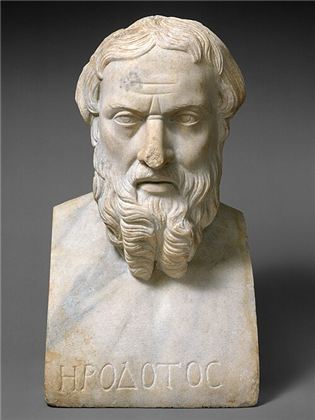
- They left no writing of their own: we know them from Greek writers, above all Herodotus, who gave them most of Book 4 of his Histories, and from thousands of excavated burial mounds.
- Their gold work of stags, panthers and griffins, and the treasures Greek goldsmiths made for their kings, belong to a wider Scythian world of related cultures that reached the Altai and Mongolia.
Timeline
- c. 800 BCEThe kurgan of Arzhan 1 is raised in Tuva, the earliest known burial with Scythian weapons, harness and animal art
- 670s BCEAssyrian texts name the Scythians and their king Bartatua, who asks Esarhaddon for an Assyrian princess in marriage
- c. 653–625 BCEBy Herodotus’s account, the Scythians of Madyes rule “Asia” for 28 years and raid as far as Palestine
- c. 513 BCEDarius I crosses the Danube to invade Scythia and withdraws without forcing a battle
- c. 400–300 BCERoyal kurgans such as Solokha, Chertomlyk and Tovsta Mohyla are raised on the lower Dnieper
- 339 BCEKing Ateas, who had extended his rule to the Danube, is killed fighting Philip II of Macedon
- c. 110–107 BCEDiophantus, general of Mithridates VI, defeats the Crimean Scythians of King Palakus
- 3rd century CEScythian Neapolis in Crimea is destroyed, probably by the Goths, ending the Late Scythian kingdom
Origins
The name Scythians is Greek. Assyrian texts of the 7th century BCE call the same people Ishkuzai, a name usually identified with the Ashkenaz whom the prophet Jeremiah lists beside Ararat and Minni, and the Persians called the nomads of the steppe Saka; Herodotus remarks that the Persians gave that name to all Scythians. He also says that the Scythians called themselves Scoloti. Their language belonged to the eastern branch of the Iranian languages. It survives only in the names of people and gods and in a few words recorded by Greek writers, and its closest living relative is Ossetian, spoken in the central Caucasus by descendants of the Alans.
Herodotus, who wrote in the 5th century BCE and probably visited the Greek city of Olbia on the estuary of the Southern Bug, gives three accounts of their origin. In the Scythians’ own, Targitaus, the first man in their land, had three sons; when a golden plough and yoke, a battle-axe and a cup fell from the sky, only the youngest, Colaxais, could take them up, and the kings descended from him. The Greeks of the Black Sea told instead of Heracles and a woman who was a serpent below the waist. The third account, which Herodotus himself preferred, held that the Scythians had been nomads in Asia who, pressed by the Massagetae, crossed the river Araxes and drove the Cimmerians from the steppe north of the Black Sea.
Archaeology partly agrees. The earliest known burial with the “Scythian triad” of weapons, horse harness and art in the animal style lies far to the east, at Arzhan in Tuva, in southern Siberia: a great mound of about 800 BCE, excavated by Mikhail Gryaznov in the 1970s, where a chief was buried with his retinue and well over a hundred horses. Nearby, Arzhan 2, of the later 7th century BCE, excavated by a Russian–German team in 2000–2004, held an undisturbed royal couple with some 5,700 gold objects. Many scholars therefore think that the Scythian way of life took shape in the eastern steppe and spread west; others stress roots in the Bronze Age Timber-grave (Srubnaya) culture of the Black Sea steppe. Studies of ancient DNA published since 2017 suggest that the peoples of the Scythian world arose from several populations mixing in different proportions, not from a single migration. By the 7th century BCE Scythian chiefs were buried in rich mounds in the Kuban, as at Kelermes, and Scythian horsemen had entered the history of the Near East.
Society
Herodotus describes the Scythians as a people without towns or walls who carried their homes with them, all of them mounted archers who lived from their herds rather than the plough. The Hippocratic treatise Airs, Waters, Places, of the late 5th century BCE, adds that the women and children lived in wagons covered with felt and drawn by oxen while the men rode, and that they lived on boiled meat, mare’s milk and a cheese made from it. Herds of horses, cattle and sheep moved between summer and winter pastures along the great rivers.
Yet Scythia was not a land of nomads alone. Herodotus distinguishes the Royal Scythians, the most numerous and warlike, who looked on the other Scythians as their slaves, from Nomad Scythians and from farming Scythians who grew grain, some of it for sale. In the forest-steppe archaeologists have found vast fortified settlements, above all Bilsk on the Vorskla river near Poltava, whose ramparts run for some 33 kilometres around about 40 square kilometres, and which Boris Shramko and others have identified with Gelonus, the wooden city that Herodotus places in the land of the Budini. Many of these settled people may have spoken other languages, but they lived within the Scythian political and cultural world.
Kings came from a royal clan that traced its descent to Colaxais. At the time of Darius’s invasion Herodotus names three kings, Idanthyrsus, Scopasis and Taxacis, each with his own part of the country, and below them stood district governors and a warrior nobility. He records grim customs of war: a warrior drank the blood of the first man he killed, brought the heads of the slain to the king to claim his share of the booty and hung their scalps from his bridle, and once a year only those who had killed an enemy might drink from the bowl of wine that the district governor mixed. Oaths were sealed by drinking wine mixed with the blood of those who swore. Rich graves show warriors armed with the short sword called the akinakes, scale armour and the gorytos, a combined case for the bow and arrows that held a short composite bow. Some women were also buried with weapons, especially among the Sauromatians beyond the Don, finds often linked with the Greek tales of the Amazons.
Beliefs & Worldview

What is known of Scythian religion comes chiefly from Herodotus, who names their gods by Greek equivalents. Most honoured was Tabiti, whom he equates with Hestia, goddess of the hearth; then Papaeus, equated with Zeus, and Api, the Earth, his wife; then gods he calls Apollo, Aphrodite Urania, Heracles and Ares, with Poseidon worshipped by the Royal Scythians. They made no images, altars or temples except for Ares. In every district a great platform of brushwood was raised for him, with an ancient iron sword set on top as his image, and to it horses and cattle were sacrificed, and one in every hundred prisoners of war. Diviners read the future in bundles of willow rods, and the Enarees, men who lived as women, used strips of lime bark.
Herodotus describes the burial of a king at length. The body was embalmed, coated with wax and carried on a wagon from one people to the next, whose mourners cut their hair, gashed their arms and pierced their left hands with arrows. At Gerrhus, the farthest point to which the Borysthenes, the Dnieper, could be navigated, it was laid in a great square pit with a concubine, a cupbearer, a cook, a groom, a servant and a messenger, all strangled, and with horses and golden cups; a year later fifty attendants and fifty horses were killed, stuffed and set up on stakes around the mound. The royal kurgans of the lower Dnieper, such as Chertomlyk and Solokha, have confirmed the core of this account: kings lie there with attendants, horses and treasure.
After a funeral, Herodotus says, the Scythians purified themselves in small tents of felt, throwing hemp seeds on red-hot stones and howling with pleasure in the vapour. In the frozen tombs of Pazyryk in the Altai, Sergei Rudenko reported the frames of such tents, censers filled with stones and hemp seeds. Stone stelae of warriors holding a drinking horn and armed with sword and bow-case stood on many kurgans. Scholars have compared the story of Targitaus with Iranian myths of the first king, and Georges Dumézil read the golden cup, axe, and plough and yoke as symbols of three orders of society, the priest-kings, the warriors and the producers, a reading that remains debated.
Arts & Knowledge

Scythian art is best known for its animal style. Stags with their legs folded beneath them, panthers curled into a ring, birds of prey, boars and griffins decorate weapons, horse harness, clothing and vessels, often with an animal’s antlers, feet or tail ending in the heads of other creatures, and in later work with beasts locked in combat. The style is already present at Arzhan, which points to eastern roots, but in the 7th century BCE, when Scythian warriors fought in the Near East, it absorbed motifs from Assyrian and Urartian art, as on the gold-covered sword sheath from the Melgunov kurgan. Among its masterpieces are the gold stag from Kostromskaya and the gold panther from Kelermes, both from the Kuban and now in the Hermitage Museum in St Petersburg.
From the late 5th century BCE Greek goldsmiths, probably working in the cities of the Bosporus and in Olbia, made works for Scythian patrons that show the Scythians themselves. The gold comb from Solokha is crowned by three warriors in combat; a gilded silver amphora from Chertomlyk shows men catching and taming horses; an electrum vase from Kul-Oba shows warriors stringing a bow and tending each other’s wounds; and the gold pectoral from Tovsta Mohyla, found by Borys Mozolevsky in 1971, shows two men holding up a sheepskin shirt among their herds, above a frieze of griffins attacking horses. These are the best pictures we have of Scythian dress: belted caftans, trousers and soft boots, worn with long hair and beards.
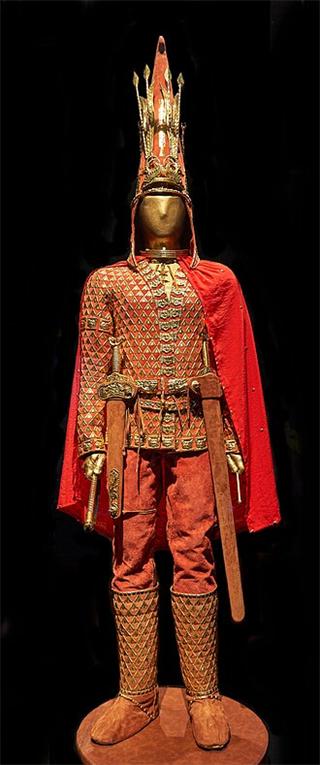
In the Altai, ice in the tombs of Pazyryk preserved what rots elsewhere: felt hangings and saddle covers with appliqué animals, carved wooden harness ornaments, textiles, the tattooed body of a chief and the oldest known knotted pile carpet, now in the Hermitage. In 1993 Natalia Polosmak found on the Ukok plateau the body of a woman of the 5th century BCE with deer tattooed on her shoulder. In south-eastern Kazakhstan the Issyk kurgan near Almaty held a Saka warrior, the “Golden Man”, clothed in thousands of gold ornaments. The Scythians had no writing of their own; a short inscription on a silver bowl from Issyk remains undeciphered. Their knowledge of horses, herds and metals was handed on without writing and survives only in what they made.
Contact & Exchange

The Scythians enter written history in Assyrian texts of the 670s BCE, when King Esarhaddon asked the sun god whether he should give a daughter in marriage to Bartatua, king of the Ishkuzai, usually identified with Herodotus’s Protothyes. Scythian warriors then seem to have fought as allies of the Assyrian Empire against the Cimmerians and the Medes. Herodotus tells that Protothyes’ son Madyes defeated the Medes, that the Scythians ruled Asia for twenty-eight years, raiding as far as Palestine, where the pharaoh Psamtik I bought them off, and that the Median king Cyaxares at last killed their leaders at a feast. Historians accept that Scythian bands were a real power in the region in the later 7th century BCE, a period often called the Scythian Interregnum in the history of the Median Empire, though the twenty-eight years and other details are uncertain.
In the west the Scythians met the Greeks, whose colonies spread along the northern shore of the Black Sea from the 7th century BCE: Berezan and Olbia, founded from Miletus, Panticapaeum and the other cities that formed the Bosporan Kingdom, and later Chersonesus in Crimea. The Greek cities bought grain, hides, fish and slaves from the interior and sold wine, olive oil, painted pottery and fine metalwork. In 5th-century BCE Athens, Scythian archers owned by the city kept order in the assembly. Herodotus tells of two Scythians killed for taking up Greek ways: the sage Anacharsis, shot by his brother King Saulius for performing a Greek rite, and King Scyles, who lived in secret as a Greek at Olbia and was overthrown when his people saw him in a Bacchic procession.
Around 513 BCE Darius I crossed the Bosporus and the Danube on bridges of boats to attack the Scythians. Led by Idanthyrsus, they refused battle and retreated eastward, filling in wells and destroying the grass, and Darius withdrew across the Danube, where his Ionian Greeks had kept the bridge: the campaign showed the limits of the Achaemenid Empire’s power against mounted nomads. In the 4th century BCE King Ateas extended his rule to the lower Danube, struck coins at Callatis and fell in battle against Philip II of Macedon in 339 BCE, and about 331 BCE the Scythians destroyed the army of Zopyrion, Alexander the Great’s governor in Thrace, after his failed siege of Olbia. The Scythians also fought and intermarried with the Thracian kings of the Odrysian Kingdom, while their eastern kin, the Saka, fought Cyrus the Great, Darius and Alexander in Central Asia.
Legacy

From the 3rd century BCE the Sarmatians, nomads of related speech from beyond the Don, took over much of the steppe, and the great royal kurgans came to an end. The Scythians held on in Crimea and along the lower Dnieper, where a Late Scythian kingdom grew up around Scythian Neapolis, near present-day Simferopol. In the 2nd century BCE its king Skilurus struck coins at Olbia and pressed Chersonesus, until Diophantus, general of Mithridates VI of the Kingdom of Pontus, defeated his son Palakus in about 110–107 BCE. The kingdom survived, much reduced, until Neapolis was destroyed in the second half of the 3rd century CE, probably by the Goths, and the last Scythians merged with Sarmatians, Alans, Goths and others.
The name outlived the people. Greek and Byzantine writers called later northern peoples Scythians: the Goths of the 3rd century CE, the Huns and even the Rus’. In 1918 the Russian poet Alexander Blok, in his poem “The Scythians”, cast Russia as a Scythian nation standing between Europe and Asia.
Rediscovery began with gold. Peter the Great gathered gold plaques from Siberian burial mounds into what became the Siberian collection of the Hermitage, and in 1763 a 7th-century BCE kurgan near present-day Kropyvnytskyi was dug open on the orders of the Russian general Aleksei Melgunov. Kul-Oba near Kerch was opened in 1830, Ivan Zabelin excavated Chertomlyk in 1862–1863 and Nikolai Veselovsky excavated Solokha in 1912–1913; Soviet and later archaeologists added Pazyryk, Arzhan, Tovsta Mohyla and thousands of ordinary graves.
Views of the Scythians have changed with the evidence. Herodotus, long doubted, has been confirmed on many points, from royal burials with servants and horses to the felt tents of hemp, yet scholars such as François Hartog have shown how far his Scythians also serve as a mirror in which Greeks defined themselves, the wandering nomad as the opposite of the citizen. Archaeology has revealed what he barely saw: farmers, great fortified settlements and links across the steppe to the Altai and the borders of China. Today the Scythians are studied as part of a wider Scythian world, and their gold fills the Hermitage and the Museum of Historical Treasures of Ukraine in Kyiv.
The Scythians were Iranian-speaking horse nomads who dominated the steppe north of the Black Sea from the 7th to the 3rd century BCE, part of a wider Scythian world reaching the Altai. Known from Herodotus and from their great burial mounds, they raided the Near East, foiled Darius I, traded with the Greeks and left some of the finest gold work of the ancient world.
References
- Cunliffe, B. (2019) The Scythians: Nomad Warriors of the Steppe. Oxford: Oxford University Press.
- Hartog, F. (1988) The Mirror of Herodotus: The Representation of the Other in the Writing of History. Trans. J. Lloyd. Berkeley: University of California Press.
- Herodotus (1998) The Histories. Trans. R. Waterfield. Oxford: Oxford University Press.
- Minns, E.H. (1913) Scythians and Greeks: A Survey of Ancient History and Archaeology on the North Coast of the Euxine from the Danube to the Caucasus. Cambridge: Cambridge University Press.
- Rolle, R. (1989) The World of the Scythians. London: Batsford.
- Simpson, St J. and Pankova, S. (eds) (2017) Scythians: Warriors of Ancient Siberia. London: Thames & Hudson.