South & Southeast Asia
Nguyen dynasty
At a glance
- Vietnam’s last imperial dynasty, founded by Gia Long in 1802 after he defeated the Tay Son and united the country.
- Minh Mang built a centralised Confucian state on the Qing model, renamed the country Dai Nam and occupied Cambodia.
- French conquest from 1858 reduced the emperors to figureheads, and Bao Dai abdicated to the Viet Minh in 1945.
Rise & Fall
- 1802Nguyen Anh proclaims himself Gia Long and unites Vietnam
- 1815The Gia Long Code, modelled on Qing law, is issued
- 1839Minh Mang renames the country Dai Nam
- 1858A Franco-Spanish expedition attacks Da Nang
- 1862The Treaty of Saigon cedes three provinces of Cochinchina to France
- 1883–1884Treaties make Annam and Tonkin French protectorates
- 1885Emperor Ham Nghi flees Hue and the Can Vuong resistance begins
- 1945Bao Dai abdicates to the Viet Minh on 30 August
Foundation

The Nguyen dynasty descended from the Nguyen lords, who had ruled southern Vietnam (Dang Trong) since the sixteenth century, from 1687 with their seat at Phu Xuan, the later Hue. In the 1770s the Tay Son rebellion destroyed their regime, and in 1777 most of the family was killed. The teenage Nguyen Anh survived and spent more than two decades fighting the Tay Son from bases in the Mekong delta, at times taking refuge in Siam, whose army was defeated on his behalf by the Tay Son leader Nguyen Hue in 1785. The French missionary bishop Pierre Pigneau de Behaine negotiated a treaty of assistance at Versailles in 1787; the French crown never honoured it, but Pigneau raised money and recruited a small number of French volunteers, who helped train Nguyen Anh’s forces and build Western-style ships and fortifications. From his capital at Gia Dinh (Saigon), taken in 1788, Nguyen Anh built up a strong army and navy, and after Nguyen Hue’s death in 1792 the Tay Son weakened. Nguyen Anh captured Phu Xuan in 1801, proclaimed the reign name Gia Long in 1802 and took Thang Long (Hanoi) the same year. For the first time a single court ruled the whole territory from the Chinese border to the Gulf of Thailand. In 1804 the Qing emperor Jiaqing invested him as king of a country now officially called Viet Nam.
Socioeconomy
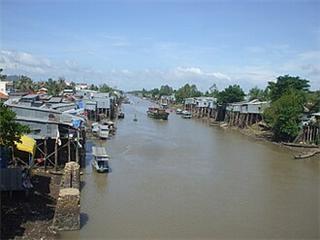
Nguyen Vietnam was an overwhelmingly agrarian society of villages growing wet rice, organised around communal land, village councils of notables and ancestral cults. The Mekong delta, still a frontier when the dynasty began, was steadily settled and reclaimed, partly through state-sponsored military colonies and land clearance projects, and became the rice basket of the south. The court levied land and head taxes, demanded corvée labour for building works such as the Hue citadel and the Vinh Te canal on the Cambodian frontier, and kept a tight hold on foreign trade, which it regarded with suspicion. Chinese merchants, including the Minh Huong descendants of Ming loyalists, handled much of the commerce, while Western ships were rarely welcomed. Neo-Confucianism was the official ideology, but Buddhism, popular religion and the cult of village guardian spirits remained strong. Catholicism, spread by missionaries since the seventeenth century, had a few hundred thousand adherents; Gia Long tolerated it out of gratitude to Pigneau, but Minh Mang issued edicts against it from 1833, and missionaries and Vietnamese Catholics were executed under him and under Tu Duc. Literature flourished in both Chinese characters and the vernacular chu Nom script: Nguyen Du, an official who served as envoy to China, composed The Tale of Kieu, the most celebrated work of Vietnamese poetry, in the early nineteenth century.
Military

Gia Long’s victory rested on a large army and a navy that included Western-style warships, and he built Vauban-style citadels with bastions at Hue, Saigon and provincial centres. Under Minh Mang (r. 1820–1841) the army was used to expand Vietnamese power to the west and south. The court suppressed the revolt of Le Van Khoi, who held the Saigon citadel from 1833 until 1835 with the help of Catholic and Chinese followers, and it absorbed the last remnant of Champa in 1832. Vietnam fought Siam over Cambodia in 1831–1834 and occupied much of the country, governing it from 1834 as the Tran Tay province; a Cambodian uprising and renewed war with Siam forced withdrawal in the early 1840s, and a settlement of 1845–1847 left Cambodia under joint Siamese and Vietnamese suzerainty. These forces were not designed to fight industrialised Europe. French warships bombarded Da Nang in 1847, and in 1858 a Franco-Spanish expedition under Admiral Charles Rigault de Genouilly attacked Da Nang, then took Saigon in 1859. Vietnamese armies resisted around Saigon but were defeated at Ky Hoa in 1861. In 1873 and 1882–1883 French forces seized the Hanoi citadel, and Chinese troops and the Black Flag army of Liu Yongfu fought them in Tonkin until the Sino-French War of 1884–1885 ended Qing involvement.
Governance & Law

The Nguyen built one of the most thoroughly Confucian states in Vietnamese history, consciously modelled on Qing China. Gia Long issued the Gia Long Code (Hoang Viet luat le) in 1815, closely based on the Qing code, and ruled the north and south through governors-general while holding the centre directly from Hue. Minh Mang, the dynasty’s great centraliser, abolished these regional governorships, divided the country into some thirty provinces under governors appointed from the capital, created a Grand Secretariat and a Privy Council on Chinese lines, and expanded the civil service examinations, which recruited officials through tests in the Confucian classics held in regional centres and at the capital. He renamed the country Dai Nam, ‘Great South’, in 1839 and styled himself emperor at home while accepting the status of tributary king in relations with the Qing. The court compiled official histories such as the Dai Nam thuc luc, the veritable records of the dynasty. Successors Thieu Tri (r. 1841–1847) and Tu Duc (r. 1847–1883) maintained this system, but Tu Duc’s long reign was weakened by rebellions, a succession conspiracy and the French advance. Under the protectorate from 1883–1884, emperors kept their court, rituals and mandarins, yet French residents controlled finances and appointments, and from 1897 a French official presided over the Council of Ministers.
Global & Regional Impact

The Nguyen dynasty gave Vietnam its present shape. Gia Long’s conquest united the northern heartland around Hanoi with the central coast and the Mekong delta for the first time, and the country’s name, Viet Nam, dates from his request to the Qing court in 1804. Minh Mang’s provinces formed the basis of later administrative divisions, and the dynasty’s expansion into the delta and its pressure on Cambodia shaped Vietnamese–Cambodian relations for the following two centuries. Hue, with its walled citadel, Purple Forbidden City and the tombs of the emperors along the Perfume River, became the country’s finest ensemble of royal architecture and in 1993 was inscribed as a UNESCO World Heritage Site. The dynasty’s records, law code and gazetteers are the main sources for nineteenth-century Vietnam. Its reputation is contested. Nationalist and later communist historians blamed the Nguyen for inviting French intervention through Pigneau, for isolationism and the persecution of Catholics, and for the court’s accommodation to colonial rule. Yet the dynasty also produced resistance: the Can Vuong (‘Aid the King’) movement launched in the name of the boy emperor Ham Nghi in 1885, and the emperors Thanh Thai and Duy Tan, deposed and exiled by the French in 1907 and 1916, became patriotic symbols.
Decline & Fall
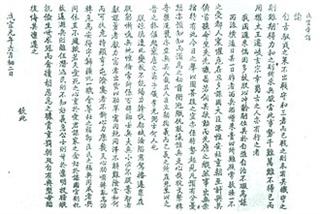
French conquest dismantled the dynasty’s power in stages. The Treaty of Saigon in 1862 ceded three provinces of Cochinchina and opened ports to trade, and in 1867 France seized the remaining three southern provinces. After Tu Duc’s death in 1883 and the killing of the French officer Henri Rivière in Tonkin, France imposed the Harmand Treaty of 1883 and the Patenôtre Treaty of 1884, making Annam and Tonkin protectorates, and the Treaty of Tientsin of 1885 ended Qing suzerainty. In July 1885 the regent Ton That Thuyet attacked the French garrison at Hue and fled with the young emperor Ham Nghi, launching the Can Vuong movement; Ham Nghi was captured in 1888 and exiled to Algeria. Thereafter the emperors were chosen and controlled by France, and from 1887 their lands formed part of French Indochina. Khai Dinh (r. 1916–1925) cooperated closely with the French, and Bao Dai, emperor from 1926, attempted modest reforms after returning from education in France in 1932 but had little power. When Japan overthrew French administration on 9 March 1945, Bao Dai proclaimed the independence of an Empire of Vietnam under Japanese patronage. After Japan’s surrender the Viet Minh seized power in the August Revolution, and on 30 August 1945 Bao Dai abdicated at Hue, handing the imperial seal and sword to the new government and ending the dynasty.
The Nguyen dynasty first united Vietnam from the Chinese border to the Mekong delta under one Confucian court at Hue, gave the country its name and provincial structure, and then saw it divided and subordinated by France, making its 143 years the bridge between precolonial Vietnam and the modern nation.
References
- Woodside, A.B. (1971) Vietnam and the Chinese Model: A Comparative Study of Vietnamese and Chinese Government in the First Half of the Nineteenth Century. Cambridge, MA: Harvard University Press.
- Taylor, K.W. (2013) A History of the Vietnamese. Cambridge: Cambridge University Press.
- Goscha, C. (2016) Vietnam: A New History. New York: Basic Books.
- Choi, B.W. (2004) Southern Vietnam under the Reign of Minh Mạng (1820–1841): Central Policies and Local Response. Ithaca, NY: Southeast Asia Program Publications, Cornell University.
- Marr, D.G. (1971) Vietnamese Anticolonialism, 1885–1925. Berkeley: University of California Press.
Connections
Open the full connections map →