
Religion · Islamic Caliphates & Middle East
Yazidism
At a glance
- Yazidis believe in one God who created the world and entrusted it to seven angels, led by Tawûsî Melek, the Peacock Angel, whom they hold to be the leader of the archangels and no source of evil.
- Sheikh Adi ibn Musafir, a 12th-century mystic who settled at Lalish, united the scattered Yazidi tribes; his tomb is the holiest Yazidi site, and the three castes of sheikhs, pirs and murids are traced to his reforms.
- Yazidis remember 74 farmans, campaigns of destruction, from Ottoman expeditions and the massacres of 1832 to the genocide by the Islamic State at Sinjar in 2014, when over 5,000 were killed and thousands of women and girls enslaved.
Timeline
- 12th centurySheikh Adi ibn Musafir settles in the valley of Lalish, unites the scattered Yazidi tribes and returns their ancient temple to them
- 1246Badr al-Din Lu’lu, ruler of Mosul, has Sheikh Hasan, the leader who had consolidated the Yazidi community, killed
- 1414A joint army of neighbouring Sunni Kurdish tribes ransacks Lalish
- 1566The Ottoman Sheikh al-Islam issues fatwas legitimising the killing of Yazidis and the enslavement and sale of Yazidi women
- 1640An Ottoman army under Melek Ahmed Pasha storms Mount Sinjar, where 3,060 Yazidis are killed
- 1832The forces of Muhammad Pasha of Rawanduz massacre the Yazidis of Sheikhan, enslave thousands and execute those who refuse Islam
- 1915During the Armenian genocide many Yazidis are killed, and others flee from Van, Kars and Bazîd to Transcaucasia
- 2014The Islamic State captures Sinjar and begins the genocide of the Yazidis: over 5,000 are killed and thousands of women and girls forced into sexual slavery
Spread through the centuries
Where it began, how it spread, and where it was a main faith (a bright glow) or held communities (a faint one), century by century to today. Press Play or move the slider, turn the globe, and tap a glow or a mark to read about it.
The map opens here once the page has loaded.
Origins
Yazidism, also called Sharfadin, took shape from a pre-Islamic Kurdish religious substratum that was reorganised and given its lasting form by Sheikh Adi ibn Musafir and his successors in the 12th and 13th centuries. Scholars generally regard it as an independent tradition with deep roots in ancient Iranian beliefs, shaped by later Sufi influences: some point to parallels with Zoroastrianism and the Yaresan tradition, others to the Harranian religion and Hellenistic currents, and the old view of it as an offshoot of Islam has been widely given up. Before the 12th century Yazidis appear in the sources as Dāsinī, after the region of Dāsin northeast of Mosul. The name Yazidi means “the servant of the creator”; some western scholars derive it from the caliph Yazid I, a link all Yazidis reject.
Sheikh Adi was born in the 1070s at Bait Far in the Beqaa Valley, studied in Baghdad among the leading mystics of his age, Ahmad al-Ghazali among them, and around the age of thirty went to the Hakkari mountains and settled in the valley of Lalish. There he united the scattered Yazidi tribes and returned to them their ancient temple, which members of other faiths had occupied. His disciples spread his teaching that the human spirit may unite directly with God, and Yazidi tradition remembers his time as the “epoch of saints”.
When he died in 1162 the leadership passed to his nephew Sakhr Abu’l-Barakat. In the 1230s and 1240s Sheikh Hasan, of the same family, brought the consolidation to its height, with a Council of Holy Men and the foundational rules of Yazidi society and religion.
Beliefs & Practice
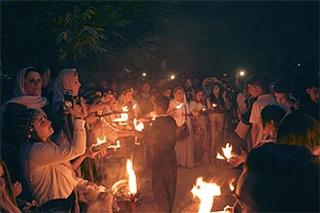
Yazidis believe in one God, called Xwedê, Xwedawend, Êzdan or Pedsha, “King”, who has 1,001 names in some hymns and 3,003 in others. Before this world, God made a white pearl from his own light and dwelt in it alone, then created seven angels, the Heft Sirr or “Seven Mysteries”, and gave them all the world’s affairs. Their leader is Tawûsî Melek, the Peacock Angel, ruler of the world. Yazidis speak of a divine triad: Tawûsî Melek, Sheikh Adi and Sultan Ezid are the three hypostases of the one hidden God, and their identities are sometimes blurred. The pantheon counts 365 holy figures, among them the Xudans, divine powers that control the phenomena of nature.
Fire, water, air and earth are sacred elements not to be polluted, and Yazidis pray towards the Sun, usually in private. They believe in the rebirth of the soul, described as a change of garment, the “changing of the shirt” (kirasgorîn), and in a cyclic course of time with three purifying disasters, by water, fire and air, of which the first has already happened. This older idea coexists with a younger belief in a collective end of time.
The New Year, Red Wednesday, falls on the first Wednesday on or after 14 April. Before the Feast of Êzî in December Yazidis fast for three days from sunrise to sunset. The greatest festival is the Feast of the Assembly, from 6 to 13 October, with its pilgrimage to the tomb of Sheikh Adi at Lalish, which Yazidis try to make at least once in their lives.
Texts & Teachers
Yazidi religious literature is mostly poetry, handed down orally, mainly in Kurmanji: hymns, prayers, the Declaration of the Faith and many other genres. Its archaic language can be hard for those not trained in religious knowledge, so prose legends and interpretations of the hymns explain it in the spoken language. The qewls, the sacred hymns, are the most authoritative form. The clergy sing them to set melodies at rites and festivals, and they tell of the creation, the nature of God, ethics, the fate of the soul and the lives of holy figures. In Yazidi belief they came not through prophets but directly from God and from angels in human form; the corpus took its foundational form in Sheikh Adi’s era and is mainly attributed to Şêx Fexredîn and his other disciples.
The oldest Yazidi documents are the mişûrs, sacred manuscripts of the 13th century; the earliest, the Mišūr of Pir Sini Bahri, dates from 1207–1208. By tradition there are forty, one for each lineage of Pirs, describing its founder and the tribes and priestly lineages tied to him; they are kept in places called stêr. They preserve Sheikh Adi’s own poems: “In the secret of my knowledge there is no God but me.”
The Book of Revelation and the Black Book, published in 1911 and 1913, are generally regarded as forgeries written by non-Yazidis for curious Western travellers and scholars, though their material agrees with Yazidi tradition. The hymns are now being collected with the community’s assent, making Yazidism a scriptural religion.
Spread
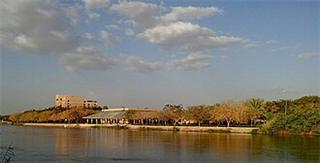
Sheikh Adi’s following drew people from Mosul, the Hakkari mountains, Syria and Iran, and an Adawi brotherhood named after him is attested across the Middle East into the 15th century, one branch centred in Cairo, before it dissolved into the Muslim majority. Yazidism was embraced by many Kurdish tribes and emirates from Antioch to Sulaymaniyah and was the official religion of principalities such as Sheikhan, Bohtan, Mahmudi, Donboli and Kilis. From the 14th century the Yazidi lands formed seven centres, each with its sinjaq: Lalish and Sheikhan, Shingal (Sinjar), Hakkari, the lands around Siirt and Mardin, Aleppo and Afrin, Tabriz, and Serhed around Kars.
Persecution and the forced conversion of chiefs reduced Yazidi power from the 15th century, and in the 18th and 19th centuries their numbers declined further. Survivors of the massacres of 1832 fled to Tur Abdin, Mount Judi and Shingal. Yazidis left for the Russian Empire during the Russo-Turkish wars of 1828–1829 and 1877–1878, and the Armenian genocide of 1915 drove many more from Van, Kars and Bazîd to Transcaucasia.
In the 20th century the Yazidi community of Turkey declined steeply, most of its people emigrating to Germany, which now has more than 230,000 Yazidis, from Turkey and more recently Iraq. Refugees have settled in Nebraska since the late 1990s, and since the 1990s many Yazidis of Georgia have left for Russia and the West.
Community & Society
Yazidi society is divided into three castes, conventionally traced to Sheikh Adi’s reforms: the sheikhs (şêx), with spiritual and administrative functions; the pirs (pîr), with religious and pastoral functions; and the murids (mirîd), the laypeople. The bond between the castes is held to be like that of siblings, so marriage between them is forbidden, and Yazidis marry only Yazidis: those who marry outside are expelled. The system served to hold the community together under pressure from proselytising majorities, and under persecution Sheikh Adi’s followers became a community one can only be born into. The Mîr, prince of the Yazidis, leads it with Baba Sheikh, its religious head, and Sheikh Adi’s family, the Adanî sheikhs, still hold senior offices.
Every six months the qewals, trained reciters of the hymns, went out from Lalish and Sheikhan under armed protection, leading a sinjaq through the Yazidi villages to uphold the authority of Lalish and the Mîr. Lalish has its own dignitaries, from the Mir Hejj, Prince of the Pilgrimage, to the Baba Chawush, guardian of Sheikh Adi’s sanctuary.
Children are baptised at birth with water from the White Spring at Lalish, in the rite called mor kirin, “to seal”, and circumcision is not required. Excluded from the status of “People of the Book”, Yazidis had none of the religious rights of Christians and Jews under the Ottoman millet system until the Ottomans gave them a certain legal status in 1849.
Legacy
Yazidis remember their history as a series of farmans, campaigns of destruction: their songs count 72, and today they speak of 74. In 1246 the ruler of Mosul killed Sheikh Hasan, and in 1414 Sunni Kurdish tribes ransacked Lalish. In 1566 the Ottoman Sheikh al-Islam issued fatwas allowing the killing of Yazidis and the sale of their women as slaves. An Ottoman army stormed Mount Sinjar in 1640, killing 3,060 Yazidis. In 1832 the forces of Muhammad Pasha of Rawanduz massacred the Yazidis of Sheikhan, enslaving women and children and executing captives who refused Islam. In 1892 an Ottoman campaign killed around 500 in Sinjar and made Lalish a madrasa until 1904, and many Yazidis died in the Armenian genocide.
In Iraq the Ba’athist government destroyed Yazidi villages and moved their people by force, and in 2007 bombings at Qahtaniya killed hundreds. In August 2014 the Islamic State, which had declared the Yazidis devil worshippers, captured Sinjar after the Peshmerga withdrew, beginning the genocide of the Yazidis: over 5,000 were killed, thousands of women and girls were forced into sexual slavery and more than 500,000 fled. Tens of thousands trapped on Mount Sinjar escaped when Kurdish fighters opened a corridor. Nadia Murad, enslaved in 2014, won the Nobel Peace Prize in 2018.
Most Yazidis of the Middle East live in Iraq’s Nineveh and Duhok governorates; new temples opened near Tbilisi in 2015 and at Aknalich in Armenia in 2019.
In the Research Series
Yazidism is the ethnic religion of the Kurdish-speaking Yazidis, rooted in a pre-Islamic Kurdish and Iranian heritage and given its form by Sheikh Adi ibn Musafir, whose tomb at Lalish is its holiest site. Yazidis venerate Tawûsî Melek, the Peacock Angel, and keep their faith in hymns and endogamous castes. Long persecuted as “devil-worshippers”, they suffered genocide by the Islamic State at Sinjar in 2014.
Test yourself
5 questions on this page, from its key events and facts.
The questions open here once the page has loaded.
References
- Birgül Açıkyıldız, The Yezidis: The History of a Community, Culture and Religion (I.B. Tauris, 2014)
- John S. Guest, Survival Among the Kurds: A History of the Yezidis (Kegan Paul International, 1993)
- Philip G. Kreyenbroek, Yezidism: Its Background, Observances and Textual Tradition (Edwin Mellen Press, 1995)
- Christine Allison, The Yezidi Oral Tradition in Iraqi Kurdistan (Curzon, 2001)