Europe
First Bulgarian Empire
At a glance
- Founded in 681 by Asparuh's Bulgars among the Slavs south of the Danube, it was Byzantium's chief Balkan rival for three centuries.
- Boris I's conversion in 864 and the schools of Preslav and Ohrid made it the cradle of Slavonic letters and Cyrillic.
- Under Simeon I (893–927) it dominated the Balkans; Basil II destroyed it after the Battle of Kleidion in 1014.
Rise & Fall
- 681Byzantium makes peace with Asparuh's Bulgars, recognising the new state
- 811Krum destroys the army of Nikephoros I, who is killed
- 864Boris I accepts baptism from Byzantium
- 886Boris I receives the disciples of Cyril and Methodius
- 917Simeon I crushes a Byzantine army at the Battle of Achelous
- 927Byzantium recognises Peter I as tsar and the Bulgarian patriarchate
- 1014Basil II destroys Samuel's army at the Battle of Kleidion
- 1018The Bulgarian nobles surrender to Basil II at Ohrid
Foundation

The Bulgars were a Turkic-speaking steppe people who in the early 7th century formed the confederation known as Old Great Bulgaria under Khan Kubrat, north of the Black Sea. After Kubrat's death, around the 660s, pressure from the Khazars broke it up, and one of his sons, Asparuh, led his followers west to the region of the Danube delta, known to Byzantine writers as the Onglos. In 680 the emperor Constantine IV led an army and fleet against them, but his forces were routed as they withdrew, and the Bulgars crossed the Danube into the province of Moesia. In 681 Byzantium made peace and agreed to pay an annual tribute, in effect recognising an independent state on former imperial territory south of the Danube, a concession without precedent in the Balkans. Asparuh's Bulgars settled among the Slavs of the region, including the group known as the Seven Slavic Tribes and the Severi, who became partners and subjects in the new realm. The khan established his residence at Pliska in the northeastern plain, and Bulgar and Slav elements coexisted under a Bulgar ruling class. Over three centuries the Bulgar minority was gradually assimilated, and by the 10th century the state's language and culture had become predominantly Slavic.
Socioeconomy
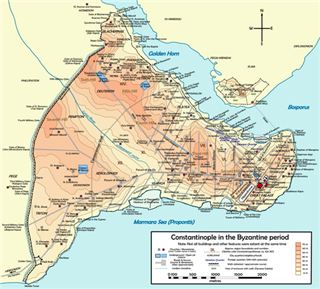
The economy rested on farming and stockbreeding in the plains of Moesia and Thrace, with horses and cattle important to the Bulgar elite and grain to the Slav peasantry. Trade with Byzantium was regulated by treaties, notably one concluded in 716 that fixed the frontier and set rules for merchants, and disputes over trade could lead to war, as in 894 when Byzantium moved the Bulgarian market from Constantinople to Thessalonica. The early Bulgars worshipped the sky god Tangra, while the Slavs kept their own pagan cults, until Boris I accepted baptism from Byzantium in 864 and imposed Christianity on his people. Monasteries and churches spread across the land; the Great Basilica at Pliska was among the largest churches in southeastern Europe, and Preslav, the capital from 893, became known for its Round Church and painted ceramic tiles. In the 10th century, under Tsar Peter I, the priest Bogomil founded a dualist religious movement, the Bogomils, which rejected the church hierarchy and the material world and later spread to Byzantium and western Europe. Cosmas the Priest wrote a treatise against them that also describes the social conditions of the time. Society was divided between a powerful landed aristocracy, the free peasantry and dependent labourers.
Military

The early Bulgarian army combined Bulgar heavy cavalry with Slav infantry and depended on fortified camps and long earthwork ramparts, including the great earthwork around Pliska and the Erkesiya rampart facing Byzantine Thrace. Tervel helped the deposed emperor Justinian II regain his throne in 705 and in 717–718 sent forces that assisted Byzantium against the Arab siege of Constantinople. In the 8th century the emperor Constantine V waged repeated campaigns and won the Battle of Anchialus in 763, but Kardam defeated Constantine VI at Markellai in 792. Krum (c. 803–814) captured Serdica in 809. When the emperor Nikephoros I sacked Pliska in 811, Krum trapped and destroyed his army in a mountain pass; the emperor was killed. Krum won again at Versinikia in 813 and threatened Constantinople. Simeon I (893–927) fought Byzantium and its Magyar allies, calling in the Pechenegs, who drove the Magyars west, and won at Bulgarophygon in 896. His greatest victory came at the Battle of Achelous in 917, where a large Byzantine army was destroyed. Simeon conquered Serbia in 924 but was defeated by the Croats in 926. Under Samuel the western Bulgarians defeated Basil II at the Gates of Trajan in 986, but were crushed at Kleidion in 1014.
Governance & Law
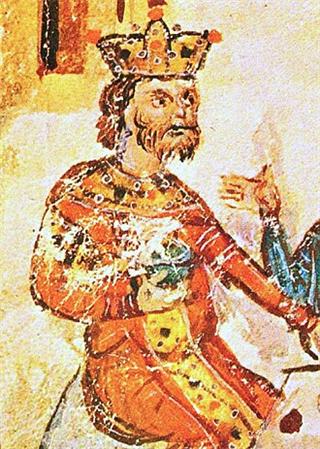
The early rulers bore the title kanasubigi, recorded in Greek-language inscriptions, and governed with a council of Bulgar nobles, the boils and bagains, and high officials such as the kavkhan and the ichirgu-boil. Inscriptions carved on stone columns at Pliska and on the cliff at Madara record treaties, buildings and military events, and the Madara Rider relief, probably of the early 8th century, is the best-known monument of the pagan period. Krum is said by a later Byzantine lexicon to have issued harsh laws against theft and drunkenness. Omurtag (814–831) made a thirty-year peace with Byzantium and built palaces and fortifications. Boris I's conversion was a political act: he crushed a revolt of pagan nobles in 866, negotiated with both Rome and Constantinople, and in 870 obtained an autonomous archbishopric under Constantinople. He reorganised the realm into provinces governed by royal appointees. Simeon I, educated in Constantinople, claimed the imperial title and was crowned by the Patriarch Nicholas Mystikos in 913 in a ceremony whose meaning was later disputed. In 927 Byzantium recognised his son Peter I as tsar, married him to Maria Lekapene, granddaughter of Romanos I, and accepted the Bulgarian church as a patriarchate.
Global & Regional Impact

The First Bulgarian Empire's greatest legacy is Slavonic Christian literacy. When disciples of Cyril and Methodius, among them Clement and Naum, were expelled from Moravia in 885–886, Boris I received them and gave them the means to teach. Clement worked at Ohrid in the southwest, while at Preslav scholars developed the Cyrillic alphabet, based on Greek letters, alongside the older Glagolitic script created by Cyril. Simeon I's reign brought a golden age of Slavonic letters: John the Exarch, Constantine of Preslav and Chernorizets Hrabar, author of the treatise On the Letters, translated and composed theological, historical and scientific works. These texts and the Cyrillic script passed to Serbia and to Kievan Rus' after its conversion in 988, and Old Church Slavonic became the liturgical and literary language of much of the Orthodox Slavic world; Cyrillic is today used for Bulgarian, Serbian, Russian, Ukrainian and many other languages. Bulgaria also served as a model of a Christian Slavic monarchy modelled on Byzantium, with its own patriarch and tsar. The Bogomil movement influenced dualist heresies as far west as the Cathars of southern France. The memory of the empire inspired the founders of the Second Bulgarian Empire in 1185 and modern Bulgarian national identity.
Decline & Fall
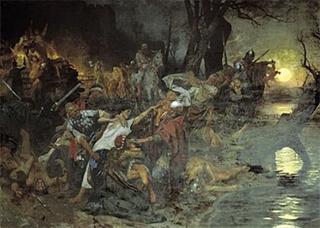
The peaceful reign of Peter I (927–969) was followed by disaster. Byzantium encouraged Prince Sviatoslav of Kiev to attack Bulgaria in 968, and he took much of the country, including Preslav, and planned to settle on the Danube. The emperor John I Tzimiskes then intervened, captured Preslav in 971 and besieged Sviatoslav at Dorostolon until he withdrew. Tsar Boris II was taken to Constantinople and stripped of his insignia, and eastern Bulgaria was annexed. In the west, the four sons of the noble Nicholas, known as the Cometopuli, rose in 976. The youngest, Samuel, emerged as ruler, defeated Basil II at the Gates of Trajan in 986 and, ruling from Prespa and Ohrid, extended his power to Dyrrhachium, Thessaly and Duklja, taking the title of tsar around 997. From 1001 Basil II waged a long war of attrition, taking fortress after fortress. At the Battle of Kleidion in July 1014 he destroyed Samuel's army; a later Byzantine chronicler claims he blinded about 15,000 prisoners, a number historians treat with caution. Samuel died that autumn. His successors Gavril Radomir and Ivan Vladislav could not stop Basil, and after Ivan Vladislav's death at Dyrrhachium in 1018 the Bulgarian nobility surrendered, and Bulgaria became a Byzantine province until 1185.
The First Bulgarian Empire was the first lasting independent state established on former imperial land in the Balkans, a rival of Byzantium for three centuries, and the cradle of Slavonic Christian literature and the Cyrillic alphabet, which through its schools at Preslav and Ohrid spread across the Orthodox Slavic world.
References
- Fine, J.V.A. (1983) The Early Medieval Balkans: A Critical Survey from the Sixth to the Late Twelfth Century. Ann Arbor: University of Michigan Press.
- Browning, R. (1975) Byzantium and Bulgaria: A Comparative Study across the Early Medieval Frontier. London: Temple Smith.
- Obolensky, D. (1971) The Byzantine Commonwealth: Eastern Europe, 500–1453. London: Weidenfeld & Nicolson.
- Stephenson, P. (2000) Byzantium's Balkan Frontier: A Political Study of the Northern Balkans, 900–1204. Cambridge: Cambridge University Press.
- Curta, F. (2006) Southeastern Europe in the Middle Ages, 500–1250. Cambridge: Cambridge University Press.
- Runciman, S. (1930) A History of the First Bulgarian Empire. London: G. Bell & Sons.
Connections
Open the full connections map →