South & Southeast Asia
Pala Empire
At a glance
- A Buddhist dynasty that ruled Bengal and Bihar for about four centuries, from around 750 to around 1161.
- Its kings founded Vikramashila and Somapura and supported Nalanda, the great monastic universities of eastern India.
- Pala scholars and art shaped the Buddhism of Tibet, Nepal and Southeast Asia; Atisha left Vikramashila for Tibet.
Rise & Fall
- c. 750Gopala is chosen king of Bengal to end a period of anarchy
- c. 800Dharmapala installs Chakrayudha as king of Kannauj
- c. 840Devapala’s Nalanda grant at the request of the Shailendra king Balaputradeva
- c. 988Mahipala I begins the revival of the Pala kingdom
- c. 1023The Chola king Rajendra I sends an expedition to the Ganges
- c. 1040Atisha leaves Vikramashila for Tibet
- c. 1085Ramapala defeats the Kaivarta rebels and recovers Varendra
- c. 1161Death of Madanapala, the last significant Pala king
Foundation
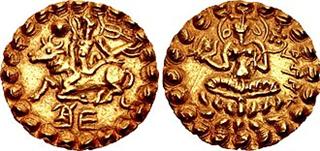
The Pala Empire arose in Bengal in the middle of the eighth century after a long period of disorder that followed the death of Shashanka, king of Gauda, in the early seventh century and the collapse of later regional powers. The Khalimpur copper plate of Dharmapala describes this period as matsyanyaya, ‘the law of the fish’, in which the big devoured the small, and records that the people, the prakriti, chose Gopala as king to end it. Whether this was a genuine election by local chiefs or a later legitimising story is uncertain, but Gopala, a Buddhist of modest origins, established a kingdom in Bengal around 750. His son Dharmapala (r. c. 770–810) turned it into an empire. He extended Pala rule over Bihar, pushed into the Ganges valley and, after setbacks against the Gurjara-Pratihara king Vatsaraja and the Rashtrakuta Dhruva, installed his own candidate, Chakrayudha, on the throne of Kannauj. According to the Khalimpur plate, the kings of the Bhojas, Matsyas, Madras, Kurus, Yadus, Yavanas, Avanti, Gandhara and Kira attended the ceremony and approved it, a claim that at least shows the scale of Dharmapala’s ambitions. His son Devapala (r. c. 810–850) consolidated these gains and made the Pala kingdom the strongest power in eastern India.
Socioeconomy

The Pala lands of Bengal and Bihar were among the most fertile in South Asia, producing rice, sugar cane, cotton and other crops in the deltas of the Ganges and the Brahmaputra, and copper-plate grants record the gift of villages to Brahmins and Buddhist monasteries, with careful descriptions of fields, ponds and boundaries. The economy was largely agrarian, and Pala coinage is scarce, though cowrie shells served as small currency in Bengal. An Arab merchant writing in 851 described a king called Rahma, usually identified with the Palas, as possessing vast numbers of elephants and a land producing cotton cloth so fine that a garment could pass through a ring. The dynasty was Buddhist, its kings styling themselves paramasaugata, devoted followers of the Buddha, and it supported Mahayana and Vajrayana Buddhism on a scale unmatched in India after the Guptas. Dharmapala founded the monastic university of Vikramashila and the great monastery of Somapura at Paharpur, in present-day Bangladesh, and Devapala made grants to Nalanda, including five villages granted at the request of Balaputradeva, the Shailendra king of Suvarnadvipa (Sumatra), for a monastery he had built there. The Palas also endowed Brahmins and Hindu temples, and their ministers came from Brahmin families. The Charyapada, Buddhist mystical songs usually dated between the eighth and twelfth centuries, are among the earliest works in an ancestor of Bengali.
Military

Pala armies relied on war elephants, for which Bengal and the eastern forests were famous, together with infantry, cavalry obtained largely from the north and west, and river fleets suited to the waterways of the delta; inscriptions mention boats as well as elephant and horse forces in the royal camps. For much of the late eighth and ninth centuries the Palas fought the tripartite struggle for Kannauj with the Gurjara-Pratihara dynasty and the Rashtrakuta dynasty. Dharmapala was defeated by Vatsaraja and then by the Rashtrakuta Dhruva around 786, yet managed to place Chakrayudha on the throne of Kannauj after both rivals withdrew; around 800 the Rashtrakuta Govinda III marched north and received the submission of both Dharmapala and Chakrayudha, and Nagabhata II defeated Dharmapala near Monghyr and took Kannauj. Devapala’s inscriptions claim victories over the Utkalas of Orissa, the Hunas, the Dravidas and the rulers of Pragjyotisha in Assam, claims that are exaggerated but suggest real campaigns to the south and east. From the late ninth century the Pratiharas under Mihira Bhoja and Mahendrapala I pushed the Palas back and occupied Magadha for a time. In the eleventh century the Chola king Rajendra I sent an expedition to the Ganges around 1021–1023 that claims to have defeated Mahipala I, and later the Kalachuris and the Chalukyas of Kalyani raided Pala territory.
Governance & Law
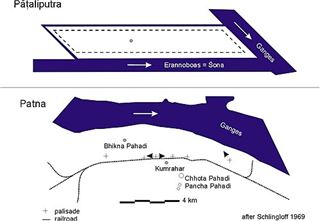
The Pala kings ruled as hereditary monarchs with the imperial titles Parameshvara, Paramabhattaraka and Maharajadhiraja, and they moved between victory camps, jayaskandhavara, at Pataliputra, Mudgagiri (Monghyr) and later Ramavati, founded by Ramapala, rather than holding a single fixed capital. Their copper-plate grants list a long hierarchy of officials, from ministers and generals to revenue officers, police and keepers of forts, ferries and elephants, and they divided the kingdom into provinces called bhukti, and further into mandala and vishaya. Despite their own Buddhism, the Palas relied on Brahmin ministers: the Badal pillar inscription records a family that served successive kings as chief ministers, including Darbhapani and Kedaramishra. Royal power beyond the core lands depended on feudatories, the samantas, who held territory in return for tribute and military service, and the reliance on them grew over time. This became decisive under Ramapala, who recovered northern Bengal from the Kaivarta rebels only with the support of a coalition of samantas whose names are recorded in the Ramacharita of Sandhyakara Nandi. The longevity of the dynasty, which ruled for about four centuries through roughly eighteen kings, owed much to this flexible structure and to the agricultural wealth of its heartland, but it also meant that local lords could break away when the centre was weak.
Global & Regional Impact
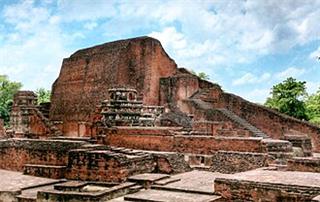
The Palas were the last great royal patrons of Buddhism in India, and their influence on the Buddhist world was immense. Nalanda, Vikramashila, Somapura and Odantapuri attracted monks and students from Tibet, China and Southeast Asia, and Tibetan tradition holds that the monastery of Samye, Tibet’s first, was modelled on Odantapuri. Scholars trained in Pala monasteries carried Indian Buddhist texts and practices abroad, and the most celebrated of them, Atisha Dipankara Shrijnana, left Vikramashila around 1040 and spent his last years in Tibet, where his teaching helped shape the later spread of Buddhism and the Kadam school. Pala art was equally influential. The bronze and black-stone sculpture of eastern India, which the Tibetan historian Taranatha associated with the artists Dhiman and his son Bitpalo, and the illustrated palm-leaf manuscripts of Buddhist texts such as the Prajnaparamita, provided models for the art of Nepal, Tibet, Myanmar and Java. The Shailendra connection seen in Devapala’s Nalanda grant illustrates these links. Within India the Palas made Bengal a major political power for the first time since Shashanka, and the scripts used in their inscriptions developed into the eastern scripts from which Bengali and Assamese writing descend. The ruins of Somapura Mahavihara at Paharpur became a UNESCO World Heritage Site in 1985, and the remains of Nalanda followed in 2016.
Decline & Fall
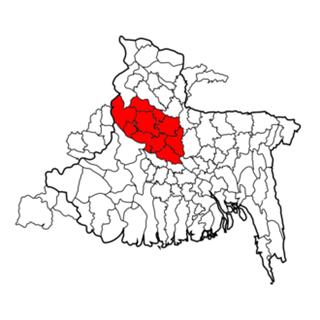
After Devapala, Pala power declined under Narayanapala and his successors. The Pratiharas occupied Magadha, the Rashtrakutas raided from the south and in the tenth century a Kamboja dynasty seized northern and western Bengal, leaving the Palas with only part of their territory. Mahipala I, who reigned from about 988 to about 1038, revived the empire by recovering Bengal, and his long reign saw building and renewed patronage at Bodh Gaya and Nalanda, but the Chola raid of 1021–1023 and pressure from the Kalachuris showed its vulnerability. In the second half of the eleventh century the Kaivartas, a community of boatmen and cultivators in northern Bengal, rose under their leader Divya, killing King Mahipala II and holding Varendra for a generation. Ramapala (r. c. 1077–1130) suppressed them with the help of his samantas and restored the kingdom, extending its influence to Kamarupa and Orissa, but the dependence on feudatories outlasted him. Among them were the Senas, of southern Indian origin, whose king Vijayasena made himself master of Bengal in the mid-twelfth century. The last Pala kings, among them Madanapala, held only parts of Bihar, and Madanapala’s death around 1161 marks the end of the dynasty. Within a few decades the Turkish campaigns of Bakhtiyar Khalji destroyed the great monasteries of Bihar, including Nalanda and Vikramashila.
The Pala Empire made Bengal and Bihar a great power for four centuries and was the last major royal patron of Buddhism in India, sustaining Nalanda, Vikramashila and Somapura, whose scholars and art carried Indian Buddhism to Tibet, Nepal and Southeast Asia.
References
- Majumdar, R.C. (ed.) (1943) The History of Bengal, Vol. 1: Hindu Period. Dacca: University of Dacca.
- Chowdhury, A.M. (1967) Dynastic History of Bengal (c. 750–1200 A.D.). Dacca: Asiatic Society of Pakistan.
- Huntington, S.L. (1984) The ‘Pāla-Sena’ Schools of Sculpture. Leiden: Brill.
- Singh, U. (2008) A History of Ancient and Early Medieval India: From the Stone Age to the 12th Century. New Delhi: Pearson Longman.
- Thapar, R. (2002) Early India: From the Origins to AD 1300. London: Allen Lane.
Connections
Open the full connections map →