Research Series · Essay 04 · · 14 min read
Cross-Cultural Exchange
How Empires Spread — and Were Changed by — Ideas and Culture
Empires as Meeting Places
Empires are usually remembered for what they imposed: their laws, their languages, their gods, their taxes. Yet the most lasting consequences of empire have often been unintended. By bringing distant peoples under a single authority, securing roads and seas, and drawing merchants, soldiers, scholars, and captives into the same cities, empires created the conditions in which ideas, techniques, crops, and beliefs could travel farther and faster than ever before. And what travelled did not move in one direction only.
The historian Philip Curtin, in Cross-Cultural Trade in World History (1984), described how long-distance commerce depended on “trade diasporas”: communities of merchants settled in foreign cities, who learned the languages and customs of their hosts and served as brokers between cultures. Jerry Bentley's Old World Encounters (1993) traced how religions and cultural traditions crossed the boundaries between civilisations before 1500, through voluntary conversion, through political and economic pressure, and through the slow work of assimilation. Both emphasised that exchange is rarely the simple transfer of a finished culture from a strong society to a weak one. It is a process of selection, translation, and adaptation, in which those who receive decide what to take and remake it in their own image, and in which those who give are changed as well.
This essay follows that two-way traffic through four episodes: the meeting of the Greek and Asian worlds after Alexander, the journeys of Buddhism and other faiths along the routes of Asia and Africa, the translation of Greek learning into Arabic under the Abbasids, and the exchange of crops, animals, people, and diseases between the hemispheres after 1492. It ends with what the Institute's register of political relations can, and cannot, show about the reach of empire across the regions of the world.
Hellenism from the Nile to the Indus
When Alexander of Macedon died at Babylon in 323 BCE, he left no stable empire, but he had carried Greek soldiers, settlers, and administrators from Egypt to the borders of India. The kingdoms his generals carved out of his conquests, the Ptolemies in Egypt, the Seleucids in Syria, Mesopotamia, and Iran, and later the Greek kings of Bactria and of north-western India, ruled for generations as Greek-speaking dynasties over peoples who were not Greek. The result was the Hellenistic world: a vast zone in which a common form of Greek, the koine, became the language of government, commerce, and learning.
Greek forms travelled astonishingly far. At Ai Khanoum, on the Oxus in what is now northern Afghanistan, excavators found a Greek city with a gymnasium and a theatre, and an inscription recording that a man named Clearchus had copied maxims from the shrine of Apollo at Delphi and set them up there, some four thousand kilometres from their source. In Alexandria the Ptolemies founded the Museum and its great Library, gathering texts from across the Mediterranean world. There, according to tradition, scholars translated the Hebrew scriptures into Greek, producing the Septuagint, the version in which those scriptures later reached the Greek-speaking world and the early Christian church.
Yet the Hellenistic kings did not simply impose Greek culture on their subjects. The Ptolemies ruled Egypt as pharaohs, built temples in the traditional Egyptian style, and honoured the Egyptian priesthood; the Rosetta Stone records a decree of 196 BCE in honour of Ptolemy V in Egyptian hieroglyphs, in demotic Egyptian, and in Greek. The Seleucid king Antiochus I restored the temple of the god Nabu at Borsippa and commemorated the work in Akkadian cuneiform, in the manner of the Babylonian kings before him. A Babylonian priest, Berossus, wrote a history of Babylon in Greek and dedicated it to the same king. Culture flowed into the Greek world as well as out of it.
The meeting went deepest in the east. The Indo-Greek king Menander, who ruled in the second century BCE, is remembered in a Buddhist text, the Questions of King Milinda, as a ruler who debated with the monk Nagasena and ended as his disciple. Around 113 BCE a Greek envoy named Heliodorus, sent by another Indo-Greek king to the court of Vidisha in central India, set up a column in honour of the god Vasudeva and described himself on it as a devotee: the Heliodorus pillar still stands. In Gandhara, in the borderlands of present-day Pakistan and Afghanistan, sculptors working in the first centuries CE under the Kushan Empire produced some of the earliest images of the Buddha in human form, robed in folds of drapery that recall Greek and Roman statuary. Gandharan art shaped the Buddhist images that travelled north and east into Central Asia and China. A Greek visual language, carried to Asia by conquest, became one of the vehicles of an Indian religion.
Rome itself was the most famous case of a conqueror conquered by the culture of the conquered. “Captive Greece took captive her savage conqueror,” wrote the poet Horace, “and brought the arts into rustic Latium.” Roman education, philosophy, literature, art, and architecture were Greek in their foundations, and in the eastern half of the Roman Empire Greek remained the language of culture, and in time of government, for a thousand years more.
Faiths on the Road
If the Hellenistic world shows exchange under conquest, the history of Buddhism in China shows exchange without it. No Indian army ever ruled China. Yet from the first centuries CE Buddhist monks, merchants, and translators travelled the routes through Central Asia that later generations would call the Silk Roads, and by the sixth century Buddhism had become one of the great religions of China.
The transmission depended on translation, and translation demanded choices. Early translators borrowed Daoist terms to render Buddhist ideas, so that Indian concepts entered Chinese in the vocabulary of a native tradition. The great translator Kumarajiva, a monk from Kucha in the Tarim Basin, was brought to Chang'an in 401 and there led a translation bureau whose versions of the scriptures remained standard for centuries. In the seventh century the Chinese monk Xuanzang travelled overland to India, studied at the monastery of Nalanda, and returned in 645 with hundreds of Buddhist texts, which he spent the rest of his life translating. Over the centuries Chinese Buddhism developed schools of its own, among them Chan, better known by its Japanese name, Zen, which travelled onward to Korea, Japan, and Vietnam.
Valerie Hansen's The Silk Road: A New History (2012), drawing on documents preserved in the desert sites of Central Asia, argues that the overland trade was smaller and more local than the romantic image of endless caravans suggests. What travelled most consequentially along these routes, in her account, was not bulk merchandise but people, refugees, envoys, monks, and artisans, and the religions, techniques, and artistic styles they carried with them.
Other faiths moved in the same way, often with merchants. Manichaeism, founded by the prophet Mani in Sasanian Iran in the third century, spread east along the trade routes, and in the 760s the Uyghur ruler Bögü Qaghan adopted it, making it for a time the faith of a steppe empire. Islam spread far beyond the lands conquered by the early caliphs, carried by traders across the Sahara and the Indian Ocean. In West Africa the rulers of Mali embraced it. When Mansa Musa made the pilgrimage to Mecca in 1324, he spent and gave away so much gold in Cairo that, according to the Egyptian official al-Umari, its value there was still depressed some twelve years later. In Southeast Asia Islam advanced through the port cities of the Malay world, where merchant communities and local rulers adopted it from the late thirteenth century onwards; the sultans of Samudera Pasai in Sumatra were among the first. In none of these places did the new faith arrive by imperial conquest. In all of them it was reshaped by the societies that received it.
The Translation Movement
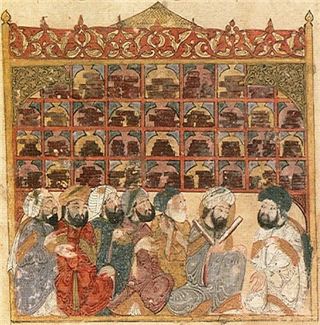
The Abbasid Caliphate, discussed in the previous essay as a case of slow decline, was in its first two centuries the centre of one of history's most remarkable episodes of cultural transfer. Between the middle of the eighth century and the end of the tenth, almost all the secular Greek works of science and philosophy available in the Near East, Aristotle, Galen, Euclid, Ptolemy, and many more, were translated into Arabic.
Dimitri Gutas, in Greek Thought, Arabic Culture (1998), argues that this translation movement was neither an accident nor the work of a single institution. The famous House of Wisdom in Baghdad, often imagined as an academy of translators, was probably a palace library of the kind the Sasanian kings had kept before it. The movement was sustained instead by a whole society: caliphs who sought legitimacy and practical knowledge, officials and physicians who needed astronomy, mathematics, and medicine, and patrons who paid handsomely for translations. Many of the translators were Christians, working from Greek and from Syriac, the language of the Christian scholarship of the Near East; the most celebrated of them, Hunayn ibn Ishaq, rendered much of the medical writing of Galen into Arabic.
The movement drew on more than Greece. Persian traditions of government and letters shaped the Abbasid court, whose most powerful family of ministers, the Barmakids, descended from the hereditary heads of a Buddhist monastery at Balkh. From India came astronomy and arithmetic. The mathematician al-Khwarizmi, working in Baghdad in the early ninth century, wrote a treatise explaining the Indian decimal numerals and another on the methods of solving equations, whose title gave Europe the word “algebra”. His own name, rendered into Latin, became “algorithm”.
The exchange did not end in Baghdad. In the twelfth century scholars in Spain and Sicily translated Arabic works into Latin; Gerard of Cremona, working in Toledo, alone rendered dozens of texts, among them Ptolemy's Almagest. The commentaries of the Andalusian philosopher Ibn Rushd, known in Latin as Averroes, shaped the reading of Aristotle in the universities of medieval Europe, and the Canon of Medicine of Ibn Sina, or Avicenna, was taught in European medical schools for centuries. The Indian numerals that al-Khwarizmi had explained reached Europe as “Arabic numerals”, commended to merchants by Leonardo of Pisa in his Liber Abaci of 1202. Greek learning, Indian mathematics, and Persian statecraft entered the Latin West in Arabic dress, enriched by centuries of Islamic scholarship.
The Columbian Exchange
The largest exchange of all began in 1492. In The Columbian Exchange (1972), Alfred Crosby gave a name to the biological consequences of Columbus's voyages: the movement of plants, animals, and microbes between hemispheres that had been separated for thousands of years.
From the Americas came maize, potatoes, cassava, tomatoes, chilli peppers, cacao, and tobacco. Their effect on the rest of the world was profound. Potatoes became a staple of northern Europe; maize and cassava spread across Africa; sweet potatoes and maize allowed farmers in China to cultivate hillsides unsuited to rice, contributing to the growth of China's population in the eighteenth century. Chilli peppers, unknown outside the Americas before 1492, became essential to the cooking of India, Thailand, Korea, and Sichuan.
From the Old World came wheat, rice, sugar cane, horses, cattle, pigs, and sheep, and diseases against which the peoples of the Americas had no acquired immunity. Smallpox, measles, influenza, and others swept through populations that had never met them. Estimates of the scale of the catastrophe vary widely, but most place the decline of the indigenous population of the Americas within a century of contact at well over half, and in many regions at nine in ten or more. Few demographic disasters in recorded history compare with it.
The exchange also moved people, and its largest movement was coerced. Between the sixteenth and the nineteenth centuries some 12.5 million Africans were forced aboard ships bound for the Americas in the Atlantic slave trade, of whom about 10.7 million survived the crossing. They carried their languages, music, foodways, and religions with them: the orisha traditions of the Yoruba, among others, live on in the Candomblé of Brazil and the Santería of Cuba. The cultures of the Atlantic world were shaped profoundly by the enslaved, as well as by those who enslaved them.
Silver completed the circuit. From the 1540s the mines of Potosí, in the Andes, and of Zacatecas, in Mexico, produced silver in quantities the world had never known. Much of it crossed the Atlantic to Spain and passed onward to pay for European wars and Asian goods; much crossed the Pacific on the Manila galleons, which sailed between Acapulco and Manila from 1565. In China, where the Ming government was converting tax obligations into payments in silver under the Single Whip reform, the metal found its greatest market. American silver, Chinese silk and porcelain, Indian textiles, and African captives were bound into a single and deeply unequal web of exchange, the first to span the whole globe.
The Conqueror Conquered
In each of these episodes the exchange flowed in both directions, and it often transformed the conquerors as much as the conquered.
The pattern is clearest among the steppe empires. The Mongols conquered China and Iran, and within two generations they were transformed by both. Kublai Khan proclaimed the Yuan dynasty in 1271 under a Chinese dynastic name and ruled from a new capital, Khanbaliq, on the site of present-day Beijing; his successors restored the Confucian civil service examinations in 1315. In Iran the Ilkhan Ghazan became a Muslim in 1295, and his minister Rashid al-Din compiled the Compendium of Chronicles, an attempt at a history of the whole known world that drew on Chinese, Persian, Arabic, Turkic, Indian, and European sources and informants. The Mongol courts became clearing houses of knowledge: the Persian astronomer Jamal al-Din took his instruments to Kublai's court, while Chinese physicians and administrators served the Ilkhans in Iran.
Other conquerors followed the same path. The Manchu rulers of the Qing dynasty, who conquered China in the seventeenth century, governed through Chinese institutions and sponsored Chinese scholarship on a vast scale, from the great dictionaries to the Complete Library of the Four Treasuries, while preserving their own language and military organisation. The Mughal emperors, descended from Timur and Chinggis Khan, created at the court of Akbar a culture that blended Persian, Central Asian, and Indian traditions; Akbar had the Sanskrit Mahabharata translated into Persian as the Razmnama, the Book of War. In each case the conquerors brought military power, and the conquered supplied much of the means of governing.
Janet Abu-Lughod, in Before European Hegemony (1989), described the world of the thirteenth and fourteenth centuries as a “world system” of eight interlocking circuits of trade, reaching from Flanders to China, in which no single region dominated. Europe, in her account, was a latecomer and a borrower: paper, the compass, and gunpowder all reached it from the east. Peter Frankopan's The Silk Roads (2015) has since retold world history from the lands between Europe and China, the crossroads through which so much of this traffic passed. The point both make is that the cultures we now think of as separate civilisations were formed in large part by what they took from one another.
The Lesson for Institutions
The lesson of these episodes is that openness to exchange has more often been a source of strength than of weakness. The empires and societies that gained most from contact were those with the institutions to absorb what arrived: translators and libraries, schools and patrons, markets that welcomed foreign merchants, and rulers willing to adopt techniques and ideas from the peoples they ruled or met. The Abbasid translation movement was sustained across generations by patronage and paid for by the state and its elites. The Mongols, for all their destructiveness, governed through Persian, Chinese, and Uyghur administrators and moved artisans and scholars across a continent.
Exchange was also, very often, coercive and unequal. The Columbian Exchange brought new foods to the world and catastrophe to the Americas; the Atlantic world was built on forced migration. To speak of exchange is not to suggest that it was fair. It is to recognise that even under the harshest conditions influence did not flow in one direction only, and that the cultures of conquerors and conquered alike were permanently changed by their meeting.
For the student of institutions, the deeper point concerns resilience. A society that can learn from others possesses a resource that no army can provide: the capacity to adapt. The imperial orders that lasted longest and left the deepest mark were those that could make foreign knowledge their own: Rome, which absorbed Greece; the Islamic world, which absorbed Persia and Greece; and the Chinese imperial state, whose institutions served conqueror after conqueror.
What the Data Shows
The Institute's register records the political relations among more than five thousand states: who ruled whom, who succeeded whom, and who paid tribute to whom. It does not record trade, scholarship, or the movement of religions, which leave fewer traces in the formal structures of power. But it does show where political relationships crossed the great regional boundaries of the world, and where they did not.
Of the 11,296 relations in the register, 1,631, about 14 per cent, connect states in different broad regions. The rest bind neighbours: a province to its empire, a successor to its predecessor, a vassal to its lord within the same part of the world.
The kind of relation matters greatly. Succession almost never crosses regions: only 5 per cent of successions, 3 per cent of personal unions, and 2 per cent of mergers do. Ties of rule travel further. Eighteen per cent of vassal relations, 19 per cent of conquests, 26 per cent of provinces, and 32 per cent of tributary relations link different regions. But one kind of relation stands apart. Of the 378 colonies in the register, 319, or 84 per cent, were held by a state in another region of the world.
The register thus traces two different kinds of empire. The first, older and far more common, ruled its neighbours, and its relations rarely crossed the boundaries of a region. The second, the oceanic empire of the early modern and modern ages, ruled across seas and continents. It is no accident that every one of the busiest pairs of regions in the register includes Europe: Europe with the Middle East (259 relations), with the Americas (257), with sub-Saharan Africa (168), with Egypt and North Africa (155), with the Ancient Near East (139), and with Central and East Asia (112).
Two cautions apply. The register's coverage is uneven, and the states of some regions, Europe among them, are recorded in greater detail than others. And political relations are only one channel of exchange. The journeys of Buddhism to China and of Islam to West Africa and Southeast Asia hardly appear in the register at all, because they did not follow the lines of political rule. Many of the most consequential exchanges in history ran along routes that no empire controlled.
Further Reading
- Abu-Lughod, Janet L. Before European Hegemony: The World System A.D. 1250–1350. New York: Oxford University Press, 1989.
- Allsen, Thomas T. Culture and Conquest in Mongol Eurasia. Cambridge: Cambridge University Press, 2001.
- Bentley, Jerry H. Old World Encounters: Cross-Cultural Contacts and Exchanges in Pre-Modern Times. New York: Oxford University Press, 1993.
- Crosby, Alfred W. The Columbian Exchange: Biological and Cultural Consequences of 1492. Westport, CT: Greenwood, 1972.
- Curtin, Philip D. Cross-Cultural Trade in World History. Cambridge: Cambridge University Press, 1984.
- Eltis, David, and David Richardson. Atlas of the Transatlantic Slave Trade. New Haven: Yale University Press, 2010.
- Frankopan, Peter. The Silk Roads: A New History of the World. London: Bloomsbury, 2015.
- Gutas, Dimitri. Greek Thought, Arabic Culture: The Graeco-Arabic Translation Movement in Baghdad and Early ʿAbbāsid Society. London: Routledge, 1998.
- Hansen, Valerie. The Silk Road: A New History. New York: Oxford University Press, 2012.
- Mann, Charles C. 1493: Uncovering the New World Columbus Created. New York: Knopf, 2011.
Profiles in this essay








Cite this essay
- APA
- The Epoch Institute. (2026). Cross-Cultural Exchange. In Research Series. https://the-epoch-institute.org/essays/cross-cultural-exchange
- MLA
- “Cross-Cultural Exchange.” Research Series, The Epoch Institute, 2026, https://the-epoch-institute.org/essays/cross-cultural-exchange. Accessed .
- Chicago
- The Epoch Institute. “Cross-Cultural Exchange.” Research Series. 2026. https://the-epoch-institute.org/essays/cross-cultural-exchange.
- Harvard
- The Epoch Institute (2026) ‘Cross-Cultural Exchange’, Research Series. Available at: https://the-epoch-institute.org/essays/cross-cultural-exchange (Accessed: ).