Research Series · Essay 05 · · 14 min read
The Military Revolution
Technology, Tactics, and the Shifting Balance of Power
A Revolution in War?
In 1955, in his inaugural lecture at the Queen's University of Belfast, the historian Michael Roberts proposed that Europe had undergone a “military revolution” between 1560 and 1660. New infantry tactics, introduced by the Dutch and perfected by the Swedes, demanded drilled and disciplined soldiers; drilled soldiers had to be kept permanently under arms; permanent armies grew larger; and the cost of raising, paying, and supplying them transformed the states that maintained them. War, in Roberts's account, did not merely change along with the state. It made the modern state.
The idea proved one of the most fertile in the history of early modern Europe, and one of the most disputed. Geoffrey Parker, in The Military Revolution (1988), moved its centre from tactics to fortification and from Europe to the world. The new artillery fortress and the armed sailing ship, he argued, gave Europeans the means to hold their footholds overseas and to dominate the seas, and help to explain how the West came to control more than a third of the world's land by 1800. Jeremy Black, in A Military Revolution? (1991), questioned the dates, arguing that the greatest changes in the size of armies and the power of states came after 1660, not before. Others have asked whether the word “revolution” can fairly describe changes that unfolded over three centuries.
This essay takes a wider view. Military history is full of innovations that shifted the balance of power between states: the war chariot, the mounted archer, the stirrup, gunpowder, the bastion, the broadside. The question is not whether such innovations mattered, but how they mattered, and why the same technology could make one state a world power and leave another unchanged.
The Horse and the Stirrup
For most of recorded history the decisive military technology was the horse. In the second millennium BCE the light two-wheeled chariot spread across the Near East, Egypt, and China, and the great powers of the age fought with chariots in their thousands; the Battle of Kadesh, fought between Egypt and the Hittites around 1274 BCE, may have been the largest chariot battle ever fought. In the first millennium BCE the peoples of the steppe perfected mounted archery, combining the horse with the composite bow. From the Scythians and the Xiongnu to the Huns and the Mongols, mounted archers gave the pastoral peoples of the Eurasian steppe a military advantage that the settled empires on their borders spent two thousand years trying to contain. The Parthians destroyed a Roman army at Carrhae in 53 BCE, and the Han dynasty sent the Xiongnu silk, grain, and princesses under the heqin treaties for some sixty years before Emperor Wu could strike back.
The stirrup, a seemingly modest device, has carried a heavier burden of historical argument than almost any other. Paired stirrups appear in China by the fourth century CE and spread westward across the steppe, reaching the Byzantine world, probably through the Avars, by about 600, when the military manual known as the Strategikon recommends them. In Medieval Technology and Social Change (1962), Lynn White Jr. argued that the stirrup, by bracing the rider in the saddle, made possible the mounted charge with the couched lance, and that the cost of maintaining such heavily armed horsemen produced the feudal order of medieval Europe. Few historical theses have been so thoroughly criticised. Later scholars showed that the timing did not fit, that mounted shock combat developed gradually over centuries, and that the institutions of feudalism had other origins.
The debate over the stirrup is a lesson in itself. A new technology rarely transforms a society on its own; it is adopted, or not, according to the needs, resources, and institutions of those who meet it. The stirrup spread across the whole of Eurasia, but the society of mounted knights it was once thought to have created arose in only one corner of it.
Gunpowder from China
Gunpowder was a Chinese invention. The earliest surviving formulas for it appear in the Wujing Zongyao, a military compendium completed for the Song court in 1044. Song armies used it in incendiary arrows, bombs, and the fire lance, a tube of bamboo or metal that spat flame and shrapnel, and by the late thirteenth century true guns, metal barrels firing projectiles by the force of the explosion, were in use in China. One of the oldest surviving guns, a small bronze hand cannon found in Heilongjiang, is dated by the circumstances of its discovery to around 1288. Within decades guns appeared in the Islamic world and in Europe, where the earliest known picture of a cannon is found in an English manuscript of 1326.
Why, then, did gunpowder weapons develop further and faster in Europe than in China in the centuries that followed? Kenneth Chase, in Firearms: A Global History to 1700 (2003), answered that the early gun was an infantry weapon, slow to load and effective chiefly in sieges and in battles between armies on foot. Where a state's main enemies were other infantry armies and walled cities, as in Europe, firearms were worth developing. Where its chief threat was mounted nomads, as on China's northern frontier, early guns were of little use against an enemy who would not stand still.
Tonio Andrade, in The Gunpowder Age (2016), added that the divergence came later than is often assumed. The Ming were vigorous military innovators through the sixteenth and seventeenth centuries, adopting and improving Portuguese and Dutch cannon and muskets. In 1662 the Ming loyalist Zheng Chenggong, known in the West as Koxinga, forced the Dutch East India Company to surrender its fortress on Taiwan. In Andrade's account the decisive gap opened only in the long peace of the eighteenth-century Qing, when the states of Europe, still at war with one another, kept innovating and China, largely at peace, did not. The gap became visible in the Opium War of 1839 to 1842.
The Gunpowder Empires
In the sixteenth century three great Islamic empires stretched across southern Asia whose armies were built around firearms: the Ottomans, the Safavids, and the Mughals. Marshall Hodgson and William McNeill called them the “gunpowder empires”, and although historians now doubt how far gunpowder alone explains their success, the label captures something real. Each used guns to defeat enemies who relied on cavalry, and each built a state able to pay for artillery and infantry on a large scale.
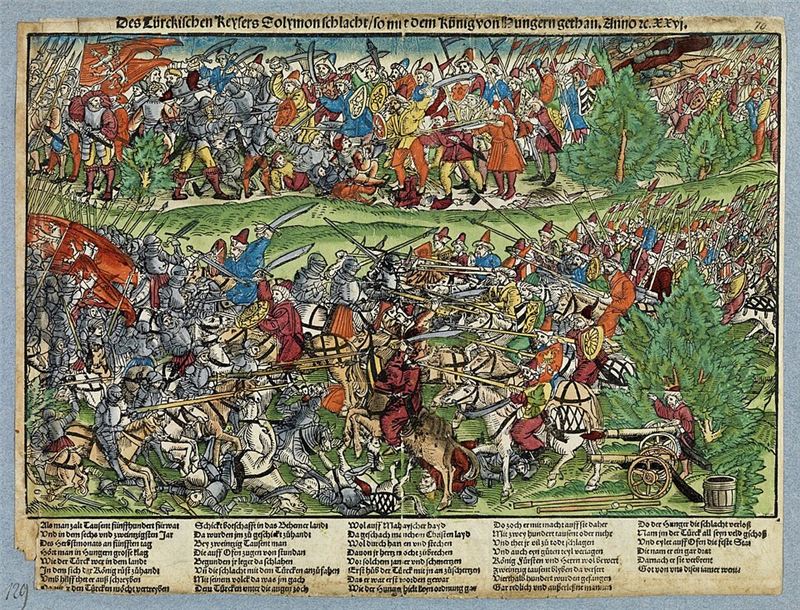
The Ottomans led. Their standing infantry corps, the Janissaries, adopted firearms in the fifteenth century, and Ottoman artillery was among the most powerful in the world. In 1453 Mehmed II battered the land walls of Constantinople, which no army had breached in more than a thousand years, with an artillery train that included enormous bombards cast by the founder Orban, who had first offered his services to the Byzantines; the city fell after a siege of fifty-three days. At Chaldiran in 1514, Ottoman guns and Janissary musketeers defeated the cavalry of the Safavid shah Ismail I. In 1516 and 1517, at Marj Dabiq and Ridaniya, the same weapons broke the Mamluk Sultanate and brought Syria and Egypt under Ottoman rule. And at Mohács in 1526 the army of Suleiman the Magnificent destroyed the army of the kingdom of Hungary, whose king died in the retreat.
The lesson was not lost on the Ottomans' neighbours. In the same year as Mohács, the Timurid prince Babur defeated the far larger army of the Delhi sultan Ibrahim Lodi at Panipat, with matchlocks and field guns behind a line of carts chained together in what he himself called the Ottoman manner. The victory founded the Mughal Empire. In Iran, Shah Abbas I (r. 1588–1629) rebuilt the Safavid army, adding a corps of musketeers and a corps of artillery, together with a new force of slave soldiers drawn largely from Georgian, Armenian, and Circassian converts, to balance the tribal cavalry on which his predecessors had relied.
Firearms changed the balance of power in Africa too. In 1591 a Moroccan army of a few thousand men, many of them armed with arquebuses and led by Judar Pasha, crossed the Sahara and defeated the far larger army of the Songhai Empire at Tondibi. Songhai, the greatest state of West Africa, never recovered. In Japan, where Portuguese traders brought the arquebus to the island of Tanegashima in 1543, local smiths were soon making guns in large numbers. At Nagashino in 1575 the massed arquebusiers of Oda Nobunaga and Tokugawa Ieyasu broke the charges of the Takeda cavalry, and the warlords who mastered firearms went on to unify the country.
Fortress, Drill, and Debt
In Europe the gun first transformed the siege. When Charles VIII of France invaded Italy in 1494, his mobile siege guns brought down in hours walls that had stood for centuries. The answer, worked out by Italian engineers within a generation, was a new kind of fortification: low, thick walls of earth and brick, and angled bastions from which the defenders could sweep every approach with gunfire. The trace italienne, as it came to be called, spread across Europe and beyond, and it changed the arithmetic of war. A town with modern bastions could hold out for months, and to take it required an army large enough to surround it and rich enough to keep its soldiers paid through a long siege.
Infantry changed too. In the 1590s Maurice of Nassau and his cousin William Louis, commanding the forces of the Dutch Republic in its war against Spain, studied the military manuals of classical antiquity and drilled their musketeers to fire by ranks: each rank fired and then withdrew to reload while the next stepped forward, so that a line could keep up a continuous fire. A letter that William Louis wrote to Maurice on 8 December 1594, setting out the method, is one of the founding documents of modern drill. In the Thirty Years War, Gustavus Adolphus of Sweden combined drilled musketeers, light field artillery, and disciplined cavalry into a system that won a great victory at Breitenfeld in 1631 and made a poor and thinly peopled northern kingdom, for a time, one of the great powers of Europe.
Each of these changes demanded money on a scale that no medieval king had commanded. Armies grew: the greatest European states of the late seventeenth century kept hundreds of thousands of men under arms, where their predecessors had fielded tens of thousands. Charles Tilly, in Coercion, Capital, and European States (1990), traced how the pressure of war drove European rulers to build bureaucracies, tax systems, and credit; in a phrase he had coined earlier, war made the state, and the state made war. John Brewer, in The Sinews of Power (1989), showed how Britain after the Glorious Revolution built a “fiscal-military state”, with a professional excise service, the Bank of England founded in 1694, and a national debt guaranteed by Parliament, which allowed a country with a far smaller population than France to borrow, and to fight, on a larger scale. The military revolution was decided in the treasury as much as on the battlefield.
Guns at Sea
The most far-reaching change came at sea. Carlo Cipolla's Guns, Sails and Empires (1965) argued that the union of the ocean-going sailing ship and the heavy gun gave the states of Atlantic Europe a decisive advantage on the oceans of the world. A sailing ship needed no oarsmen, and so could carry more guns, more cargo, and more supplies on longer voyages than the galleys of the Mediterranean; with its cannon mounted along its sides and firing through gunports, it became a floating fortress.
The Portuguese showed the consequences first. Vasco da Gama reached Calicut in 1498. In 1509 a Portuguese fleet destroyed a combined fleet of the Mamluk Sultanate, Gujarat, and their allies off Diu, and within six years Afonso de Albuquerque had seized Goa (1510), Malacca (1511), and Hormuz (1515), the keys to the trade of the Indian Ocean. Portugal was a small kingdom of little more than a million people. It could not have conquered the great land empires of Asia, and it never tried. But with a few dozen fortified ports and a navy that could defeat any fleet it met, it built a seaborne empire that taxed and redirected a large share of the commerce of the Indian Ocean for a century.
Others followed. The Dutch East India Company, founded in 1602, took many of the Portuguese strongholds in Asia in the seventeenth century, and the Dutch Republic, a federation of provinces with fewer than two million people, became for a time the leading commercial power in the world. England, and then Britain, built the navy that made it the dominant power at sea from the eighteenth century into the twentieth.
Not every naval power took the same path. In the early fifteenth century the Ming admiral Zheng He led seven great expeditions across the Indian Ocean, as far as the coast of East Africa, with fleets far larger than any Europe could then have assembled. Then the Ming court ended the voyages, and the fleets were allowed to decay. The capability had existed; the will to sustain it as an instrument of state policy, and the institutions that would have demanded it, did not.
From the Margins to World Power
The most striking feature of the gunpowder age is who gained from it. The great empires of the early modern world, Ming and Qing China, the Ottoman Empire, the Mughal Empire, were vast, populous, and rich, and all of them used gunpowder weapons with skill. Yet the states that rose fastest in the new military world were small, peripheral, and poor in people: Portugal, the Dutch Republic, Sweden, England, and, at the eastern edge of Europe, Russia, whose army Peter the Great rebuilt on western lines and led to victory over the Swedes at Poltava in 1709.
Their advantage did not lie in any secret weapon. Ottoman cannon were the equal of European ones for much of the sixteenth century, and Chinese and Japanese gunsmiths copied and improved European designs within a few years of meeting them. The advantage lay instead in institutions: in the constant pressure of competition among many states of similar strength, which punished any state that fell behind; in fiscal systems that allowed small states to borrow and spend on a scale out of all proportion to their populations; and in the union of state power and private capital in chartered companies that could make war and trade at the same time. William McNeill, in The Pursuit of Power (1982), described the result as the commercialisation of organised violence: the harnessing of the market to the service of military power.
The Lesson for Institutions
The history of military innovation is often told as a story of weapons. The cases suggest instead that the decisive factor was rarely the weapon itself, which spread quickly to anyone who wanted it, but the institutions that could make use of it: the drill that turned peasants into musketeers, the treasury that paid for fortresses and fleets, the credit that sustained long wars, and the political will to adopt new methods even when they threatened established elites.
The same technology could therefore produce opposite results in different hands. Gunpowder was invented in China, but it was the states of Europe, locked in competition with one another, that pushed it furthest. The stirrup spread across Eurasia but produced a knightly order in only one corner of it. The Ottomans were among the first and most successful users of firearms, yet by the eighteenth century their army had fallen behind those of Austria and Russia, held back in part by the Janissaries, who resisted every reform that threatened their privileges. When Sultan Selim III tried to build a new army on European lines in the 1790s, the Janissaries rose against him and he was deposed in 1807; the corps was abolished only in 1826, by Mahmud II.
For any large organisation, the lesson is that innovation is less a matter of invention than of adoption. What counts is not who first possesses a new capability, but who builds the systems of training, finance, and command that allow it to be used at scale, and who is willing to change itself in order to do so.
What the Data Shows
The Institute's profiles give each state and empire a military score from one to ten, reflecting its military strength relative to the powers of its own time. Grouping the profiles by the period in which their power peaked shows how those scores have changed across five thousand years.
| Peak of power | Profiles | Mean military score | Scoring 8 or more |
|---|---|---|---|
| Before 1000 BCE | 16 | 4.5 | 2 |
| 1000 BCE – 1 CE | 44 | 4.9 | 6 |
| 1 – 600 | 27 | 4.3 | 1 |
| 600 – 1200 | 55 | 4.8 | 2 |
| 1200 – 1500 | 65 | 4.2 | 3 |
| 1500 – 1700 | 57 | 4.4 | 5 |
| 1700 – 1900 | 66 | 4.2 | 4 |
| Since 1900 | 64 | 3.8 | 8 |
There is no upward trend: the average score stays between 3.8 and 4.9 in every age. Because the scores measure each power against its contemporaries, a flat line is what one would expect if military innovation raised the bar for every state at once. What a revolution in war changes is not the average strength of states but the identity of the strongest.
On that measure the data is revealing. Among the profiles whose power peaked between 1500 and 1700, five score 8 or more for military strength: the Ottoman Empire with 9, and the Spanish Empire, Habsburg Spain, the Mughal Empire, and the Kingdom of France with 8. All were great land powers, and all fielded the large gunpowder armies that the age demanded.
The maritime powers that this essay has followed tell a different story. The Portuguese Empire, the Dutch Republic, and the Dutch overseas empire score no higher than 5 for military strength, yet 9 or 10 for their trade networks; the Republic of Venice, the Hanseatic League, and the Srivijaya Empire of Southeast Asia share the same profile. Their power rested less on the size of their armies than on their command of the sea lanes, and on the institutions, companies, banks, convoys, and fortified ports, that turned naval strength into commercial dominance.
The empire that combined both forms of power most completely was the British Empire, which the Institute's data scores 9 for military strength and 10 for territory, economy, trade networks, and administration. It was in a sense the culmination of the processes this essay has described: a fiscal-military state with a global navy, chartered companies, and a financial system that allowed it to outspend its rivals. Its peak, on the Institute's curve, came in 1815, the year of Waterloo.
Since 1900 the number of powers scoring 8 or more has risen to eight, among them the German Empire, Nazi Germany, the Empire of Japan, the Soviet Union, and the United States: the largest group of first-rank military powers in any period. The industrial age turned the military revolution into a revolution of steel, railways, and oil, and it rewarded the states that could mobilise whole economies for war. The age of gunpowder had rewarded small states that organised well; the age of industrial war rewarded large states that organised well. In both, the decisive factor was organisation.
Further Reading
- Andrade, Tonio. The Gunpowder Age: China, Military Innovation, and the Rise of the West in World History. Princeton: Princeton University Press, 2016.
- Black, Jeremy. A Military Revolution? Military Change and European Society, 1550–1800. Basingstoke: Macmillan, 1991.
- Brewer, John. The Sinews of Power: War, Money and the English State, 1688–1783. London: Unwin Hyman, 1989.
- Chase, Kenneth. Firearms: A Global History to 1700. Cambridge: Cambridge University Press, 2003.
- Cipolla, Carlo M. Guns, Sails and Empires: Technological Innovation and the Early Phases of European Expansion, 1400–1700. New York: Pantheon Books, 1965.
- McNeill, William H. The Age of Gunpowder Empires, 1450–1800. Washington, DC: American Historical Association, 1989.
- McNeill, William H. The Pursuit of Power: Technology, Armed Force, and Society since A.D. 1000. Chicago: University of Chicago Press, 1982.
- Parker, Geoffrey. The Military Revolution: Military Innovation and the Rise of the West, 1500–1800. Cambridge: Cambridge University Press, 1988.
- Roberts, Michael. The Military Revolution, 1560–1660. Belfast: Marjory Boyd, 1956.
- Rogers, Clifford J., ed. The Military Revolution Debate: Readings on the Military Transformation of Early Modern Europe. Boulder: Westview Press, 1995.
- Tilly, Charles. Coercion, Capital, and European States, AD 990–1990. Oxford: Basil Blackwell, 1990.
- White, Lynn, Jr. Medieval Technology and Social Change. Oxford: Clarendon Press, 1962.
Profiles in this essay
 Ottoman Empire1299 CE – 1922 CE
 Safavid Empire1501 CE – 1736 CE
 Mughal Empire1526 CE – 1857 CE
 Songhai Empire1430 CE – 1600 CE
 Tokugawa Shogunate1603 CE – 1868 CE
 Ming Empire1368 CE – 1644 CE
 Portuguese Empire1415 CE – 1975 CE
 Dutch Republic1581 CE – 1795 CE
 Swedish Empire1611 CE – 1721 CE
 British Empire1583 CE – 1997 CE
Cite this essay
- APA
- The Epoch Institute. (2026). The Military Revolution. In Research Series. https://the-epoch-institute.org/essays/the-military-revolution
- MLA
- “The Military Revolution.” Research Series, The Epoch Institute, 2026, https://the-epoch-institute.org/essays/the-military-revolution. Accessed .
- Chicago
- The Epoch Institute. “The Military Revolution.” Research Series. 2026. https://the-epoch-institute.org/essays/the-military-revolution.
- Harvard
- The Epoch Institute (2026) ‘The Military Revolution’, Research Series. Available at: https://the-epoch-institute.org/essays/the-military-revolution (Accessed: ).