Islamic Caliphates & Middle East
Mamluk Sultanate
At a glance
- The Mamluk Sultanate was ruled from Cairo by slave soldiers, renewed by fresh purchases rather than hereditary succession.
- It halted the Mongols at Ain Jalut, ended the Crusader states and grew rich on the spice trade between India and Europe.
- Plague, Portuguese competition at sea and Ottoman guns brought it down, ending with Selim I's conquest of Egypt in 1517.
Rise & Fall
- 1250Mamluks assassinate Turanshah, the last Ayyubid sultan of Egypt, and seize power
- 1260Qutuz and Baybars defeat the Mongols at Ain Jalut; Baybars then takes the throne
- 1291Al-Ashraf Khalil captures Acre, ending the Crusader states
- 1315Al-Nasir Muhammad orders the rawk, a new land survey that reshapes the iqta system
- 1347The Black Death reaches Egypt, beginning repeated catastrophic population losses
- 1382Barquq inaugurates the Burji regime of Circassian mamluks
- 1509The Portuguese defeat a Mamluk fleet at Diu, cutting customs revenue
- 1517Selim I wins at Ridaniya and conquers Egypt, ending Mamluk sovereignty
Foundation

The Mamluk Sultanate was founded in 1250 following the collapse of Ayyubid authority in Egypt. The immediate catalyst was the assassination of Turanshah, the last Ayyubid sultan of Egypt, by the mamluks of his late father, al-Salih Ayyub; these elite slave soldiers, predominantly of Kipchak Turkic origin, had just helped defeat the Seventh Crusade of Louis IX at al-Mansura. Shajar al-Durr, al-Salih's widow, briefly ruled as sultan before opposition from the Abbasid caliph and Syrian Ayyubids led to her marriage to the commander Aybak, who became sultan. The decisive consolidation came in 1260, when Sultan Qutuz and the Bahri Mamluk commander Baybars defeated the Mongols at Ain Jalut; Baybars then seized the throne (r. 1260–1277) and established the sultanate's military credibility by campaigning against both Mongols and Crusader states. The sultanate's rise was facilitated by its control of Egypt, Syria and the Red Sea, which provided both economic and military advantages. Its distinctive foundation lay in institutionalising a slave-soldier system as a self-renewing ruling class, constantly replenished by new purchases rather than by hereditary succession, which allowed rapid consolidation of power and the defence of a durable state in a volatile region.
Socioeconomy

The Mamluk Sultanate developed a complex economic system integrating agriculture, trade and urban administration. Egypt's fertile Nile Valley supported intensive cultivation of cereals, flax and sugar cane, sustained by irrigation works maintained under state supervision. Society was hierarchically organised: a ruling class of mamluk emirs held military and political power, while urban merchants, scholars (ulama) and artisans, along with a largely agrarian peasantry, sustained production and exchange. Control of Red Sea ports and the Levant allowed the sultanate to dominate the transit trade in spices, textiles and precious goods between the Indian Ocean and the Mediterranean, with Karimi merchants playing a leading role and customs duties yielding substantial revenue. Cities such as Cairo, Alexandria and Damascus became cosmopolitan centres of craftsmanship, scholarship and Islamic law. Land revenue was distributed through the iqta system, which assigned officers the revenues of specific lands in return for military service. By the third reign of al-Nasir Muhammad (r. 1310–1341), Cairo was the largest and wealthiest city of the Islamic world, demonstrating how production, urbanisation and trade were integrated under a military elite.
Military

The Mamluk military apparatus was central to the sultanate's survival and expansion. Its core was a disciplined cavalry of slave soldiers purchased as boys, converted to Islam and trained in barracks schools in horsemanship, lance work and mounted archery, the arts known as furusiyya. Infantry, auxiliary troops and Bedouin contingents supported the cavalry, while fleets operated in the Mediterranean and Red Sea. Mamluk officers were integrated into provincial command structures, creating a hybrid politico-military hierarchy, and an extensive network of postal relays and signal beacons allowed rapid communication between Cairo and Syria. Campaigns under Baybars, Qalawun and al-Nasir Muhammad secured Syria and the Hejaz, reduced Makuria in Nubia to vassalage and raided Cilician Armenia, while the victory at Ain Jalut in 1260 and later at Homs and Marj al-Saffar checked Mongol expansion. Military power also brought the defeat of the Crusader states, culminating in al-Ashraf Khalil's capture of Acre in 1291. The army emphasised loyalty to one's master and comrades, but rivalry between the mamluk households of successive sultans bred factionalism that shaped succession and stability throughout the sultanate's history.
Governance & Law
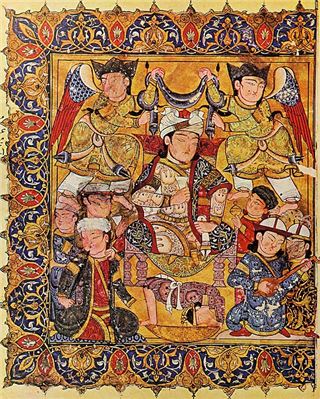
Governance in the Mamluk Sultanate combined autocratic sultanic authority with a sophisticated bureaucracy and the iqta land-grant system. The sultan controlled appointments, military operations and fiscal policy, while provincial governors (na'ibs) and emirs administered Syria and other outlying regions. From 1261 the sultans hosted a line of Abbasid caliphs in Cairo, whose nominal endorsement lent religious legitimacy to rulers of slave origin. The legal system rested on Sunni Islamic law, with chief qadis appointed for each of the four schools, alongside military jurisdiction over mamluk conduct. Civil bureaucracies of scribes and tax officials, often drawn from established civilian and Coptic families, ensured efficient mobilisation of resources. Under al-Nasir Muhammad, institutional consolidation reached its apex with a new cadastral survey (the rawk of 1315), redistribution of iqtas and extensive urban building. After 1382 power passed to the Burji regime of Circassian mamluks under Barquq, but governance remained vulnerable to succession crises, factional rivalry and demographic shocks such as the Black Death, which undermined labour and administrative capacity.
Global & Regional Impact

The Mamluk Sultanate profoundly influenced the Eastern Mediterranean and the Islamic world. By repelling the Mongols and eliminating the Crusader strongholds, it stabilised the region and became guardian of Mecca, Medina and Jerusalem. Control of Egypt, Syria and the Red Sea routes gave it a dominant role in the spice trade between India and Europe until the Portuguese opened the Cape route to India in 1498. Architectural patronage by Qalawun, al-Nasir Muhammad, Sultan Hasan and later Qaitbay made Cairo a showcase of Islamic architecture, while scholars such as Ibn Khaldun, al-Maqrizi and Ibn Hajar made it a centre of learning. The sultanate's military and administrative model influenced neighbouring Islamic states, and its chancery practices set precedents for government in the Eastern Mediterranean. Diplomatically, Mamluk relations with the Golden Horde, the Ilkhanate, the Ottomans and European powers such as Venice and Aragon confirmed its role as a critical player in regional politics. Its longevity and control of trade and holy sites left a lasting imprint on the economic, military and cultural development of the region.
Decline & Fall
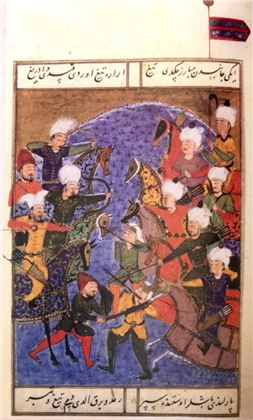
The decline of the Mamluk Sultanate began in the mid-14th century under a combination of internal and external pressures. Recurrent succession crises after the death of al-Nasir Muhammad in 1341 weakened central authority. The Black Death, which reached Egypt in 1347 and returned repeatedly, caused catastrophic population loss, labour shortages and the decay of irrigation systems, undermining agriculture and state revenue. Timur's sack of Damascus in 1400–1401 devastated Syria. Economic disruption deepened in the early 16th century as the Portuguese contested the Indian Ocean trade, defeating a Mamluk fleet at Diu in 1509 and depriving the sultanate of vital customs revenue. Meanwhile, the Ottoman Empire, with its firearms-equipped infantry and artillery, presented an insurmountable military threat. Defeat at the Battle of Marj Dabiq in 1516, where Sultan Qansuh al-Ghawri was killed, and at Ridaniya near Cairo in 1517 led to the Ottoman conquest of Egypt under Selim I, ending Mamluk sovereignty. Mamluk households persisted in Egypt under Ottoman rule, but the sultanate ceased to exist as an independent state.
The Mamluk Sultanate's enduring significance lies in its transformation of a slave-soldier corps into a durable ruling state, one that halted the Mongols at Ain Jalut, ended the Crusader states, and made Cairo the leading city of the Islamic world until the Ottoman conquest of 1517.
References
- Amitai-Preiss, R. (1995) Mongols and Mamluks: The Mamluk-Ilkhanid War, 1260–1281. Cambridge: Cambridge University Press.
- Ayalon, D. (1977) Studies on the Mamluks of Egypt, 1250–1517. London: Variorum Reprints.
- Garcin, J.C. et al. (1998) États, sociétés et cultures du monde musulman médiéval. Paris: Presses Universitaires de France.
- Irwin, R. (1986) The Middle East in the Middle Ages: The Early Mamluk Sultanate, 1250–1382. London: Croom Helm.
- Levanoni, A. (1995) A Turning Point in Mamluk History: The Third Reign of al-Nasir Muhammad Ibn Qalawun, 1310–1341. Leiden: Brill.
- Northrup, L.S. (1998) From Slave to Sultan: The Career of Al-Mansur Qalawun and the Consolidation of Mamluk Rule in Egypt and Syria, 678–689 AH/1279–1290 CE. Stuttgart: Franz Steiner.
Connections
Open the full connections map →