At a glance
- A league of mainly German merchant towns, led by Lübeck, that dominated Baltic and North Sea trade from the 14th to the 16th century.
- It had no constitution, army or treasury; diets coordinated policy, and four great Kontore traded at Novgorod, Bergen, Bruges and London.
- Strong territorial states, Dutch competition and the shift of trade to the Atlantic eroded it; the last diet met in 1669.
Rise & Fall
- 1159Henry the Lion refounds Lübeck, the future head of the Hansa
- 1356The first general Hanseatic diet meets in Lübeck
- 1370The Peace of Stralsund ends the war with Valdemar IV of Denmark
- 1474The Treaty of Utrecht confirms Hanseatic privileges in England
- 1494Ivan III closes the Hanseatic office at Novgorod
- 1598Elizabeth I revokes the privileges of the London Steelyard
- 1669The last Hanseatic diet meets in Lübeck
Foundation
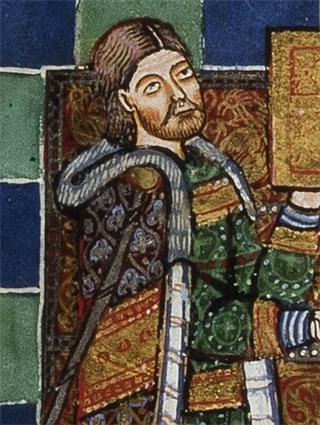
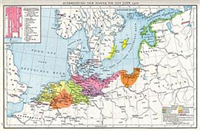
The Hanseatic League grew out of the German eastward expansion of the twelfth and thirteenth centuries. Lübeck, founded in 1143 by Count Adolf II of Holstein and refounded by Henry the Lion, Duke of Saxony, in 1159, gave German merchants direct access to the Baltic. They formed a sworn association on Gotland, trading through Visby to Novgorod, and new German towns such as Riga, Reval (Tallinn), Danzig (Gdańsk), Rostock, Wismar and Stralsund were founded along the southern and eastern coasts, many of them under Lübeck law. In the West, merchants from Cologne and other Rhineland and Westphalian towns had long held privileges in London. The word Hanse originally meant a company of merchants travelling abroad, and for a long time the Hansa was an association of merchants rather than of cities. Towns increasingly took over the protection of their traders: Lübeck and Hamburg made an alliance in 1241, and the Wendish towns of the southern Baltic coordinated policy from the later thirteenth century. The first general diet, the Hansetag, met in Lübeck in 1356 to deal with problems at the Bruges office, and historians usually date the “Hansa of the towns” from then; the expression stede van der dudeschen hanse appears in documents soon afterwards.
Socioeconomy
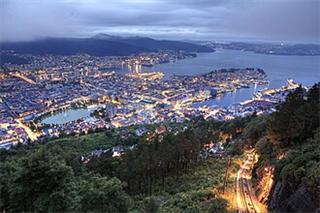
The Hansa linked the raw materials of the Baltic and the North with the manufactures of western Europe. From Novgorod and Livonia came furs and wax; from Prussia and Poland grain, timber, pitch, potash and amber; from Sweden copper and iron; from Bergen the dried cod known as stockfish; and from the Scania coast of southern Sweden, then Danish, the herring salted with salt from Lüneburg. Westward these goods went to Bruges, London and the Low Countries in exchange for Flemish and English cloth, wine, spices and metal goods; Hamburg also exported large quantities of beer. The cog, a capacious single-masted ship, and later the larger hulk carried this trade. Merchant families such as the Veckinchusens, whose letters survive, operated through partnerships rather than large firms, and bookkeeping remained simple compared with Italy. Hanseatic towns were governed by merchant patricians organised in town councils, beneath whom stood craft guilds that sometimes rebelled, as in Lübeck in 1408. Middle Low German served as the common language of trade and administration from London to Novgorod. The towns invested their wealth in brick Gothic churches, town halls and warehouses, from the Marienkirche in Lübeck to the wharf at Bergen, many of which survive today.
Military

The Hansa had no standing army or permanent fleet. When its interests were threatened, member towns agreed at the diet to raise ships and soldiers, usually armed merchantmen hired or requisitioned for a campaign, or to impose a trade embargo, which was often its most effective weapon. A blockade of Flanders in 1358–1360 forced Bruges to restore the merchants’ privileges. The great test came when Valdemar IV of Denmark sacked Visby in 1361 and defeated a Hanseatic fleet at Helsingborg in 1362. In 1367 the towns formed the Confederation of Cologne with Holstein, Mecklenburg and Swedish allies, ravaged the Danish coasts and took Copenhagen, and the Peace of Stralsund of 1370 gave them control of the Scanian fortresses for fifteen years and a voice in the Danish succession. The towns then fought the pirates known as the Victual Brothers, whose leader Klaus Störtebeker was executed in Hamburg around 1401. Later wars were less decisive: a conflict with Denmark ended with the Peace of Vordingborg in 1435, and a naval war with Holland ended in 1441. The Anglo-Hanseatic War of 1469–1474, fought largely by privateers such as Paul Beneke of Danzig, ended favourably, but the Count’s Feud of 1534–1536 in Denmark was a costly failure for Lübeck.
Governance & Law
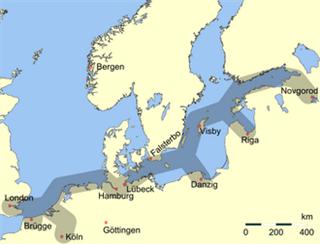
The Hansa never had a constitution, a common treasury, an official seal or a head, and its membership was never fixed: some seventy towns took an active part, while up to about two hundred were associated with it at its height. Its central institution was the Hansetag, the diet of town envoys that met irregularly, usually in Lübeck, and issued resolutions known as Rezesse; many towns did not attend, and decisions bound members only in practice. Lübeck, the “head of the Hansa”, presided and handled correspondence. The towns were grouped into regional thirds, and later quarters, led by Lübeck, Cologne, Danzig and other leading cities, which held their own regional meetings. Abroad, the four great offices or Kontore at Novgorod (the Peterhof), Bergen (the German Wharf), Bruges and London (the Steelyard) were self-governing communities with their own aldermen, statutes, treasuries and courts; the Bergen and Novgorod offices imposed strict, almost monastic discipline on young merchants. The ultimate sanction against a disobedient town was exclusion from the Hansa, Verhansung, used against Bremen in 1285 and Cologne in 1471. The members remained subject to their own lords, from the emperor to the Teutonic Order and the dukes of Pomerania, which limited the league’s capacity to act as a state.
Global & Regional Impact

For about two centuries the Hansa organised the commerce of northern Europe and spread a common urban culture around the Baltic. Lübeck law, granted to around a hundred towns, shaped municipal government from Holstein to Estonia, and German merchant elites dominated towns such as Riga and Reval until modern times. Brick Gothic churches, town halls and merchant houses gave the region a shared architectural style; the old towns of Lübeck, Visby, Stralsund and Wismar, Tallinn and the Bryggen wharf in Bergen are UNESCO World Heritage Sites. Middle Low German left many loanwords in the Scandinavian languages. The Hansa’s privileges abroad, defended by embargoes rather than armies, also showed how a network of towns without a state could hold its own against kings for a time. Politically it influenced the Scandinavian kingdoms: the Peace of Stralsund marked the high point of its power over Denmark, and Lübeck’s support helped Gustav Vasa become king of Sweden in 1523. Its memory remains strong: Hamburg and Bremen still call themselves Free and Hanseatic Cities, other towns use the H in vehicle registrations, and since 1980 a modern Hanseatic League of cities has revived the name for cultural cooperation.
Decline & Fall
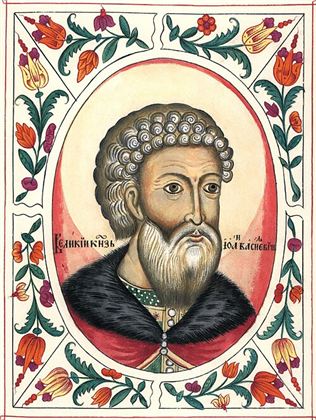
The Hansa declined slowly from the later fifteenth century as the conditions that had favoured it changed. Territorial states grew stronger and less willing to tolerate foreign privileges: Ivan III of Moscow closed the Novgorod office in 1494, Sweden under Gustav Vasa and Denmark reduced Lübeck’s influence after the Count’s Feud, and Elizabeth I of England revoked the privileges of the London Steelyard in 1598. Dutch merchants, with larger ships, cheaper freight and a stronger financial base in Amsterdam, took over much of the Baltic grain and timber trade passing through the Danish Sound, while the herring shoals moved from the Baltic to the North Sea. The shift of European trade towards the Atlantic and the Americas reduced the relative importance of the northern routes. The members’ interests also diverged: Danzig and the other Prussian towns came under Polish sovereignty in 1466 and pursued their own policies, and the Livonian towns fell to Sweden, Poland and Russia in the wars after 1558. The Thirty Years’ War devastated much of northern Germany and its trade. A last diet met in Lübeck in 1669, attended by only a handful of towns, and no successor diet was ever summoned. Lübeck, Hamburg and Bremen continued a looser alliance and kept the Hanseatic name.
The Hanseatic League was a loose association of mainly German towns that controlled the trade of the Baltic and North Sea for two centuries, showing how a network of merchant cities without a common state, army or treasury could dominate a region’s commerce and shape its towns.
Test yourself
5 questions on this page, from its key events and facts.
The questions open here once the page has loaded.
References
- Dollinger, P. (1970) The German Hansa. Trans. D.S. Ault and S.H. Steinberg. London: Macmillan.
- Hammel-Kiesow, R. (2000) Die Hanse. Munich: C.H. Beck.
- Lloyd, T.H. (1991) England and the German Hanse, 1157–1611: A Study of their Trade and Commercial Diplomacy. Cambridge: Cambridge University Press.
- Wubs-Mrozewicz, J. and Jenks, S. (eds) (2013) The Hanse in Medieval and Early Modern Europe. Leiden: Brill.
Connections
Open the full connections map →