Europe
Swedish Empire
At a glance
- In the 17th century a poor kingdom of some 2.5 million people made itself the dominant power of the Baltic.
- Gustavus Adolphus's military reforms reshaped European warfare and his intervention changed the course of the Thirty Years War.
- Charles XII's defeat by Russia at Poltava in 1709 broke Swedish power, and the Peace of Nystad in 1721 ended the empire.
Rise & Fall
- 1617The Peace of Stolbovo gives Sweden Ingria and Kexholm from Russia
- 1630Gustavus Adolphus intervenes in the Thirty Years War
- 1631Swedish and Saxon forces rout Tilly's Catholic League army at Breitenfeld
- 1648The Peace of Westphalia grants Sweden Western Pomerania, Bremen, Verden and Wismar
- 1658Charles X Gustav marches across the frozen Belts and forces the Treaty of Roskilde on Denmark
- 1709Peter the Great crushes Charles XII's army at Poltava
- 1718Charles XII is killed at the siege of Fredriksten in Norway
- 1721The Peace of Nystad cedes Estonia, Livonia and Ingria to Russia
Foundation
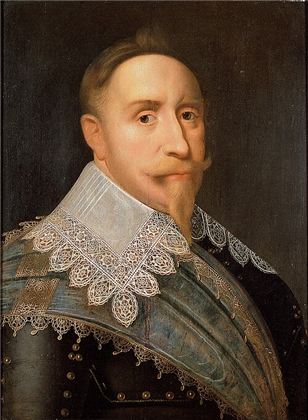
The Swedish Empire, known in Swedish historiography as Stormaktstiden, the Age of Great Power, was the product of one of history's most remarkable military transformations, in which a poor, sparsely populated northern kingdom became within a century the dominant power of northern Europe and a major force in continental warfare. Its rise began under Gustavus Adolphus (r. 1611–1632), whose military reforms created a prototype of the modern European army and whose intervention in the Thirty Years War in 1630 changed the course of the conflict. The empire was built through a series of conquests around the Baltic: Ingria and Kexholm from Russia at the Peace of Stolbovo (1617), Riga in 1621 and most of Livonia confirmed at the Truce of Altmark (1629), the mouth of the Oder River in Pomerania in the early 1630s, and the territories formalised in the Peace of Westphalia (1648), which gave Sweden Western Pomerania, the bishoprics of Bremen and Verden and the port of Wismar, together with a voice in the Imperial Diet. The Dano-Swedish wars completed the structure. At the Treaty of Roskilde (1658), imposed by Charles X Gustav after his celebrated March across the Belts over the frozen straits, Denmark–Norway ceded Scania, Blekinge, Halland, Bornholm, Bohuslän and Trøndelag, the region of Trondheim; Bornholm and Trøndelag were returned in 1660, but the remaining provinces fixed the southern borders of modern Sweden. At its height between about 1660 and 1700, Sweden controlled the Baltic from Finland and Estonia in the east to Pomerania and Wismar in the south, making it the dominant Baltic power and one of the leading military states of Europe, a remarkable achievement for an empire with a combined population of only around 2.5 million.
Socioeconomy

The Swedish imperial economy operated under the permanent constraint of the kingdom's small population and limited agricultural resources, which were wholly inadequate to sustain the military establishment that great power status demanded. Swedish statecraft answered this with the contribution system: the systematic extraction of revenues from occupied German and Baltic territories to pay for the armies stationed in them, so that war was made to pay for itself at the expense of conquered populations. The system worked while Swedish arms were victorious but broke down whenever Swedish forces were driven out of the lands they had relied upon. At home, mercantilist policies promoted iron and copper production. The great Falun copper mine made Sweden Europe's dominant copper producer for much of the seventeenth century and was for decades a leading source of crown revenue, while Swedish bar iron supplied much of northern Europe's demand; the decline of the richest Falun ores later in the century contributed to the state's fiscal difficulties. The Baltic trade in grain, timber, naval stores and manufactures remained dominated by Dutch and English merchants, and later efforts to win a larger share of long-distance commerce, such as the Swedish East India Company founded in 1731 after the imperial era had ended, met with only modest success. The fundamental economic reality of the empire was that military expenditure persistently exceeded what Sweden could raise at home, forcing it to rely on foreign subsidies, above all French payments under successive treaties, and on resources drawn from its subject territories.
Military
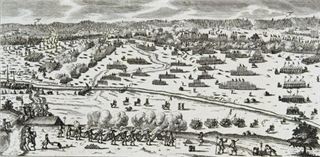
The Swedish army of Gustavus Adolphus was one of the most innovative and effective fighting forces of its age, introducing tactical, logistical and organisational reforms that transformed European warfare and were widely imitated across the continent. Building on Dutch practice, Gustavus replaced the massive infantry squares of the Spanish tercio with smaller, more manoeuvrable brigades of musketeers and pikemen; introduced light regimental guns that could be moved and fired on the battlefield rather than used mainly for sieges; and employed cavalry aggressively in shock action within a combined-arms system. The army was also notable for its national conscription system and for organising pay, supply and record-keeping more thoroughly than most contemporary forces, reducing, though never eliminating, the desertion, plunder and disease that crippled other armies. At Breitenfeld (1631), Swedish and Saxon forces routed Tilly's veteran Catholic League army, and at Lützen (1632) the Swedes held the field against Wallenstein even though Gustavus himself was killed. Charles XII (r. 1697–1718) represented the apogee of personal Swedish generalship: a commander of extraordinary tactical skill whose victories at Narva (1700) and Holowczyn (1708) against numerically superior opponents rank among the finest tactical performances of the early eighteenth century. His strategic recklessness, above all the invasion of Russia in 1708 and the decision to turn south into Ukraine in hope of support from the Cossack hetman Ivan Mazepa, led to the catastrophic defeat at Poltava (1709) that broke Swedish military power. A strategic culture built on aggressive offensive warfare, superbly effective against conventional opponents, proved unable to answer the Fabian strategy of scorched-earth retreat and attrition that Peter the Great employed.
Governance & Law

Swedish imperial government was marked by tension between the centralising ambitions of the monarchy, seen most clearly in Charles XI's Great Reduction of the 1680s, which returned alienated crown lands from the nobility and greatly increased royal revenues, and the constitutional traditions of the Riksdag and the nobility, which periodically asserted their rights against the crown. Sweden's domestic constitution was among the most distinctive in seventeenth-century Europe: the Riksdag was composed of four estates, nobility, clergy, burghers and peasants, and the presence of a peasant estate had few parallels among the major European states. Between periods of royal absolutism it exercised real legislative and fiscal authority. Axel Oxenstierna, the great chancellor who governed Sweden during the minority of Queen Christina (1632–1644) after Gustavus's death, gave the state a central administration of collegiate boards (collegium) responsible for finance, war, the admiralty, justice and the chancery, codified in the Form of Government of 1634 and more systematically organised than most contemporary European administrations. The overseas Baltic provinces of Estonia, Livonia and Ingria combined Swedish governors-general with considerable respect for the privileges of the local Baltic German nobility, their towns and their Lutheran church institutions, a continuity that eased the burden of administration. Finland, by contrast, was governed as an integral part of the Swedish realm. The Age of Liberty that followed Charles XII's death (1718–1772), during which the Riksdag effectively governed Sweden and the monarchy was reduced to a largely ceremonial role, represented both the fulfilment of constitutional principles long embedded in Swedish political culture and the end of any realistic prospect of imperial restoration.
Global & Regional Impact

The Swedish Empire's historical impact was concentrated in northern Europe, where it shaped the territorial configuration, administrative traditions and military culture of the Baltic lands, Finland and northern Germany. Swedish rule over Finland, which lasted from the Middle Ages until 1809, integrated Finnish administration, law and cultural life so thoroughly into the Swedish system that the subsequent Grand Duchy under Russian rule retained Swedish law and the dominance of a Swedish-speaking elite, with lasting consequences for Finnish institutional development. In Estonia and Livonia, Swedish rule is associated with the founding of the University of Dorpat (Tartu) in 1632 and with educational and legal reforms that left institutional legacies under later Russian governance, while Swedish Pomerania remained in Swedish hands until 1815. The military reforms of Gustavus Adolphus were among the most widely imitated innovations of the seventeenth century, adopted in modified form by most major European armies and contributing to the development of the modern standing army. Swedish financial institutions were also pioneering: Stockholms Banco issued the first banknotes in Europe in 1661, and its successor, the Sveriges Riksbank, founded in 1668, is the oldest central bank still in operation, a landmark in the history of central banking. The Swedish East India Company's trade with China, though modest in global terms, brought tea, porcelain and other Asian goods into northern European markets. Sweden's demonstration that a small, poor northern kingdom could achieve great power status through military innovation and state organisation influenced later Nordic state-building, and the Age of Great Power remains a central element of Swedish national identity and historical memory.
Decline & Fall

The Swedish Empire's decline was precipitated by a single catastrophic defeat and the collapse of the strategic position that military supremacy had sustained. At the Battle of Poltava on 28 June 1709 (Old Style), Peter the Great's numerically superior Russian army, fighting in prepared positions after the severe winter of 1708–1709 had worn down Charles XII's forces, decisively defeated the exhausted Swedish army in one of the most consequential battles in European history. Charles escaped with a small retinue to the Ottoman Empire, where he remained for five years while his empire disintegrated. The aftermath was catastrophic: the remnants of the army surrendered at Perevolochna three days after the battle, delivering Sweden's main field army into Russian captivity; Denmark re-entered the war and invaded Scania, though it was defeated at Helsingborg in 1710; the anti-Swedish coalition of the Great Northern War, which had faltered before Poltava, re-formed with renewed confidence; and over the following years Russia overran Livonia, Estonia and Finland while Sweden's German possessions fell to Denmark, Prussia, Saxony and Hanover. Charles returned in 1714 and continued the war with characteristic stubbornness, invading Norway in 1718, where he was killed by a bullet at the siege of Fredriksten, whether by enemy fire or by a Swedish hand remains disputed. The peace settlements of 1719–1721 dismantled the empire: Bremen and Verden passed to Hanover, Stettin and southern Western Pomerania to Prussia, and by the Peace of Nystad (1721) Sweden ceded Estonia, Livonia, Ingria and part of Karelia to Russia, surrendering the Baltic provinces that had been the core of its imperial position and acknowledging Russian supremacy in the Baltic. The Swedish Empire had lasted roughly a century, but its military innovations, administrative developments and geopolitical consequences shaped northern European history for the following three centuries.
The Swedish Empire's most enduring contribution to world history was the military revolution of Gustavus Adolphus, whose tactical and organisational innovations transformed European warfare and whose intervention in the Thirty Years War helped prevent a Catholic Habsburg consolidation of Germany, a consequence that shaped the subsequent development of European religious and political pluralism.
Test yourself
5 questions on this page, from its key events and facts.
The questions open here once the page has loaded.
References
- Frost, R. (2000) The Northern Wars: War, State and Society in Northeastern Europe, 1558–1721. London: Longman.
- Lockhart, P.D. (2004) Sweden in the Seventeenth Century. Basingstoke: Palgrave Macmillan.
- Oakley, S.P. (1992–1993) War and Peace in the Baltic, 1560–1790. London: Routledge.
- Roberts, M. (1953–1958) Gustavus Adolphus: A History of Sweden, 1611–1632. 2 vols. London: Longman.
- Roberts, M. (1968) The Early Vasas: A History of Sweden, 1523–1611. Cambridge: Cambridge University Press.
- Upton, A.F. (1998) Charles XI and Swedish Absolutism. Cambridge: Cambridge University Press.
Connections
Open the full connections map →