South & Southeast Asia
Bijapur Sultanate
At a glance
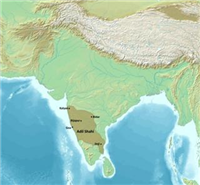
- One of the five Deccan sultanates that replaced the Bahmani Sultanate, ruled by the Adil Shahi dynasty from Bijapur.
- It joined the coalition that defeated Vijayanagara at Talikota in 1565 and later conquered much of southern Karnataka.
- Squeezed by the Mughals and the rising Marathas, it fell to Aurangzeb after a long siege in 1686.
Rise & Fall
- c. 1490Yusuf Adil Khan makes himself independent at Bijapur
- 1510The Portuguese capture Goa from Bijapur
- 1565Bijapur and its allies defeat Vijayanagara at the Battle of Talikota
- 1619Ibrahim Adil Shah II annexes the Bidar Sultanate
- 1636Treaty with Shah Jahan makes Bijapur a Mughal tributary
- 1659Shivaji kills the Bijapur general Afzal Khan at Pratapgad
- 1686Aurangzeb takes Bijapur after a siege of more than a year
Foundation
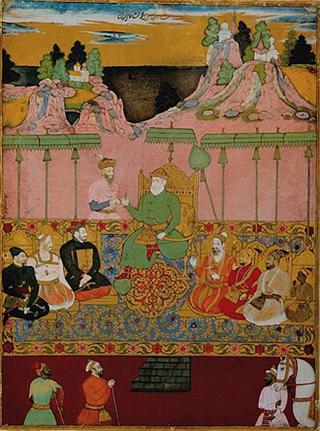
The Bijapur Sultanate was one of five states that emerged from the break-up of the Bahmani Sultanate, which had ruled the Deccan from Gulbarga and later Bidar since 1347. As the Bahmani sultans lost control to their great nobles in the late fifteenth century, Yusuf Adil Khan, governor of the province of Bijapur, made himself effectively independent around 1489–1490, while at first still acknowledging the Bahmani ruler. His origins are uncertain: the historian Ferishta repeats a story that he was a son of the Ottoman sultan Murad II, but he was more probably a Turkman or Persian who came to the Deccan as a young man and rose in Bahmani service. He made the old fortified town of Bijapur, on the plateau between the Krishna and Bhima rivers, his capital, and extended his rule across the western Deccan to the coast, where he held the port of Goa. Yusuf was a Shia and, according to Ferishta, introduced the Shia form of the Friday sermon in his realm, an unusual step in India at the time. He died in 1510, the year Afonso de Albuquerque seized Goa for Portugal. His successors took the title Adil Shah, and the dynasty, the Adil Shahis, held Bijapur for nearly two centuries.
Socioeconomy
Bijapur ruled a mixed society. The court and army drew on three main groups: Persian, Turkish and Arab immigrants known as Westerners (gharibs), Deccani Muslims long settled in the region, and Africans, called Habshis, many of whom had arrived as slaves and rose to high command. The great majority of subjects were Hindu peasants speaking Kannada and Marathi, and the countryside was administered through hereditary local officials, the Marathi-speaking deshmukhs and deshpandes, whose cooperation the sultans needed. Ibrahim Adil Shah I (r. 1534–1558) is credited with making Marathi a language of revenue administration alongside Persian. The economy rested on the black cotton soils of the plateau, which produced cotton, millet and wheat, and on textile weaving and the trade of ports on the Konkan coast such as Dabhol. Bijapur itself grew into a large walled city with markets, mosques, palaces and an elaborate water supply of tanks, wells and channels, among them the great stepwell known as the Taj Bawdi. Sufi shaikhs, studied by the historian Richard Eaton, had important roles at court and among the people. Ibrahim Adil Shah II, who praised the goddess Saraswati and the god Ganesha in his songs, was remembered for his openness towards Hindu subjects, musicians and scholars.
Military
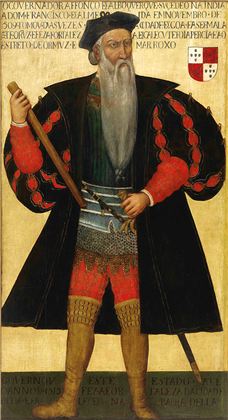
Bijapur's armies were built around cavalry raised by nobles holding land assignments, supported by infantry, war elephants and substantial artillery. The sultanate was almost constantly at war. Its early decades were spent fighting the neighbouring Deccan sultanates of Ahmadnagar, Golconda and Bidar, and the Vijayanagara Empire to the south over the fertile Raichur doab between the Krishna and Tungabhadra rivers. In 1510 Bijapur's forces briefly retook Goa from Albuquerque, but the Portuguese captured it again in November that year, and later efforts to recover it, notably the great siege of 1570–1571 under Ali Adil Shah I, failed. In January 1565 Bijapur joined Ahmadnagar, Golconda and Bidar in the coalition that crushed Vijayanagara at the Battle of Talikota, opening the south to expansion. Bijapur annexed Bidar in 1619, and in the 1630s and 1640s its generals, among them the Maratha commander Shahaji Bhonsle, conquered much of the southern Karnataka plateau and parts of the Tamil country, taking Bangalore in 1638 and the fortress of Gingee in 1649. The massive walls of Bijapur, with great bastions mounting heavy guns such as the bronze Malik-i-Maidan, protected the capital, which resisted a Mughal army under Jai Singh in 1665–1666 before falling to Aurangzeb in 1686.
Governance & Law
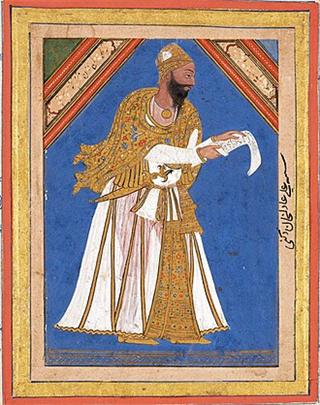
The Adil Shahs ruled as absolute monarchs with Persianate court institutions inherited from the Bahmanis. Under the sultan stood a chief minister, ministers for finance and the army, and provincial governors and commanders paid through land assignments. Persian was the language of high government and diplomacy, while the Dakhni form of Urdu became a language of court literature. The dynasty's religious policy shifted with its rulers: Yusuf and his son Ismail Adil Shah favoured Shia Islam and Persian immigrants; Ibrahim I turned to Sunni Islam and the Deccanis; Ali Adil Shah I (r. 1558–1580) restored Shia observance; and Ibrahim Adil Shah II (r. 1580–1627), who succeeded as a boy under the regency of Chand Bibi, his uncle's widow, favoured Sunni Islam while patronising Hindu musicians and scholars. Factional conflict between Westerners, Deccanis and Habshis repeatedly paralysed government during royal minorities. Hindu chiefs and Maratha families, among them Shahaji Bhonsle, father of Shivaji, served as commanders and revenue officials, a dependence that later helped Shivaji build his own power in Bijapur's western territories. From 1636 the sultans also had to manage the overbearing suzerainty of the Mughal Empire, whose envoys at Bijapur watched over the payment of tribute and the conduct of foreign policy.
Global & Regional Impact
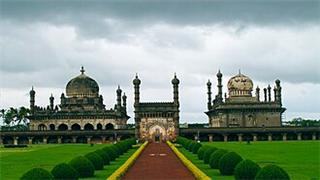
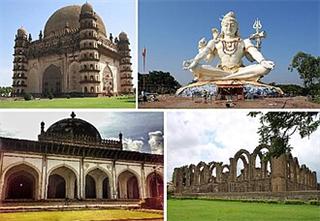
Bijapur's greatest legacy is its architecture and art. The Ibrahim Rauza, the tomb and mosque complex of Ibrahim Adil Shah II completed in the 1620s, is admired for its refined carving and proportions, and the Gol Gumbaz, the tomb of Muhammad Adil Shah (r. 1627–1656), carries a dome about 44 metres across on the outside, one of the largest masonry domes of the pre-modern world, with a famous whispering gallery. The Jami Masjid, the Asar Mahal and the city walls complete one of the richest groups of Islamic monuments in India. Ibrahim II, a musician and poet, wrote the Kitab-i-Nauras, a collection of songs in Dakhni set to Indian ragas that opens with an invocation to Saraswati, and his court produced a distinctive school of Deccani painting. The historian Muhammad Qasim Ferishta wrote his celebrated history of Muslim India under his patronage. Under Ali Adil Shah II the poet Nusrati wrote some of the major early works of Dakhni literature, a forerunner of Urdu poetry. Politically, Bijapur's part in the defeat of Vijayanagara reshaped the south, and its employment of Maratha nobles and soldiers gave the future Maratha state a training ground in war and administration.
Decline & Fall

Bijapur's decline came from the pressure of two rising powers. The Mughal conquest of Ahmadnagar left Bijapur exposed, and in 1636 Muhammad Adil Shah accepted a treaty with Shah Jahan that recognised Mughal overlordship and required payment of tribute, in return for part of Ahmadnagar's lands. Bijapur compensated by expanding south, but after Muhammad's death in 1656 the succession of the young Ali Adil Shah II prompted a Mughal invasion under Prince Aurangzeb, who took Bidar and Kalyani in 1657. At the same time Shivaji, son of the Bijapur noble Shahaji, carved a Maratha kingdom out of Bijapur's western lands, killing the general Afzal Khan at Pratapgad in 1659 and defeating further expeditions sent against him. Factional strife among the nobility worsened under the child Sikandar Adil Shah, who came to the throne in 1672, and Bijapur's southern conquests slipped away to local commanders and to the Marathas. In 1685 Aurangzeb, now emperor, came south in person and his armies besieged Bijapur. After a siege of more than a year, with the defenders weakened by hunger, Sikandar surrendered in September 1686. He died a prisoner in 1700, and Bijapur became the seat of a Mughal province; the following year Aurangzeb annexed Golconda.
The Bijapur Sultanate of the Adil Shahi dynasty, one of the successor states of the Bahmani Sultanate, dominated the western Deccan for nearly two centuries, helped defeat Vijayanagara at Talikota in 1565 and left monuments such as the Gol Gumbaz before falling to Aurangzeb in 1686.
References
- Eaton, R.M. (1978) Sufis of Bijapur, 1300–1700: Social Roles of Sufis in Medieval India. Princeton: Princeton University Press.
- Eaton, R.M. (2005) A Social History of the Deccan, 1300–1761: Eight Indian Lives. Cambridge: Cambridge University Press.
- Michell, G. and Zebrowski, M. (1999) Architecture and Art of the Deccan Sultanates. Cambridge: Cambridge University Press.
- Sherwani, H.K. and Joshi, P.M. (eds) (1973–1974) History of Medieval Deccan (1295–1724). 2 vols. Hyderabad: Government of Andhra Pradesh.
Connections
Open the full connections map →