Central & East Asia
Kara-Khanid Khanate
At a glance
- A Turkic dynasty, probably of Karluk origin, that ruled from Balasagun and Kashgar from the mid-9th century.
- The first Turkic state to adopt Islam, it took Bukhara from the Samanids in 999, bringing Transoxiana under Turkic rule.
- Its court culture gave rise to the first works of Turkic Islamic literature; rivalry split it in two around 1042.
Rise & Fall
- c. 840The fall of the Uyghur Khaganate opens the way for a new Karluk-led khanate
- 893The Samanid amir Ismail ibn Ahmad captures Talas
- c. 934Satuq Bughra Khan converts to Islam, according to tradition
- 960Chroniclers record the conversion of 200,000 tents of Turks to Islam
- 999Nasr ibn Ali takes Bukhara and ends the Samanid Empire
- 1008Mahmud of Ghazni defeats the Kara-Khanids near Balkh
- c. 1042The khanate splits into eastern and western khanates
Foundation
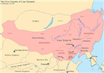
The Kara-Khanids, also called Karakhanids or Ilek Khanids, were a Turkic dynasty whose origins remain uncertain. Most historians connect them with the Karluk confederation, which had dominated the lands of the Chu and Talas rivers since the eighth century, while others favour the Yaghma or the Chigil, tribes that formed the core of their later armies. The khanate is conventionally dated from about 840, when the destruction of the Uyghur Khaganate in Mongolia by the Kyrgyz left a vacuum in the eastern steppe and probably allowed Karluk leaders to claim the title of khagan. The early rulers, who held Balasagun in the Chu valley and Kashgar in the western Tarim Basin, are known mainly from later Muslim traditions and from coins. In 893 the Samanid amir Ismail ibn Ahmad captured Talas from them, showing that the Muslim states of Transoxiana could still push the Turkic frontier back. The decisive change came under Satuq Bughra Khan, who according to tradition converted to Islam in Kashgar, perhaps around 934, with the help of Muslim merchants and scholars, and then seized power from his uncle. He died in 955, and under his successors Islam became the religion of the dynasty and of the tribes it led.
Socioeconomy
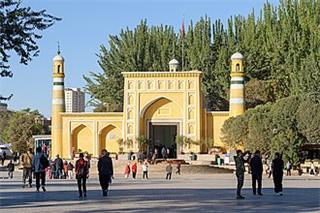
The Kara-Khanid realm joined two different worlds: the pastures of Semirechye and the Tian Shan, where Turkic tribes such as the Karluk, Chigil, Yaghma and Tukhsi herded horses and sheep, and the irrigated oases of Transoxiana, Ferghana, Shash and Kashgar, with their Persian- and Sogdian-speaking farmers, craftsmen and merchants. The conquest of the Samanid lands in 999 gave the dynasty some of the richest cities of the Islamic east, including Bukhara and Samarqand, whose textiles, paper and metalwork were traded across Eurasia. The khanate sat astride the overland routes linking the Islamic world with China, and caravans crossed it from Kashgar through the Ferghana valley to Samarqand. Large issues of silver and copper coins, struck in dozens of towns, reflect a monetised urban economy. Conversion drew the Turks into the religious life of the cities. The Kara-Khanids generally respected the Hanafi scholars of Bukhara and Samarqand, built mosques, caravanserais and madrasas, and endowed religious foundations, although relations between khans and the ulama were sometimes tense. Among the nomads Islam spread more slowly, and older beliefs and customs persisted for generations. In the towns Turkic gradually joined Persian as a spoken language, a long process of Turkicisation that Kara-Khanid rule accelerated.
Military

Kara-Khanid power rested on tribal cavalry: mounted archers from the Karluk, Chigil, Yaghma and other tribes, led by members of the ruling clan and supplemented by the garrisons and militias of the oasis towns. Conversion gave the dynasty a cause for holy war against the Buddhist kingdom of Khotan, its eastern neighbour, and against non-Muslim Turks. The war against Khotan was long and hard, and verses preserved by Mahmud al-Kashgari recall raids on its towns and temples; Khotan finally fell to Yusuf Qadir Khan, probably around 1006. In the west the khanate exploited the weakness of the Samanid Empire. Hasan Bughra Khan briefly occupied Bukhara in 992 but fell ill and died while withdrawing. In 999 Nasr ibn Ali, the Ilek Khan, entered Bukhara and captured the last Samanid amir, Abd al-Malik II, while Mahmud of Ghazni took Khurasan. The two powers agreed to make the Amu Darya their frontier, but in 1006 Kara-Khanid armies invaded Khurasan while Mahmud was in India. Mahmud hurried back and, with war elephants and a disciplined professional army, defeated Nasr and Yusuf Qadir Khan near Balkh in January 1008. From the 1020s the Kara-Khanid princes fought increasingly among themselves, and Seljuk Turkmen bands served Ali Tegin of Bukhara in these wars.
Governance & Law
The Kara-Khanids ruled their lands as the collective property of the royal clan, in the tradition of the steppe empires. Supreme authority was divided between two great khans, a senior ruler with the title Arslan Khan ('lion khan') and a junior ruler with the title Bughra Khan ('camel khan'), each supported by subordinate princes holding the titles ilek and tegin. Rank passed among the senior members of the dynasty, and princes held appanages, often a city with its district, from which they could rise to higher titles. Numismatists have reconstructed much of this hierarchy from the coins, which name both the minting prince and his overlords. Two rival branches of the dynasty, conventionally named after their ancestors Ali and Hasan, competed for the senior titles, so the system bred rivalry as well as cooperation. The khans had no strong central bureaucracy of their own. In Transoxiana they kept the Persian administrative traditions inherited from the Samanids, relying on local officials, landowners (dihqans) and the ulama, who mediated between the Turkic rulers and the urban population. Grants of land revenue to princes and soldiers, of the kind later called iqta, supported the army. Royal courts at Balasagun, Kashgar, Uzgen, Samarqand and Bukhara became centres of patronage for scholars and builders.
Global & Regional Impact
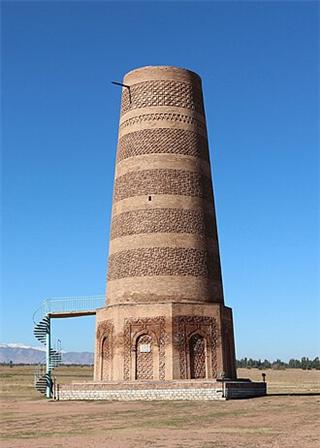
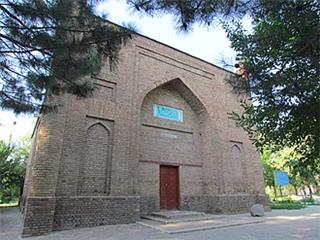
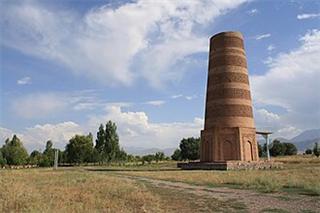
The Kara-Khanids were the first Turkic dynasty to make Islam the religion of their state, and their conversion opened the way for the Islamisation of the Turkic peoples of Central Asia, from whom later Muslim Turkic dynasties such as the Seljuks emerged. Their conquest of the Samanid lands in 999 brought Transoxiana permanently under Turkic rule, beginning the transformation of the region's population and language that eventually made it part of Turkestan. Under Kara-Khanid patronage Turkic became, for the first time, a written language of Islamic literature. The most celebrated works were completed after the division of the khanate but grew out of its court culture. Yusuf Khass Hajib of Balasagun wrote the Kutadgu Bilig ('Wisdom of Royal Glory'), a mirror for princes in verse, around 1069–1070, and presented it to the khan at Kashgar. Mahmud al-Kashgari, a prince of the dynasty, compiled in Baghdad the Diwan Lughat al-Turk, a dictionary of the Turkic languages with a map of the Turkic world, in the 1070s. The dynasty's buildings, among them the Burana Tower near Balasagun, the mausoleums of Uzgen and the Kalyan Minaret raised in Bukhara in 1127 by the western Kara-Khanids, shaped the later architecture of Central Asia.
Decline & Fall
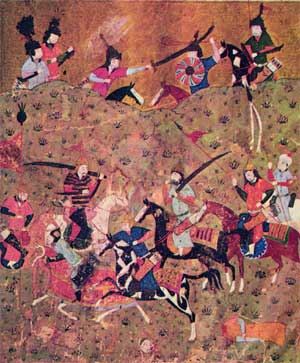
The united khanate did not survive the rivalries built into its system of collective rule. After the death of Nasr ibn Ali in 1012 or 1013, princes of the two branches fought over Transoxiana. Ali Tegin seized Bukhara around 1020, and in 1025 Mahmud of Ghazni met the eastern khan Yusuf Qadir Khan near Samarqand and agreed to act against him, although no lasting settlement followed. Yusuf Qadir Khan died in 1032 and Ali Tegin in 1034, and their heirs struggled to hold their lands as the Seljuk Turkmen grew powerful in the region. Around 1040, as the Seljuks defeated the Ghaznavids at the Battle of Dandanaqan, Ibrahim ibn Nasr, known as Böritegin and later as Tamghach Khan, took control of Bukhara and Samarqand. By about 1042 the realm had split into two independent khanates: a western one centred on Samarqand and Bukhara and an eastern one centred on Balasagun and Kashgar, with Ferghana contested between them. Both survived for more than a century and a half. The Western Kara-Khanids became vassals of the Seljuks after Malik-Shah I took Samarqand in 1089, and both branches later submitted to the Qara Khitai after the Battle of Qatwan in 1141. The eastern line ended around 1211, and the western in 1212, when the Khwarazmshah Muhammad II executed the last khan of Samarqand.
The Kara-Khanid Khanate was the first Turkic state to adopt Islam as its religion, brought Transoxiana under lasting Turkic rule with the conquest of Bukhara in 999, and nurtured the beginnings of Turkic Islamic literature, from which the Kutadgu Bilig and Mahmud al-Kashgari's great dictionary emerged.
References
- Barthold, W. (1928) Turkestan Down to the Mongol Invasion. London: Luzac (E.J.W. Gibb Memorial Series, new series 5).
- Bosworth, C.E. (1963) The Ghaznavids: Their Empire in Afghanistan and Eastern Iran, 994–1040. Edinburgh: Edinburgh University Press.
- Bosworth, C.E. (1996) The New Islamic Dynasties: A Chronological and Genealogical Manual. Edinburgh: Edinburgh University Press.
- Golden, P.B. (1992) An Introduction to the History of the Turkic Peoples. Wiesbaden: Otto Harrassowitz.
- Soucek, S. (2000) A History of Inner Asia. Cambridge: Cambridge University Press.
Connections
Open the full connections map →