Europe
Kingdom of Scotland
At a glance
- A northern British kingdom formed from the Picts and Gaelic Dál Riata, traditionally dated to Kenneth MacAlpin around 843.
- It kept its independence against England in the Wars of Independence, won by Robert the Bruce at Bannockburn in 1314.
- James VI inherited England in 1603, and the Acts of Union of 1707 merged the two kingdoms into Great Britain.
Rise & Fall
- c. 843Kenneth MacAlpin becomes king of the Picts
- 1266The Treaty of Perth transfers the Western Isles from Norway
- 1314Robert the Bruce defeats Edward II at Bannockburn
- 1320The Declaration of Arbroath asserts Scottish independence
- 1513James IV is killed at the Battle of Flodden
- 1560The Reformation Parliament creates a Protestant church
- 1603James VI inherits the English throne
- 1707The Acts of Union create the Kingdom of Great Britain
Foundation
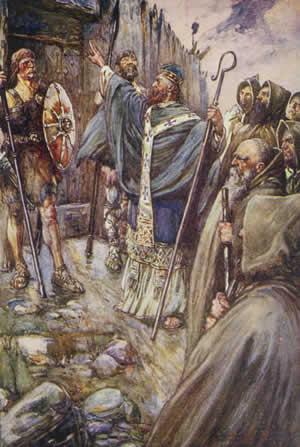
The Kingdom of Scotland grew out of the union of the Picts, who held most of the land north of the Forth, and the Gaelic kingdom of Dál Riata in Argyll. Tradition dates the new realm to Kenneth MacAlpin (Cináed mac Ailpín), a king of Gaelic descent who became ruler of the Picts around 843 and died in 858. Medieval accounts later described a violent conquest of the Picts, but modern historians see a more gradual process in which Viking attacks on both peoples, intermarriage among royal kindreds and the spread of Gaelic language and church culture fused them into one realm. By about 900, under Donald II and Constantine II, the kingdom was called Alba, with its royal centre at Scone and relics of Columba at Dunkeld. Over the following centuries its kings expanded southwards. Malcolm II’s victory at the Battle of Carham, around 1018, secured Lothian between the Forth and the Tweed, and the British kingdom of Strathclyde was absorbed during the eleventh century. Galloway, Moray and the Norse-ruled north and west were brought under royal control only slowly: after the Battle of Largs in 1263, the Treaty of Perth of 1266 transferred the Western Isles and the Isle of Man from Norway to Scotland, and Orkney and Shetland followed in 1468–1469.
Socioeconomy

Scotland was a thinly populated country, with pastoral farming dominant in the Highlands and mixed farming in the Lowlands, and it probably had around a million people by 1700. Its society combined Gaelic kin-based lordship, strongest in the Highlands and Islands, with feudal tenures introduced from the twelfth century, when David I and his successors invited Anglo-Norman and Flemish settlers. Royal burghs such as Berwick, Perth, Aberdeen and Edinburgh held monopolies of foreign trade, exporting wool, hides, fish and later coal and salt to the Low Countries, the Baltic and France; from the fifteenth century a Scottish staple port in the Netherlands, from 1541 at Veere, handled much of this trade. Language divided the country: Gaelic remained dominant in the north and west, while Scots, which grew from northern English, became the language of the Lowlands, the court and the law. The church was rich, with great reformed abbeys such as Melrose, Kelso and Holyrood, and the founding of universities at St Andrews (1413), Glasgow (1451) and Aberdeen (1495) gave Scotland three universities when England still had two. After the Reformation of 1560 the Kirk aimed at a school in every parish, a goal written into law by an act of 1696. Many Scots sought a living abroad as soldiers, merchants and pedlars in Poland, Scandinavia and Ireland.
Military
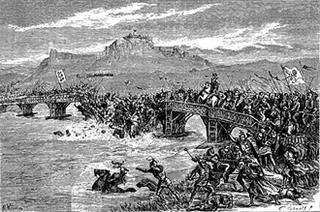
Scotland’s armies were raised from the common army of free men owing service, the feudal knights of the Lowlands and the clan levies of the Highlands, and they were rarely a match for English armies in pitched battle. Their strength lay in defensive warfare, the spear formations known as schiltrons, and raiding into northern England. The Wars of Independence began when Edward I of England invaded in 1296, sacked Berwick and took the Stone of Scone to Westminster. William Wallace defeated an English army at the Battle of Stirling Bridge in 1297 but lost at Falkirk in 1298. Robert the Bruce, crowned in 1306, waged a guerrilla war and took castles one by one before routing Edward II at the Battle of Bannockburn in 1314. The Second War of Independence brought defeats at Halidon Hill in 1333 and Neville’s Cross in 1346, where David II was captured. The alliance with France, the Auld Alliance first sealed in 1295, drew Scotland into repeated wars with England: James IV built a royal navy, including the great ship Michael, but was killed with much of his nobility at the Battle of Flodden in 1513, and another heavy defeat followed at Solway Moss in 1542. In the 1640s the Covenanting army was among the strongest in Britain, but Oliver Cromwell crushed Scottish forces at Dunbar in 1650 and Worcester in 1651.
Governance & Law

Scottish kings ruled through a small, personal government rather than a large bureaucracy. David I (1124–1153) laid the foundations of the medieval state, developing sheriffdoms, founding royal burghs, issuing the first Scottish coinage and organising the church into territorial dioceses and parishes. The crown passed within the royal house, but repeated royal minorities in the fifteenth and sixteenth centuries left regents and noble factions to govern, and several kings met violent ends, among them James I, murdered in 1437. The Parliament of Scotland, a single chamber of the estates of clergy, nobility and burgh commissioners, developed from the thirteenth century; much of its business was prepared by a committee, the Lords of the Articles. Scots law drew on Roman and canon law as well as native custom, and in 1532 James V founded the College of Justice, whose Court of Session remains Scotland’s supreme civil court. In the localities great magnates held hereditary jurisdictions, and in the Highlands clan chiefs ruled with considerable independence. The Reformation of 1560 created a national Kirk governed, after a long conflict over bishops, by Presbyterian courts of kirk sessions, presbyteries, synods and a General Assembly. After the Union of the Crowns in 1603, James VI governed Scotland from London through the Privy Council in Edinburgh, boasting that he ruled it with his pen.
Global & Regional Impact
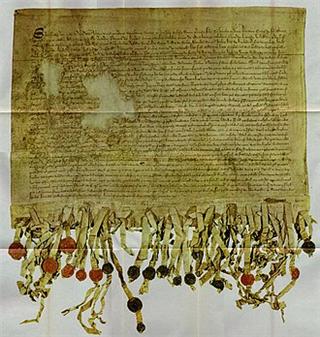
Scotland’s long resistance to English conquest made it a rare case of a small medieval kingdom preserving its independence beside a much larger neighbour. The Declaration of Arbroath of 1320, a letter from the barons to Pope John XXII asserting the kingdom’s freedom and the right to replace a king who betrayed it, became one of the most quoted documents of Scottish history. The kingdom produced a distinctive literature in Scots, from John Barbour’s verse epic The Bruce of the 1370s to the makars of the late fifteenth and early sixteenth centuries, Robert Henryson, William Dunbar and Gavin Douglas, whose translation of Virgil’s Aeneid was completed in 1513. The Reformation led by John Knox produced a Calvinist church that shaped Scottish society, education and ideas of resistance, and the National Covenant of 1638 helped to start the Wars of the Three Kingdoms that convulsed Britain and Ireland. When James VI became king of England in 1603, a Scottish dynasty came to rule all of Britain and Ireland, and Scots settled in large numbers in the Plantation of Ulster from 1609. The institutions the kingdom kept after 1707, its law, church and universities, became the base for the Scottish Enlightenment of the eighteenth century and for a lasting Scottish national identity within the United Kingdom.
Decline & Fall
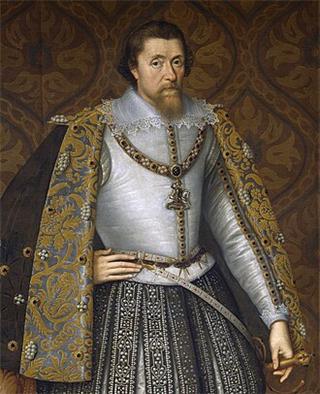
The road to union began in 1603, when James VI inherited the English throne as James I and moved his court to London. The two kingdoms shared a monarch but kept separate parliaments, churches and laws, and the arrangement proved unstable. Charles I’s attempt to impose a new prayer book in 1637 provoked the National Covenant of 1638 and the Bishops’ Wars, and in the civil wars that followed Scotland was conquered by Cromwell and incorporated into the Commonwealth from 1652 until the Restoration of 1660. After the Revolution of 1688–1689 the Scottish Parliament became more assertive, while economic weakness grew acute: the famines of the 1690s, known as the ill years, and the failure of the Darien scheme, a colony on the Isthmus of Panama in 1698–1700 that lost a large share of the country’s capital, convinced many that access to English markets was essential. England, at war with France, wanted to secure the Protestant succession and prevent Scotland from choosing a different monarch. After negotiations in 1706, the Parliament of Scotland ratified the Treaty of Union, and on 1 May 1707 Scotland and England were united as the Kingdom of Great Britain, with one parliament at Westminster. The kingdom ended, but its law, Presbyterian church and education system were guaranteed, and a devolved Scottish Parliament was established in 1999.
The Kingdom of Scotland preserved its independence against a far larger England for four centuries, created a distinctive law, church, literature and university tradition, and through James VI gave Britain its first shared monarch before the Union of 1707 merged it into the Kingdom of Great Britain.
References
- Barrow, G.W.S. (1965) Robert Bruce and the Community of the Realm of Scotland. London: Eyre and Spottiswoode.
- Duncan, A.A.M. (1975) Scotland: The Making of the Kingdom. Edinburgh: Oliver and Boyd.
- Lynch, M. (1991) Scotland: A New History. London: Century.
- Whatley, C.A. (2006) The Scots and the Union. Edinburgh: Edinburgh University Press.
- Woolf, A. (2007) From Pictland to Alba, 789–1070. Edinburgh: Edinburgh University Press.
- Wormald, J. (1981) Court, Kirk, and Community: Scotland, 1470–1625. London: Edward Arnold.
Connections
Open the full connections map →