Europe
Kingdom of León
At a glance
- Successor of Asturias, the kingdom took its name from León, the royal seat from 914, and ruled Galicia and the Douro plain.
- Its kings claimed Visigothic heritage and an imperial title, and Alfonso VI captured Toledo in 1085.
- The Cortes of León of 1188 included townsmen; in 1230 León was united permanently with Castile.
Rise & Fall
- 910Alfonso III's sons divide his realm; García I rules from León
- 939Ramiro II defeats Abd al-Rahman III at Simancas
- 997Almanzor sacks Santiago de Compostela
- 1037Ferdinand I of Castile kills Bermudo III at Tamarón and takes León
- 1085Alfonso VI captures Toledo
- 1135Alfonso VII is crowned emperor in León
- 1188Alfonso IX summons the Cortes of León with town representatives
- 1230The Treaty of Benavente unites León with Castile under Ferdinand III
Foundation

The Kingdom of León grew out of the Kingdom of Asturias, the small Christian realm founded in the mountains of northern Spain after the Muslim conquest of 711. Under Alfonso III (r. 866–910) the Asturian kings pushed south to the Douro, resettling the thinly populated plain with colonists from the north and from al-Andalus and fortifying towns such as Zamora, Toro and the old Roman camp of León. In 910 Alfonso III was deposed by his sons, and his realm was divided: García I took the lands south of the mountains, centred on León, Ordoño received Galicia and Fruela Asturias. When García died in 914 Ordoño II reunited most of the inheritance and made León his royal seat, and historians date the kingdom's name from this transfer of the capital from Oviedo. The new kingdom thus combined the mountain core of Asturias, the populous region of Galicia in the north-west and the frontier lands of the Douro basin, with Castile in the east, governed by counts, as its most exposed and increasingly independent district. The Leonese kings presented themselves as heirs of the Visigothic monarchy of Toledo, a claim that gave ideological purpose to their wars against al-Andalus and to the resettlement (repoblación) of the lands to the south.
Socioeconomy
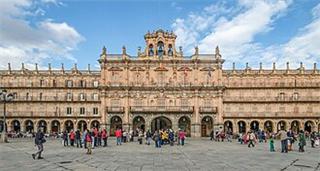
León was an agrarian frontier society. Its wealth lay in grain, vines and above all livestock, since cattle and sheep were easier to save from raids than crops. Free peasant settlers received land and privileges under charters (fueros) in return for settling the frontier, alongside monasteries and nobles who claimed land by presura, the occupation of vacant land. Society comprised nobles, clergy, free peasants and dependent cultivators, with Mozarabs, Arabic-speaking Christians who migrated from al-Andalus bringing their own artistic traditions, and Jewish communities in the towns. The city of León, seat of the court and a bishop, and later Astorga, Zamora, Salamanca and Santiago de Compostela were the main centres. Trade was modest until the eleventh century, when tribute in gold (parias) from the taifa kingdoms of al-Andalus enriched the court and the Church, and the pilgrimage road to the shrine of Saint James at Santiago brought French pilgrims, merchants and settlers, with communities of Franks growing up at Sahagún and León. Cluniac monks, generously endowed by Alfonso VI, reformed monastic life, and the Roman liturgy replaced the old Hispanic, or Mozarabic, rite in the 1080s. A royal coinage was first minted under Alfonso VI, a sign of the economy's growth in the eleventh century.
Military

Leonese warfare combined royal campaigns with constant frontier raiding by nobles, town militias and settlers who were obliged to serve on horseback or on foot under their fueros. Ordoño II won a victory at San Esteban de Gormaz in 917 but was badly defeated by Abd al-Rahman III at Valdejunquera in 920. Ramiro II (r. 931–951), allied with the count of Castile, Fernán González, defeated the caliph at the Battle of Simancas in 939, one of the few great Christian victories of the period, and resettled the Tormes valley around Salamanca. In the late tenth century the balance turned: al-Mansur, the chief minister of the caliphate known in Spanish as Almanzor, led dozens of campaigns into the north, sacking the city of León in the late 980s and Santiago de Compostela in 997. After the collapse of the caliphate the advantage returned to the Christians. Ferdinand I took Coimbra in 1064, and Alfonso VI captured Toledo, the old Visigothic capital, in 1085, but the Almoravid victory at the Battle of Sagrajas in 1086 and the death of his heir at Uclés in 1108 checked the advance. Under Ferdinand II and Alfonso IX the frontier moved south again, helped by the military orders of Santiago and Alcántara, until Alfonso IX took Cáceres in 1229 and Mérida and Badajoz in 1230.
Governance & Law

The king of León ruled with a royal court (curia regia) of bishops, magnates and palace officials, and through counts and royal agents (merinos) who governed districts, collected dues and administered justice. The Liber Iudiciorum, the Visigothic law code, remained the basis of law, supplemented by local charters and custom. The kings stressed their descent from the Visigoths, and from the tenth century some styled themselves emperor (imperator), a claim to precedence over the other Christian rulers of Iberia: Alfonso VI called himself emperor of all Spain, and Alfonso VII was crowned emperor in León in 1135. Alfonso V's fuero of León, issued at a royal council in 1017 or 1020, set out rules for the city and the kingdom and became a model for later charters. The most celebrated institution was the assembly summoned by Alfonso IX in León in 1188, at the start of his reign, where representatives of the towns sat alongside bishops and nobles; the king promised to respect the laws, to seek their counsel on war and peace and to protect property. Its decrees, which UNESCO recognised in 2013 as the oldest documentary record of the European parliamentary system, have made the Cortes of León of 1188 a landmark in the history of representative government. Alfonso IX also founded the University of Salamanca around 1218.
Global & Regional Impact

León carried the Asturian idea of a Christian restoration of Visigothic Spain into the central Middle Ages, and its kings were the leading Christian rulers of Iberia for much of the tenth and eleventh centuries. Its expansion to the Tagus and later the Guadiana laid foundations for the Crown of Castile, and the County of Portugal, granted by Alfonso VI to his son-in-law Henry of Burgundy, became the independent Kingdom of Portugal under Afonso Henriques, recognised by León in the Treaty of Zamora in 1143. Culturally the kingdom produced some of the finest art of early medieval Europe. The illuminated Beatus manuscripts, copies of Beatus of Liébana's commentary on the Apocalypse, were painted in Leonese scriptoria in the Mozarabic style, among them the Beatus of Facundus made for Ferdinand I and Queen Sancha in 1047. The church of San Isidoro in León, which received the relics of Isidore of Seville in 1063, houses the Pantheon of the Kings, whose twelfth-century Romanesque paintings are among the best preserved in Europe. The pilgrimage to Santiago de Compostela, promoted by the Leonese kings and by Archbishop Diego Gelmírez, became one of the great routes of Christendom. The Cortes of 1188 is often cited as the earliest European parliament to include townsmen, and the Leonese language survives in the Asturian and Leonese dialects of today.
Decline & Fall

León's history was bound up with that of Castile, its eastern county turned rival. Castile under Fernán González became effectively autonomous in the mid-tenth century, and in 1037 Ferdinand I, count of Castile and son of Sancho III of Navarre, killed Bermudo III, the last king of the old Leonese line, at the Battle of Tamarón and took the Leonese throne by right of his wife Sancha. Ferdinand divided his kingdoms among his sons in 1065, but Alfonso VI reunited León, Castile and Galicia by 1072, and they remained together under Urraca and Alfonso VII. At Alfonso VII's death in 1157 León and Castile were separated again, Ferdinand II taking León and Sancho III Castile. For the next seventy years the two kingdoms were rivals, competing for frontier territory and sometimes allying with the Almohads against each other; Alfonso IX took no part in the Castilian victory at Las Navas de Tolosa in 1212. Alfonso IX's marriage to Berenguela of Castile produced a son, Ferdinand III, who became king of Castile in 1217. When Alfonso IX died in 1230 he left León to his daughters by an earlier marriage, Sancha and Dulce, but the Treaty of Benavente, negotiated by their mothers, gave the kingdom to Ferdinand III, uniting León and Castile permanently in the Crown of Castile.
León was the leading Christian kingdom of Iberia in the tenth and eleventh centuries, carrying the Visigothic legacy of Asturias south to the Douro and Tagus, producing the Beatus manuscripts and the Pantheon of San Isidoro, and summoning in 1188 an assembly with town representatives often called Europe's first parliament.
References
- Collins, R. (2012) Caliphs and Kings: Spain, 796–1031. Chichester: Wiley-Blackwell.
- Fletcher, R.A. (1984) Saint James's Catapult: The Life and Times of Diego Gelmírez of Santiago de Compostela. Oxford: Clarendon Press.
- O'Callaghan, J.F. (1975) A History of Medieval Spain. Ithaca: Cornell University Press.
- Reilly, B.F. (1982) The Kingdom of León-Castilla under Queen Urraca, 1109–1126. Princeton: Princeton University Press.
- Reilly, B.F. (1988) The Kingdom of León-Castilla under King Alfonso VI, 1065–1109. Princeton: Princeton University Press.
Connections
Open the full connections map →