Europe
Reval
At a glance
- A German-speaking merchant town under Lübeck law, granted self-government by King Eric IV of Denmark in 1248.
- It prospered as a Hanseatic link between Novgorod and Lübeck, governed by a council drawn from the Great Guild.
- Ruled by Denmark and from 1346 by the Teutonic Order, it submitted to Sweden in 1561 during the Livonian War.
Rise & Fall
- 1219Valdemar II defeats the Estonians at Lindanise and builds a castle on Toompea
- 1248Eric IV of Denmark grants the town Lübeck law
- 1343Estonian rebels besiege Reval in the St George's Night Uprising
- 1346Denmark sells northern Estonia, with Reval, to the Teutonic Order
- 1404The Gothic town hall is completed
- 1524Iconoclastic riots mark the Lutheran Reformation in Reval
- 1561Reval submits to Eric XIV of Sweden during the Livonian War
Foundation
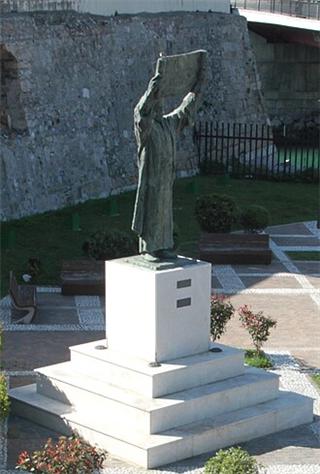
Reval, the medieval name of Tallinn, grew on a site long used by the Estonians, who had a fort on the limestone hill of Toompea and a harbour that the Arab geographer al-Idrisi probably refers to in 1154. In 1219 King Valdemar II of Denmark landed with a crusading army, defeated the Estonians at the Battle of Lindanise, the battle at which, according to later legend, the Danish flag, the Dannebrog, fell from heaven, and built a castle on Toompea. The Danes lost the area to the Livonian Brothers of the Sword in 1227 but regained it by the Treaty of Stensby in 1238, and their Duchy of Estonia covered the northern provinces of Harria and Vironia. German merchants, many from Lübeck and Westphalia, settled below the castle, and Dominican friars founded the convent of St Catherine in the 1240s. In 1248 King Eric IV of Denmark granted the town Lübeck law, giving its citizens self-government, their own council and the right to seek legal guidance from Lübeck; the history of Reval as a self-governing city is dated from this grant. Over the following decades Reval walled its lower town, obtained further privileges from the Danish kings and joined the network of German trading towns that became the Hanseatic League.
Socioeconomy
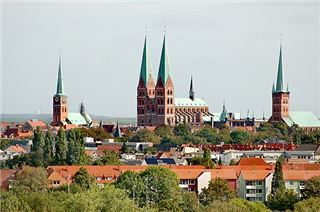
Reval lived from long-distance trade. Its merchants bought furs, wax, flax and hides from Novgorod and Pskov, often through the Hanseatic counting house at Novgorod, the Peterhof, and shipped them west to Lübeck and Flanders, while salt, cloth, herring, wine and metals moved east. Grain from the estates of Harria and Vironia was another export, and the town also traded with Finland and Sweden across the Gulf of Finland. Its population was small, probably several thousand people at most, and sharply divided. The wealthiest German merchants belonged to the Great Guild, whose guildhall was built in the early fifteenth century, and only its members could sit on the council. Unmarried merchants and merchants' assistants formed the Brotherhood of the Blackheads, named after its patron Saint Maurice, which also helped defend the city. Craftsmen organised in the Canute Guild and the more mixed Olaf Guild, while Estonians, called Undeutsche (non-Germans) in the sources, worked as porters, carters, servants and labourers and were largely excluded from the privileged trades and from high office. Religious life centred on the parish churches of St Olaf and St Nicholas, the Dominican convent and the Cistercian nunnery of St Michael, and the guilds and wealthy families endowed altars, chapels, almshouses and other charitable foundations.
Military
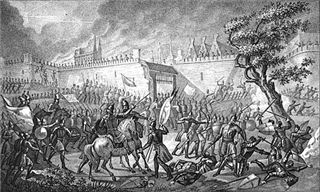
As a merchant town Reval relied mainly on its walls and its citizens rather than on an army of its own. The ring of walls around the lower town was extended and strengthened from the thirteenth to the sixteenth century, eventually reaching about 2.4 kilometres with more than forty towers, around half of which still stand. The cannon tower known as Kiek in de Kök, built from the 1470s, and the massive artillery tower called Fat Margaret at the harbour gate, completed around 1530, show the town's adaptation to gunpowder. Citizens served in the defence by quarters, and the Brotherhood of the Blackheads and the guilds supplied men and equipment. The castle on Toompea, rebuilt as a convent castle by the Livonian Order after 1346, housed the ruler's garrison rather than the town's. Reval's fortifications proved their worth in 1343 during the St George's Night Uprising, when Estonian rebels besieged the town until the Livonian Order's knights crushed them. The town contributed money and ships to the defence of Livonia, including the campaigns against Muscovy led by Master Wolter von Plettenberg in the early sixteenth century. During the Livonian War Russian armies came close, and after Reval passed to Sweden its walls withstood the long Russian sieges of 1570–1571 and 1577.
Governance & Law

Reval was not a sovereign state but a self-governing town under an overlord: the kings of Denmark until 1346, then the Teutonic Order and its Livonian branch. Within its walls, however, the lower town ran its own affairs under Lübeck law. The council, a small body of councillors headed by burgomasters, co-opted its members for life from the merchant elite of the Great Guild, issued ordinances, administered justice, regulated markets and crafts, and conducted relations with other towns. In difficult cases it sought rulings from the council of Lübeck, the mother city of its law. The town also sent delegates to the Livonian diets, where the Order, the bishops, the vassal nobility and the towns met, and to Hanseatic assemblies, and Reval, Riga and Dorpat formed the leading Livonian group within the Hanse. A sharp legal divide separated the lower town from the upper town on Toompea, the seat of the ruler's officials, the bishop of Reval and the knighthood of Harria and Vironia, which had its own jurisdiction, and relations between the two were often tense. The council used its wealth to secure commercial privileges, and together with the other Livonian towns it barred foreign merchants from trading directly with Russians or with each other, so that the Russian trade had to pass through the hands of Reval's citizens.
Global & Regional Impact
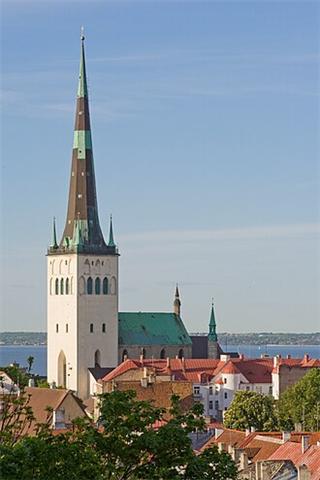
Reval's most enduring legacy is physical. Because the town escaped large-scale destruction for centuries, its lower town keeps much of its medieval street plan, walls, towers, merchant houses, guildhalls and churches, and the Historic Centre (Old Town) of Tallinn was inscribed on the UNESCO World Heritage List in 1997. Its Gothic town hall, completed in 1404, is often described as the oldest surviving town hall in the Baltic region and Scandinavia, and the spire of St Olaf's Church, rebuilt several times, probably made it one of the tallest buildings in Europe in the sixteenth century. The Lübeck artist Bernt Notke painted the Danse Macabre now displayed in St Nicholas' Church and the altarpiece of the Church of the Holy Spirit, while Hermen Rode's high altar survives in St Nicholas. Reval also served as a vital link in the Hanseatic network, carrying the Russian trade between Novgorod and the West and helping to draw north-eastern Europe into the commercial economy of the Baltic. Its legal and social institutions outlasted its medieval status: Lübeck law, the guilds and the German-speaking urban elite remained dominant in the city's civic life until the early twentieth century, and in 1918 the city became, as Tallinn, the capital of independent Estonia.
Decline & Fall

Reval's position changed long before its self-governing life ended. The St George's Night Uprising of 1343 persuaded the Danish crown that its Estonian lands were too costly to hold, and in 1346 Valdemar IV sold them to the Teutonic Order, which entrusted them to its Livonian branch. Reval kept its privileges but now lay inside the Livonian Confederation, a loose union of the Order, the bishoprics and the towns. The closure of the Hanseatic Peterhof at Novgorod by Ivan III of Moscow in 1494 disrupted trade, though Reval and the other Livonian towns continued to profit as intermediaries for Western merchants dealing with Russia. Lutheran preaching spread in the early 1520s, and in 1524 iconoclastic riots stripped many church interiors; the council took control of church affairs, weakening the Catholic Order's hold. When Ivan IV invaded Livonia in 1558, the Livonian War exposed the Confederation's weakness. Russia took Narva and Dorpat, diverting Russian trade to Narva, and the Order could not protect its subjects. In June 1561 the city and the knighthood of Harria and Vironia swore allegiance to Eric XIV of Sweden, who promised to confirm their privileges. Reval became the capital of the Swedish Duchy of Estonia, ending its life as a self-governing Hanseatic town of Livonia.
Reval, the medieval Hanseatic town of Tallinn, governed itself under Lübeck law for more than three centuries and grew rich carrying Russian furs and wax to the West, leaving one of the best-preserved medieval old towns in northern Europe before it submitted to Sweden in 1561.
Test yourself
5 questions on this page, from its key events and facts.
The questions open here once the page has loaded.
References
- Kasekamp, A. (2010) A History of the Baltic States. Basingstoke: Palgrave Macmillan.
- Raun, T.U. (2001) Estonia and the Estonians. 2nd edn. Stanford: Hoover Institution Press.
- Dollinger, P. (1970) The German Hansa. London: Macmillan.
- Christiansen, E. (1997) The Northern Crusades. 2nd edn. London: Penguin.
Connections
Open the full connections map →