South & Southeast Asia
Sikh Empire
At a glance
- Maharaja Ranjit Singh united the feuding Sikh Misls into a single Punjab state, ruling from Lahore from 1799.
- Its European-drilled army was among the strongest in India, and it governed a Muslim-majority population with a mixed-faith court.
- Without institutions to manage succession, it collapsed into court intrigue after 1839 and was annexed by Britain in 1849.
Rise & Fall
- 1799Ranjit Singh, aged eighteen, seizes Lahore from its Bhangi chiefs
- 1801Ranjit Singh is proclaimed Maharaja of the Punjab on Baisakhi
- 1809The Treaty of Amritsar fixes the Sutlej as the Sikh-British boundary
- 1819Sikh forces conquer Kashmir
- 1834The Sikhs occupy Peshawar, extending the empire to the Khyber Pass
- 1839Ranjit Singh dies, leaving the Lahore court to rival factions
- 1846Defeat at Sobraon ends the First Anglo-Sikh War; Kashmir is lost
- 1849Lord Dalhousie annexes the Punjab after the Second Anglo-Sikh War
Foundation

The Sikh Empire's origins are inseparable from the personality and political genius of Maharaja Ranjit Singh, born in 1780 into the Sukerchakia Misl, one of the twelve Sikh confederacies that had governed the Punjab in fragmented fashion after the disintegration of Mughal authority in the mid-eighteenth century. The Punjab in this period was a contested borderland, subject to repeated Afghan invasions under Ahmad Shah Durrani and his successors, and the Misls, though militarily formidable, remained chronically disunited. Ranjit Singh's consolidation began when, aged only eighteen, he exploited the withdrawal of the Durrani ruler Zaman Shah from the Punjab to seize Lahore from its Bhangi chiefs in July 1799, with the support of his formidable mother-in-law Sada Kaur of the Kanhaiya Misl. He was formally proclaimed Maharaja on 12 April 1801, coinciding with Baisakhi, the spring harvest festival, lending the proclamation religious resonance, and in 1802 he took Amritsar, the spiritual centre of Sikhism. Over the following three decades he absorbed the remaining Misls through military pressure, marriage alliances and negotiated submission, unifying the Punjab for the first time as a coherent sovereign state. The Anglo-Sikh Treaty of 1806 and the Treaty of Amritsar of 1809, which fixed the Sutlej River as the boundary between Sikh and East India Company spheres, halted expansion to the east but gave the empire room to grow without direct British confrontation, enabling Ranjit Singh to direct his military energy northward and westward towards Multan, Kashmir and the Khyber frontier.
Socioeconomy
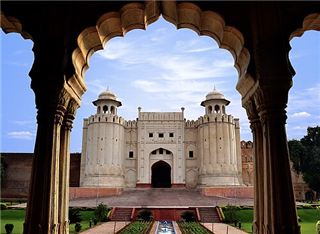
The Sikh Empire governed one of the most agriculturally productive regions of the subcontinent, with the five rivers of the Punjab, the Jhelum, Chenab, Ravi, Beas and Sutlej, sustaining intensive cultivation of wheat, cotton and sugarcane across a densely populated agrarian hinterland. Revenue administration followed a modified form of Mughal practice, with land assessed according to crop and yield and revenue collected through a hierarchy of kardars (revenue officers) and local intermediaries. The jagir system, the assignment of territorial revenues to military commanders and courtiers in lieu of salary, was the empire's principal means of rewarding its elite, though Ranjit Singh kept the most productive territories as khalsa (crown) land under direct management. Lahore served as capital and commercial hub, its bazaars linking Central Asian caravan trade with the Himalayan passes and the markets of Hindustan. Amritsar, the spiritual centre of Sikhism, was also a major commercial entrepôt, its trade in shawls, horses and dried fruits linking the empire to Afghanistan, Kashmir and the wider Indian market. The population was religiously diverse, with a Muslim majority alongside Hindus, Sikhs and smaller communities, and Ranjit Singh's administration pursued a deliberate policy of inclusion, appointing Muslims, Hindus and Europeans to senior civil and military positions alongside the Sikh nobility.
Military
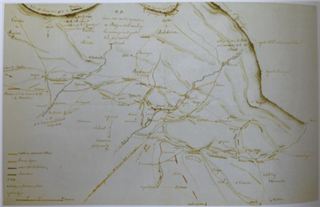
The Fauj-i-Ain, the regular army, was Ranjit Singh's most consequential institutional innovation and the engine of Sikh expansion. Recognising that the traditional Khalsa cavalry, however formidable in irregular warfare, could not match disciplined modern forces, Ranjit Singh from 1822 onwards recruited veterans of the Napoleonic armies, most notably the Frenchman Jean-François Allard, who raised a cavalry corps, the Italian Jean-Baptiste Ventura, who trained the infantry, and the Frenchman Claude Auguste Court, who reorganised the artillery, to drill his troops along European lines. By the late 1830s the army's total strength is often estimated at around 100,000 men, regular and irregular, supported by a substantial artillery park, and many British observers regarded it as the most formidable indigenous army in India. The conquest of Multan in 1818 secured southern Punjab; the Sikh conquest of Kashmir in 1819 brought the valley under Lahore's authority; and the occupation of Peshawar in 1834 extended the empire to the mouth of the Khyber Pass, giving Ranjit Singh a frontier with Afghanistan and a buffer against Afghan resurgence, defended in 1837 at the Battle of Jamrud, where the general Hari Singh Nalwa was killed. The Battle of Nowshera (1823) against Afghan forces had already shown the effectiveness of disciplined infantry and artillery operating together with Khalsa horsemen. The army's reputation was such that the East India Company kept to a cautious policy of non-interference beyond the Sutlej throughout Ranjit Singh's lifetime.
Governance & Law
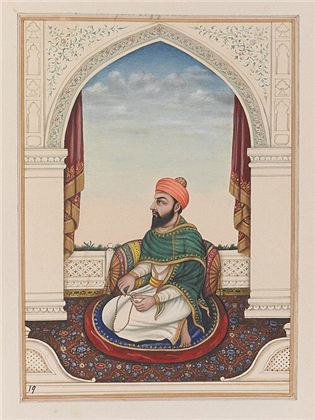
The Sikh Empire's administration was marked by personalised centralisation under Ranjit Singh, whose authority was both secular and sacral: he ruled as Maharaja but presented himself as a servant of the Khalsa and the Sikh Panth, styling his government the Sarkar-i-Khalsa and issuing coins in the name of the Sikh Gurus rather than his own. The Lahore Darbar, the imperial court, was the administrative nucleus, with senior offices, among them the wazir (chief minister), the diwan (finance minister) and the foreign minister, held by a multiethnic and multireligious elite. Fakir Azizuddin, a Muslim, served as Ranjit Singh's principal foreign minister and envoy to the British; the Dogra Dhian Singh rose to become chief minister; and finance was managed successively by officials such as Diwan Bhawani Das, Diwan Ganga Ram and Diwan Dina Nath. Provincial government was delegated to governors (nazims) who were theoretically accountable to Lahore but in practice exercised considerable autonomy, particularly in distant territories such as Kashmir and Peshawar. There was no codified legal system comparable to the Ottoman kanun or Mughal regulations; justice was administered through customary practice, sharia for Muslim subjects and ad hoc royal arbitration. This institutional informality, workable under a dominant personal sovereign, proved fatally fragile after Ranjit Singh's death in 1839, when no mechanism existed to stabilise the succession or restrain the competing ambitions of the Lahore Darbar's factions.
Global & Regional Impact
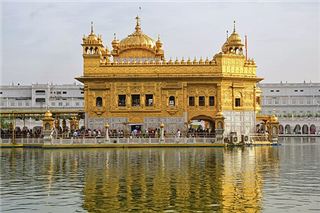
The Sikh Empire's most significant geopolitical function was its role as a buffer between British India and the turbulent Afghan frontier at a critical stage of the Great Game, the rivalry between the British and Russian Empires for influence in Central and South Asia. Ranjit Singh's control of Peshawar and the approaches to the Khyber Pass denied Afghanistan a secure eastern frontier and complicated both Durrani and Barakzai strategic calculations throughout the 1820s and 1830s. The empire's commercial networks extended from the shawl industry of Kashmir, whose fine pashmina was exported to European markets via Lahore and Delhi, to the horse trade of Central Asia and the grain markets of the Gangetic plain. Culturally, Ranjit Singh's patronage transformed Amritsar: the upper storeys of the Harmandir Sahib were covered in gilded copper under his sponsorship, work largely completed by around 1830 that gave the shrine its popular name, the Golden Temple, and it remains the defining monument of Sikh civilisation. The empire demonstrated the viability of a Sikh-led, non-theocratic state that governed a Muslim-majority population with enough even-handedness to secure administrative loyalty, an achievement later historians have often cited as an example of pre-colonial plural government. Europeans who served at the Lahore court left detailed accounts, among them Allard's correspondence and the physician Johann Martin Honigberger's Thirty-five Years in the East, which are important primary sources for the period.
Decline & Fall

The Sikh Empire's collapse was among the most precipitous in this dataset: barely ten years separated the death of its founder from final annexation, a disintegration so rapid that contemporaries struggled to account for it. Ranjit Singh died on 27 June 1839, having named his eldest son Kharak Singh as heir but without building institutions capable of managing the transition, leaving the Lahore Darbar to competing factions of Dogra courtiers, Sikh sardars and army commanders. Rulers followed in rapid and violent succession: Kharak Singh died under suspicious circumstances in November 1840, and his son Nau Nihal Singh was fatally injured the same day by a collapsing gateway in an accident of equally suspicious character; Sher Singh was assassinated in 1843, along with the chief minister Dhian Singh; and the five-year-old Duleep Singh was installed under the regency of his mother, Maharani Jind Kaur. The Khalsa army, unpaid and politically radicalised, increasingly dictated policy through its elected regimental committees (panchayats), and court leaders, notably the wazir Lal Singh and the commander-in-chief Tej Singh, are widely believed to have encouraged war with the British in the hope that defeat would break the army as a political force. The First Anglo-Sikh War (1845–1846) ended in Sikh defeat at Sobraon; the Treaty of Lahore stripped the empire of the Jullundur Doab and Kashmir, which the British then sold to the Dogra Gulab Singh for 7.5 million rupees under the Treaty of Amritsar (1846). The Second Anglo-Sikh War (1848–1849), triggered by risings at Multan and Hazara, ended with Lord Dalhousie's annexation of the entire Punjab on 29 March 1849, and the young Maharaja Duleep Singh was pensioned off and later taken to England.
The Sikh Empire's enduring historical significance lies in its demonstration that a Sikh-led, pluralist and militarily modernised state could emerge from the ruins of Mughal collapse and briefly rival British India in military capacity, a fifty-year arc of extraordinary achievement whose sudden extinction through institutional fragility rather than military inferiority makes it one of history's most consequential might-have-beens.
Test yourself
5 questions on this page, from its key events and facts.
The questions open here once the page has loaded.
References
- Cunningham, J.D. (1849) A History of the Sikhs. London: John Murray.
- Gardner, A. (1898) Memoirs of Alexander Gardner. Edinburgh: William Blackwood.
- Grewal, J.S. (1990) The Sikhs of the Punjab. Cambridge: Cambridge University Press.
- Khushwant Singh (1999) A History of the Sikhs. 2nd edn. 2 vols. Delhi: Oxford University Press.
- Lafont, J.M. (2002) Indika: Essays in Indo-French Relations, 1630–1976. Delhi: Manohar.
- Ratan Singh Bhangu (2004) Prachin Panth Prakash. Translated by H.S. Deol. Amritsar: Singh Brothers.
Connections
Open the full connections map →