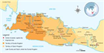
South & Southeast Asia
Hoysala Empire
At a glance
- Hill chiefs of the Malnad who rose as Western Chalukya feudatories and became an independent kingdom under Veera Ballala II in 1187.
- Their soapstone temples at Belur, Halebidu and Somanathapura, on star-shaped platforms, are World Heritage masterpieces of sculpture.
- Weakened by the Delhi Sultanate’s invasions from 1311, the dynasty ended when Veera Ballala III was killed in 1343.
Rise & Fall
- 1116Vishnuvardhana’s forces take Talakad from the Cholas
- 1117The Chennakeshava temple at Belur is consecrated
- 1187Veera Ballala II assumes full imperial titles
- c. 1190Ballala II defeats the Seuna Yadavas at Soratur
- 1268The Keshava temple at Somanathapura is built
- 1311Malik Kafur captures the Hoysala capital Dwarasamudra
- 1343Veera Ballala III is killed fighting the Madurai Sultanate
Foundation

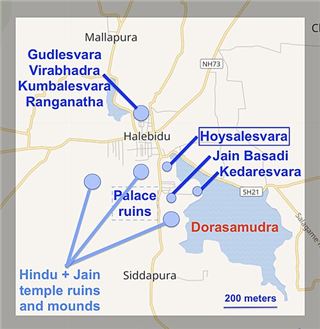
The Hoysalas were hill chiefs of the Malnad, the forested uplands of the Western Ghats in southern Karnataka. Dynastic legend, carved on temples as the royal emblem, tells how their ancestor Sala killed a tiger, or a lion, at the command of a Jain teacher at Sosevur, modern Angadi, who cried out hoy, Sala, ‘strike, Sala’. The first chiefs known from inscriptions, Nripa Kama II in the early eleventh century and his son Vinayaditya, who ruled c. 1047–1098, were feudatories of the Western Chalukya Empire and fought in its wars against the Chola Empire, which then held the old Ganga country around Talakad. The family rose with the service of Ereyanga, a prominent Chalukya commander, and his sons Ballala I and Vishnuvardhana. Vishnuvardhana, who ruled from c. 1108 to 1152, made the Hoysalas a major regional power. In 1116 his generals took Talakad from the Cholas, driving them out of southern Karnataka, and he assumed the title Talakadugonda, ‘conqueror of Talakad’. He moved the court from Sosevur and Belur to Dwarasamudra, modern Halebidu, and pressed northwards against his Chalukya overlords, though Vikramaditya VI contained him. Full independence came only under his grandson Veera Ballala II, who threw off Chalukya and Kalachuri overlordship and assumed imperial titles in 1187.
Socioeconomy
The Hoysala lands joined two economies: the wet Malnad, which produced areca nut, pepper, cardamom and timber, and the drier Maidan plateau, where large irrigation tanks built by kings, nobles and merchants watered rice and sugarcane alongside millet. Many inscriptions record the construction of tanks and the gifts of land to temples and Brahmin villages that went with them. Trade passed through the west-coast ports, where horses from Arabia and Persia were imported for the army and spices exported, and merchant guilds were active in towns such as Dwarasamudra and Belur. Society was organised by caste and occupation, with landholders, merchant communities and village assemblies taking part in local administration. Religion was notably plural. The early Hoysalas patronised Jainism, and Vishnuvardhana’s queen Shantala Devi and his general Gangaraja endowed Jain shrines at Shravanabelagola. According to tradition Vishnuvardhana himself turned to Vaishnavism under the influence of Ramanuja, the Sri Vaishnava philosopher who lived at Melkote in the Hoysala country, while Shaivism flourished too, and the Lingayat movement spread among the population in the twelfth and thirteenth centuries. Madhvacharya, founder of the Dvaita school of Vedanta, was born near Udupi on the Hoysala coast in the thirteenth century. Temples served as centres of worship, education, employment and banking.
Military

The Hoysala army combined infantry and war elephants with a growing cavalry of imported horses, and much of it was supplied by commanders, called dandanayakas, and by local chiefs. The kings also kept bodyguards known as garudas, sworn to share their lord’s fate; inscriptions record such retainers taking their own lives on the death of their master. Vishnuvardhana’s victory at Talakad in 1116 broke Chola power in southern Karnataka, and his campaigns reached the Kongu region and Nolambavadi. Veera Ballala II, who ruled from 1173 to 1220, fought the Kalachuris and the Seuna Yadavas for the inheritance of the Western Chalukya Empire and defeated the Yadava forces at Soratur c. 1190, fixing a frontier along the Malaprabha and Krishna rivers. In the following generation the Hoysalas became arbiters of Tamil politics. Narasimha II intervened repeatedly to protect the weakened Chola king Rajaraja III against the Pandyas and the Kadava chief Kopperunchinga, and his son Vira Someshvara built a second capital at Kannanur Kuppam near Srirangam. These campaigns brought the Hoysalas into conflict with the resurgent Later Pandyan Empire, whose king Jatavarman Sundara Pandya I defeated and killed Someshvara c. 1262. The last major war was against the Delhi Sultanate: Malik Kafur captured Dwarasamudra in 1311, and Veera Ballala III fought on against Delhi’s governors and the Madurai Sultanate.
Governance & Law
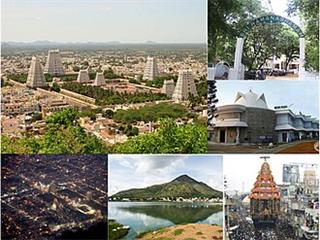
Hoysala government grew out of a chiefdom into a monarchy modelled on the Western Chalukya court. The king ruled with a council of ministers headed by a chief minister, the mahapradhana, and treasurers, commanders and secretaries, and princes and royal kin often governed provinces. The kingdom was divided into provinces called nadu and vishaya, with smaller units of villages, and local government was in the hands of village headmen, assemblies and the corporations of towns, temples and merchants. Royal revenue came from land, trade and tolls, recorded in Kannada inscriptions that are among the most numerous of any medieval Indian kingdom. Succession usually passed from father to son, though princes were associated in government during their fathers’ lifetimes. The main kings after Vishnuvardhana were Narasimha I, Veera Ballala II, Narasimha II, Vira Someshvara, Narasimha III and Veera Ballala III. In the mid-thirteenth century Vira Someshvara divided his lands between two sons: Narasimha III ruled the Karnataka homeland from Dwarasamudra and Ramanatha the Tamil territories from Kannanur Kuppam, an arrangement that led to rivalry and even war between the brothers. The kingdom was reunited under Narasimha III’s son Veera Ballala III, who ruled from 1292 until 1343 and in his last years governed from Tiruvannamalai in the Tamil country.
Global & Regional Impact
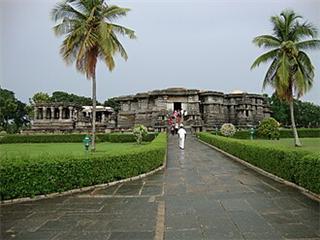
The Hoysalas are remembered above all for their temples. Built mostly of chloritic schist, a soft soapstone that hardens with exposure, on star-shaped platforms, they carry friezes of elephants, horsemen, scrolls and epic scenes and densely carved images of gods and bracket figures, with many panels signed by sculptors such as Mallitamma and Dasoja. The Chennakeshava temple at Belur, consecrated in 1117 by Vishnuvardhana, the twin Hoysaleshvara temple at Halebidu, begun in the 1120s, and the Keshava temple at Somanathapura, built in 1268 by the commander Somanatha under Narasimha III, are the finest of the roughly one hundred surviving Hoysala temples. In 2023 they were inscribed together on the UNESCO World Heritage List as the Sacred Ensembles of the Hoysalas. The period was also rich in Kannada literature: Harihara and Raghavanka pioneered new metres and themes, Janna and Rudrabhatta wrote major works on Jain and Vaishnava subjects, and Kesiraja’s Shabdamanidarpana of 1260 became the classic grammar of Old Kannada. The Hoysala court supported Sanskrit scholarship and the spread of Ramanuja’s Sri Vaishnavism. Politically, the Hoysala kingdom was the last great independent Kannada state before the Delhi Sultanate’s invasions, and its commanders and territories formed the base from which the Vijayanagara Empire emerged in the 1330s.
Decline & Fall
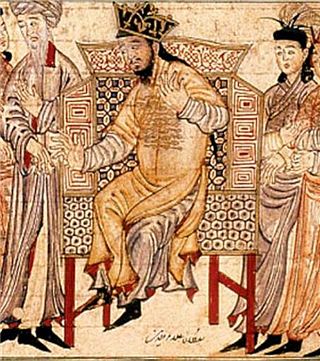
The Hoysala decline began with the division of the kingdom between Narasimha III and Ramanatha in the 1250s and the loss of the Tamil territories to the Later Pandyan Empire, whose armies drove the Hoysalas from Kannanur. The rivalry between the two branches absorbed resources until Veera Ballala III reunited the kingdom in the 1290s. Soon afterwards, in 1311, the Delhi Sultanate’s general Malik Kafur, sent south by Alauddin Khalji, captured Dwarasamudra. Ballala III submitted, surrendered treasure, paid tribute and sent his son to Delhi, and he is reported to have guided Kafur’s army towards the Pandya country. After Muhammad bin Tughluq’s armies extended Delhi’s rule over the south in the 1320s and Dwarasamudra was attacked again, Ballala III shifted his base to Tiruvannamalai and organised fortified posts along his northern frontier. When Delhi’s grip loosened in the 1330s he took the offensive against the new Madurai Sultanate, but in 1343 he was captured near Tiruchirappalli and killed; Ibn Battuta, then at Madurai, reported that his flayed and stuffed body was displayed on the city wall. His son Veera Ballala IV held on briefly, but the remaining Hoysala territories passed by c. 1346 to Harihara I and his brothers, founders of the Vijayanagara Empire, some of whom had probably served the Hoysalas.
The Hoysala Empire grew from Malnad hill chiefs into the leading power of southern Karnataka, whose soapstone temples at Belur, Halebidu and Somanathapura rank among the masterpieces of Indian sculpture, and whose resistance to the Delhi Sultanate prepared the ground for the Vijayanagara Empire.
References
- Derrett, J.D.M. (1957) The Hoysalas: A Medieval Indian Royal Family. Madras: Oxford University Press.
- Nilakanta Sastri, K.A. (1955) A History of South India from Prehistoric Times to the Fall of Vijayanagar. Madras: Oxford University Press.
- Kamath, S.U. (1980) A Concise History of Karnataka from Pre-historic Times to the Present. Bangalore: Archana Prakashana.
- Foekema, G. (1996) A Complete Guide to Hoysala Temples. New Delhi: Abhinav Publications.
- Hardy, A. (1995) Indian Temple Architecture: Form and Transformation. The Karnata Dravida Tradition, 7th to 13th Centuries. New Delhi: Abhinav Publications.
Connections
Open the full connections map →