South & Southeast Asia
Vijayanagara Empire
At a glance
- Founded around 1336 by the Sangama brothers on the Tungabhadra as Delhi Sultanate power collapsed in the south.
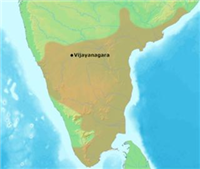
- Under Krishnadevaraya (r. 1509–1529) it was the dominant power of southern India, ruled from a vast capital at Hampi.
- Defeat at Talikota in 1565 led to the sack of the capital; nayaka governors became independent and the empire ended by 1646.
Rise & Fall
- c. 1336Harihara I and Bukka I found the kingdom on the Tungabhadra
- 1378The Madurai Sultanate is destroyed by Vijayanagara armies
- 1443Persian envoy Abdur Razzaq visits the capital
- 1509Krishnadevaraya becomes king
- 1520Krishnadevaraya defeats Bijapur at the Battle of Raichur
- 1565The Deccan sultanates defeat Vijayanagara at Talikota and sack the capital
- c. 1570Tirumala founds the Aravidu dynasty at Penukonda
- c. 1646Sriranga III loses his last territories to Bijapur and Golconda
Foundation
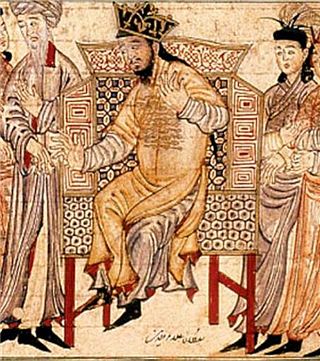
The Vijayanagara Empire arose in the political vacuum left by the Delhi Sultanate's campaigns in southern India in the early fourteenth century. The armies of Alauddin Khalji and Muhammad bin Tughluq had destroyed or humbled the old kingdoms of the Yadavas of Devagiri, the Kakatiyas of Warangal and the Pandyas of Madurai, and in 1327 annexed the small kingdom of Kampili on the Tungabhadra River. Shortly afterwards, as Tughluq authority in the south crumbled, the brothers Harihara I and Bukka I of the Sangama family established their own kingdom on the Tungabhadra, traditionally in 1336, with its capital at the city they named Vijayanagara, "city of victory". Their earlier careers are obscure: a later tradition, now doubted by many historians, holds that they had served Kampili, were captured and converted to Islam by the Tughluqs, and then returned to Hinduism under the guidance of the sage Vidyaranya of Sringeri. When the Hoysala king Veera Ballala III was killed fighting the Madurai Sultanate in 1343, the Sangamas absorbed the Hoysala lands within a few years. Bukka I's son Kumara Kampana then campaigned in the Tamil country and destroyed the Madurai Sultanate by 1378, giving Vijayanagara control of almost all of India south of the Krishna and Tungabhadra rivers.
Socioeconomy

Vijayanagara's wealth came from an agrarian economy expanded by irrigation tanks and canals, from textile production and from trade through the ports of the western and eastern coasts. The capital, at the site now called Hampi, lay in a rocky landscape on the Tungabhadra and drew water from a network of canals and tanks; its population in the early sixteenth century may have reached several hundred thousand, though estimates vary. Foreign visitors, including the Persian envoy Abdur Razzaq in 1443 and the Portuguese Domingo Paes around 1520, described its bazaars of jewels, cloth and grain, its palaces and its festivals, especially the annual Mahanavami celebrations. The state struck gold coins, the varaha or pagoda, widely used in southern India. Horses could not be bred in sufficient numbers in the south, and the import of Arabian and Persian horses through the western ports, after 1510 largely through Portuguese Goa, was vital to the army. Temples were major landowners and economic centres, and kings and nobles endowed huge complexes such as the Virupaksha and Vitthala temples at the capital. Society was dominated by Brahmin and warrior elites, while merchant and artisan groups, organised in guilds and caste associations, gained wealth and influence. The empire also had substantial Muslim populations, including soldiers in royal service.
Military

Vijayanagara was a militarised state, continuously at war for most of its history. Its long rivalry with the Bahmani Sultanate, and later with the Deccan sultanates that succeeded it, centred on the fertile Raichur Doab between the Krishna and Tungabhadra rivers and began in the reign of Bukka I with notoriously destructive campaigns on both sides. Armies combined large infantry levies, archers, war elephants and cavalry mounted on imported horses. Deva Raya II (r. 1424–1446) recruited Muslim cavalry and archers and gave them land, aiming to match the mounted archery of his Deccani rivals, and firearms were adopted in the sixteenth century, sometimes with Portuguese help. Abdur Razzaq described the capital as surrounded by several concentric lines of fortification, and a chain of strongholds, including Raichur, Gooty, Penukonda and Chandragiri, defended the frontiers. The empire's greatest commander was Krishnadevaraya (r. 1509–1529), who defeated the Gajapati rulers of Odisha in campaigns between 1513 and 1519, taking Udayagiri and Kondavidu, and in 1520 defeated Ismail Adil Shah of Bijapur at the Battle of Raichur. The decisive defeat came on 23 January 1565 at the Battle of Talikota, when the combined armies of Bijapur, Ahmadnagar, Golconda and Bidar destroyed the Vijayanagara army and killed its leader Aliya Rama Raya.
Governance & Law
Four dynasties ruled Vijayanagara in succession: the Sangama (c. 1336–1485), the Saluva (1485–1505), the Tuluva (1505–c. 1570) and the Aravidu (c. 1570–1646). Changes of dynasty usually came through powerful generals who first acted as regents: Saluva Narasimha seized the throne from the last weak Sangama king, the Tuluva general Narasa Nayaka ruled in the name of a Saluva heir, and Aliya Rama Raya dominated the court as regent for Sadashiva Raya before his family founded the Aravidu line. The king, styled raya, stood at the top of a hierarchy of ministers, provincial governors and military chiefs. The most distinctive institution was the nayaka system, in which commanders received the revenue of assigned territories, called amaram, in return for maintaining specified numbers of troops and paying tribute to the crown. The system allowed rapid mobilisation but gave great power to the nayakas, who became hereditary rulers in many regions. At the local level, villages were managed by hereditary officials, the ayagars, paid with shares of the harvest. Brahmin ministers and temple institutions supported royal government, and the kings presented themselves as protectors of Hindu dharma while also using Persianate titles, dress and court ceremony; several styled themselves "sultan among Hindu kings".
Global & Regional Impact

Vijayanagara shaped the political and cultural map of southern India for centuries. Its patronage fostered literature in Sanskrit, Kannada, Telugu and Tamil. Under the early Sangama kings the scholar Sayana and his collaborators produced commentaries on the Vedas that became standard. Krishnadevaraya himself composed the Telugu poem Amuktamalyada, and his court is associated with celebrated poets such as Allasani Peddana. The composer Purandara Dasa, traditionally regarded as the father of Carnatic music, lived and worked within the empire. Vijayanagara architecture, with its tall gateway towers, pillared halls carved with horses and mythical beasts and large temple-city complexes, set a style followed across the south, and many temples in Tamil Nadu and Andhra Pradesh were rebuilt or enlarged under its rule. The ruins of the capital at Hampi were inscribed as a UNESCO World Heritage Site in 1986. Politically, the nayaka kingdoms that succeeded it, including Madurai, Thanjavur, Gingee, Ikkeri and the Wodeyars of Mysore, inherited its institutions and claimed its legitimacy. Even foreign trade was affected: in 1639 the English East India Company obtained the site of Madras, where it built Fort St George, from a local nayaka subordinate to the Aravidu kings. In modern times Vijayanagara has been invoked as a symbol of south Indian and Hindu resistance, a reading that historians often treat with caution.
Decline & Fall
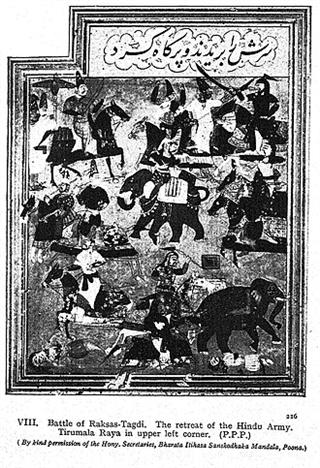
The defeat at the Battle of Talikota in 1565 was followed by the sack of the capital, which the victorious armies plundered for months; the city was abandoned and never reoccupied. Rama Raya's brother Tirumala withdrew with the treasury and the puppet king Sadashiva Raya to Penukonda and around 1570 took the throne himself, founding the Aravidu dynasty. The empire survived for another eighty years in reduced form. Venkatapati Raya II (r. 1586–1614) restored some authority and moved the court to Chandragiri, but after his death a disputed succession led to civil war among the nobility. The great nayakas of Madurai, Thanjavur and Gingee, and the Wodeyars of Mysore, who took Srirangapatna in 1610, now ruled largely as independent princes, giving only nominal allegiance. Meanwhile the Deccan sultanates of Bijapur and Golconda advanced into the south. The last king, Sriranga III, came to the throne in 1642 and tried to reassert control, but he was defeated by the armies of Bijapur and Golconda and by his own nayakas, and by about 1646 had lost his remaining territories, after which he lived as a fugitive under the protection of others. The southern nayaka kingdoms carried on many of Vijayanagara's institutions until they too fell to the Marathas, the Mughals and later the British.
Vijayanagara was the dominant power of southern India for over two centuries, uniting the south against the Deccan sultanates, building at Hampi one of the great cities of its age and shaping the politics, architecture, music and literature of the region long after its defeat at Talikota in 1565.
References
- Sewell, R. (1900) A Forgotten Empire (Vijayanagar): A Contribution to the History of India. London: Swan Sonnenschein.
- Nilakanta Sastri, K.A. (1955) A History of South India from Prehistoric Times to the Fall of Vijayanagar. Madras: Oxford University Press.
- Stein, B. (1989) Vijayanagara. The New Cambridge History of India, I.2. Cambridge: Cambridge University Press.
- Eaton, R.M. (2005) A Social History of the Deccan, 1300–1761: Eight Indian Lives. Cambridge: Cambridge University Press.
Connections
Open the full connections map →