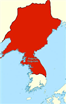
Central & East Asia
Hephthalite Empire
At a glance
- The Hephthalites, who called themselves Ebodalo on their coins, were militarily important from 450, when they defeated the Kidarites, to 560, when the First Turkic Khaganate and the Sasanian Empire destroyed them.
- Peroz I fought three wars against them from 474: captured and ransomed twice, he was defeated and killed at the Battle of Herat in 484, and the Sasanians paid tribute until the 530s.
- They were a tribal confederation of nomadic and settled communities who adopted the Bactrian language, took Sasanian coin designs, and ruled a largely Iranian population through local rulers.
Rise & Fall
- 456The first Hephthalite embassy reaches the Chinese court of the Northern Wei; twenty-four embassies to China are recorded in all, the last in 558.
- 458The Hephthalite king Akhshunwar helps Peroz I gain the Sasanian throne from his brother.
- 474Peroz I begins three wars against his former allies; captured in the first two, he pays thirty mules loaded with silver drachms and leaves his son Kavad as a hostage.
- 484At the Battle of Herat Peroz I is defeated and killed by the Hephthalite king Kun-khi; for two years the Hephthalites plunder and control the eastern Sasanian Empire.
- 488A Hephthalite army defeats the Sasanian army of Balash and places Kavad I, who had lived four years among the Hephthalites, on the throne.
- 509The Hephthalites capture Sughd, the capital of Sogdiana, and push north of Turfan to the Urumchi region in the Tarim Basin.
- 516King Yilituo Yandai sends the first Hephthalite ambassador to the Southern Liang court, recorded in the Portraits of Periodical Offering of Liang.
- 557The Turks of the First Turkic Khaganate and the Sasanians under Khosrow I defeat the Hephthalites after an eight-day battle near Qarshi, the Battle of Gol-Zarriun; the empire breaks into principalities.
Foundation
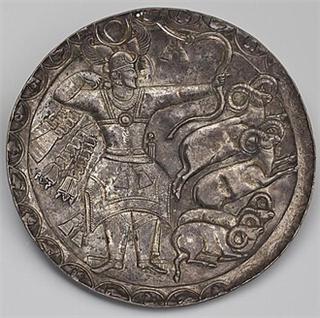
The Hephthalites belong to what the numismatist Robert Göbl called the Iranian Huns. Their stronghold was Tokharistan, on the northern slopes of the Hindu Kush in today's southern Uzbekistan and northern Afghanistan, with a capital probably at Kunduz. Their origins are disputed: the Weishu, as quoted in the Tongdian, says they were a branch of the Gaoju, early Turkic speakers, who came south from the Altai around 360, and the most prominent current view, that of de la Vaissière, makes them Turkic in origin, adopting the Bactrian language after settling in Bactria; others have argued for Iranian or Proto-Mongolic roots, and Richard Frye called them 'probably a mixed horde'.
They were vassals of the Rouran Khaganate until the early 5th century, borrowing the title khan, before moving south-east to escape Rouran pressure. The Hephthalites became a significant power in Bactria around 450, displacing the Kidarites and then the Alchon Huns, who went on into Gandhara and northern India. Persian sources name them as foes of Yazdegerd II from 442. Their first embassy reached the Northern Wei in 456. In 458 the king Akhshunwar helped Peroz I take the Sasanian throne from his brother Hormizd III, and by 467 Peroz, with Hephthalite aid, had captured Balaam and ended Kidarite rule in Transoxiana. A tax receipt from the Kingdom of Rob dated 483/484 securely attests Hephthalite rule in Bactria.
Socioeconomy
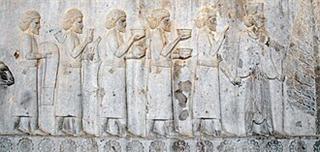
The Hephthalites were a tribal confederation that included both nomadic and settled urban communities. Procopius insisted they were 'not nomads like the other Hunnic peoples' but settled under one king and a lawful constitution, while some Chinese sources said they lived in tents; Litvinsky sees nomads who moved into the cities they conquered. They adopted Bactrian, an Eastern Iranian language written in the Greek alphabet, as their official tongue and inscribed their coins with it, calling themselves Ebodalo. Documents from the Kingdom of Rob record taxes paid to Hephthalite rulers between 484 and 527.
Wealth came above all from Persia. After 474 the Sasanians paid 'an enormous tribute' until the 530s, and Peroz's coinage flooded Tokharistan; the Hephthalites developed no coinage of their own but minted Sasanian designs or countermarked Sasanian coins with their symbols. The ransoms and tributes may have been reinvested in Sogdia, which they conquered in 479 or 509 and which grew extremely prosperous as the centre of a new Silk Road linking China with the Sasanian and Byzantine empires; the Hephthalites took over the Kushans' old role as intermediary and contracted Sogdians to carry silk and luxury goods. They may have built fortified grid-plan cities at Bukhara, Panjikent and Herat. De la Vaissière estimates the major oases of Tokharistan and western Turkestan at several hundred thousand people each, those of the Tarim Basin at tens of thousands.
Military
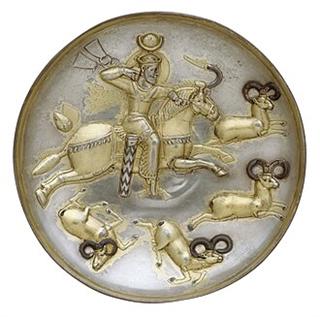
The Hephthalites were a powerful military force whose main weapon, depending on the source, was the bow, the mace or the sword; the Chinese considered them excellent archers, and their achievements imply a strong cavalry. The Armenian chronicler Lazar Parpetsi wrote that even in peacetime the mere mention of a Hephthalite terrified everybody in Persia. The reliefs of the Bandian complex seem to show a defeat by the Sasanians in 425 and then alliance, until the Hephthalites destroyed the complex in 484.
From 474 Peroz I fought three wars against them. In the first two he was captured and ransomed; after the second he handed over thirty mules loaded with silver drachms and left his son Kavad as a hostage. In the third, the Battle of Herat in 484, he was defeated and killed by the king Kun-khi, and for two years the Hephthalites plundered and controlled the eastern Sasanian Empire. In 488 a Hephthalite army beat the Sasanian army of Balash and enthroned Kavad I, and in 498 the king gave Kavad 30,000 troops to regain his throne in return for Chaganiyan; Joshua the Stylite records Kavad leading Hephthalite troops against the Romans at Theodosiupolis in 501–502 and Edessa in 503. In the east they took the western Tarim Basin from the weakening Rouran, Turfan in 479 and the Urumchi region in 497–509. The two-point sword suspension and the lamellar helmet spread from them to the Sasanians, and a dagger of 'Hunnic' design found at Gyerim-ro reached Korea.
Governance & Law

Rule rested on a confederation of local rulers and governors bound by alliance agreements. Central control was weak: there were some government officials, but local dynasties paid tribute, and vassals such as Asbar of Vardanzi minted their own coins. The ruler bore the title yabghu, as on the seal reading 'Ebodalo Yabghu', the Lord of the Hephthalites, dated to the late 5th or early 6th century. Known rulers are few: Akhshunwar around 458, Kun-khi around 484, Yilituo Yandai around 516, Hwade-gang from the Rob archive, Ghadfar around 567–568 and Faghanish of Chaghaniyan. There is no king-list.
Government and religion were mixed. Chinese sources say the Hephthalites worshipped the heaven god or the fire god, and the monk Song Yun, who visited in 540, reported that they did not recognise Buddhism; some destroyed Buddhist monasteries, which others rebuilt. Yet under their dominion Buddhism was predominant, with Zoroastrian and Manichaean minorities and many Hindu adherents; Balkh had some 100 monasteries and 30,000 monks, the capital of Chaghaniyan five, and the Buddhas of Bamiyan were begun under Hephthalite rule. In 549 they asked the patriarch of the Church of the East, Mar Aba I, to consecrate a priest they had chosen as their bishop. Cities such as Balkh, Kobadiyan and Samarkand were allowed to send their own embassies to China, and the Hephthalite envoys led the column of foreign ambassadors at the Liang court in 516–526.
Global & Regional Impact

For nearly a century the Hephthalites held the balance of power in Iran. They made and unmade Sasanian kings, raising Peroz I in 458 and Kavad I in 488 and 498, and from 474 the Sasanian Empire paid them tribute until Khosrow I's rise in the 530s. Their conquest of Sogdia placed them at the centre of a new Silk Road between China and the Sasanian and Byzantine empires; Sasanian silver received as tribute spread along it, and the Hephthalite symbol appears on Samarkand's coinage from 500 to 700. Chinese chronicles record twenty-four embassies between 456 and 558.
Their rule unified Central Asia culturally. The 'Hephthalite period' in art, with caftans folded to a triangular right lapel, cropped hair and crowns with crescents, appears in the murals of Balalyk Tepe and Tavka Kurgan, among the donors painted on the ceiling of the Buddhas of Bamiyan, in Sogdia and in the Kizil Caves of Kucha; their rulers also fill the panels of the Sogdian trader Wirkak's tomb at Xi'an. A number of peoples have been proposed as their descendants, among them the Pashtuns, whom Gankovsky connects with the dissolution of the Hephthalite confederacy, the Khalaj, the Abdals and some Rajput clans; Chinese chronicles still mention a Hephthalite kingdom in 748.
Decline & Fall
After Kavad I the Hephthalites turned their attention away from Persia, and his successor Khosrow I (531–579) resumed expansion to the east. In 552 the Göktürks took Mongolia and formed the First Turkic Khaganate. Around 555–567, perhaps in 557, the Turks and Khosrow I allied against the Hephthalites and defeated them after an eight-day battle near Qarshi, the Battle of Gol-Zarriun. The empire fragmented into semi-independent principalities paying tribute to the Sasanians or the Turks as the military situation dictated; the defeated Hephthalites withdrew to Bactria and replaced king Gatfar with Faghanish, ruler of Chaghaniyan, upon which Khosrow crossed the Oxus and put Chaghaniyan and Khuttal under tribute. The Oxus became the frontier between the two empires.
The remnants lasted long. Principalities in Chaghaniyan, Khuttal, Termez, Balkh, Badghis, Herat and Kabul held castles on the roads to Bamiyan, where the giant Buddhas were built around 570 and 618. The Hephthalites rebelled against the Sasanians on Khosrow's death in 579 and were crushed by the Turks; they joined Bagha Qaghan's invasion south of the Oxus in 588 and raided as far as Isfahan around 600 and 616–617. From 625 the Western Turks took over Tokharistan as the Tokhara Yabghus. After the Arab conquest of Balkh in 652 the principalities paid tribute to the Arabs, and Nezak Tarkan's revolt of 709 ended in 710 when Qutaiba ibn Muslim captured and executed him despite a promise of pardon.
The Hephthalites, the White Huns of Tokharistan, rose around 450 to dominate Central Asia from Sogdia to the Tarim Basin, killed Peroz I in 484, made Kavad I king and drew tribute from Persia for sixty years. A Turkic-Sasanian alliance destroyed their empire around 560, but Hephthalite principalities on the Oxus survived into the 8th century.
Test yourself
5 questions on this page, from its key events and facts.
The questions open here once the page has loaded.
References
- Mark Dickens, 'Hephthalites (White Huns, Abdelai, Hayatila, Hua)', in Oliver Nicholson (ed.), The Oxford Dictionary of Late Antiquity (Oxford University Press, 2018)
- M. Grignaschi, 'La Chute de l'Empire Hephthalite dans les sources byzantines et perses et le problème des Avar', Acta Antiqua Academiae Scientiarum Hungaricae 28 (Akadémiai Kiadó, 1980)
- Hans Wilhelm Haussig, Die Geschichte Zentralasiens und der Seidenstrasse in vorislamischer Zeit (Wissenschaftliche Buchgesellschaft, 1983)
- M. Morony, 'Arab ii. Arab conquest of Iran', Encyclopaedia Iranica, vol. II, fasc. 2 (1986)
Connections
Open the full connections map →