Europe
Duchy of Brabant
At a glance
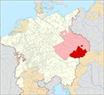
- A duchy of the Holy Roman Empire centred on Leuven, Brussels and Antwerp, among the most urbanised lands of medieval Europe.
- Its Joyous Entry of 1356 bound every new duke to respect the estates' rights and was sworn by Burgundian and Habsburg rulers alike.
- Antwerp made it Europe's commercial hub in the 1500s; the Dutch Revolt split it, and France annexed the rest in 1795.
Rise & Fall
- 1190The Diet of Schwäbisch Hall confirms Henry I's ducal rank over Brabant
- 1288John I wins the Battle of Worringen and gains the Duchy of Limburg
- 1356Duchess Joanna and Wenceslaus swear the Joyous Entry charter
- 1430Philip the Good of Burgundy inherits Brabant
- 1531Antwerp opens its new commercial exchange
- 1585Alexander Farnese captures Antwerp; the Dutch close the Scheldt
- 1648The Peace of Münster confirms the split of Brabant between Spain and the Dutch Republic
- 1795The French Republic annexes the duchy
Foundation

Brabant grew out of the County of Louvain, a lordship on the Dyle river held from the eleventh century by a line of counts who also controlled Brussels. In 1106 Emperor Henry V gave Count Godfrey I of Louvain the title of duke of Lower Lorraine, an old duchy that had once covered most of the Low Countries but had by then dissolved into a mass of counties and bishoprics. Godfrey's successors contested this largely empty title with the rival house of Limburg. Henry I, associated with his father Godfrey III in government from about 1183 and sole ruler from 1190, began to style himself duke of Brabant, after the name of an old district west of Brussels. At the Diet of Schwäbisch Hall in 1190 Emperor Henry VI confirmed that the ducal rank applied to Henry's own territories, which included Louvain, Brussels, Antwerp and lands stretching north towards the Meuse, rather than to the whole of Lower Lorraine. This marked the birth of the Duchy of Brabant as a territorial principality of the Holy Roman Empire. Henry I (d. 1235) spent the next half century enlarging it, founding towns such as 's-Hertogenbosch around 1185, competing with Flanders, Holland and the prince-bishops of Liège, and building a network of castles and chartered towns that gave the duchy its distinctively urban character.
Socioeconomy
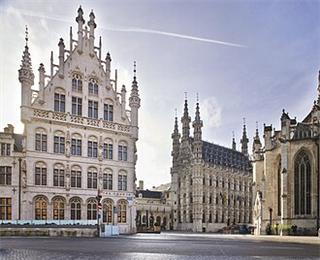
Brabant was one of the most urbanised regions of medieval Europe. Its four chief towns, Leuven, Brussels, Antwerp and 's-Hertogenbosch, along with smaller centres such as Tienen, Nivelles and Lier, grew rich on woollen cloth woven from English wool, and their guilds and patrician families became both partners and rivals of the dukes. When cloth-making declined in the late fourteenth century the towns turned to luxury trades, and Brussels became famous for tapestries, carved altarpieces and goldsmiths' work. The duchy's commercial centre of gravity then shifted to Antwerp. Its fairs, alongside those of Bergen op Zoom, attracted English cloth merchants, South German financiers such as the Fuggers and, from about 1500, the Portuguese spice trade, and in 1531 the city opened a purpose-built exchange. By the 1560s Antwerp had around 100,000 inhabitants and was the commercial and financial capital of northern Europe, and a centre of printing where Christophe Plantin ran one of the largest presses of the age. Most Brabanters spoke Dutch, but Walloon Brabant around Nivelles spoke French. Religious life was shaped by abbeys such as Villers and Affligem and by mystics including Hadewijch and Jan van Ruusbroec, and the University of Leuven, founded in 1425, became one of the leading universities of Catholic Europe. In the sixteenth century Protestant ideas spread quickly in Antwerp, preparing the conflicts of the Dutch Revolt.
Military

Brabant's dukes fought chiefly for control of the lands between the Scheldt, the Meuse and the Rhine. Henry I's expansion towards Liège ended in defeat by the prince-bishop's forces at the Battle of Steppes in 1213. The duchy's greatest military success came under John I, who in the War of the Limburg Succession defeated Siegfried of Westerburg, archbishop of Cologne, and Count Reinald I of Guelders at the Battle of Worringen on 5 June 1288, and so acquired the Duchy of Limburg and control of the trade route from the Rhine to the sea. The death of Duke John III in 1355 without a male heir provoked the War of the Brabantine Succession: Louis of Male, count of Flanders, defeated the Brabanters at the Battle of Scheut in August 1356 and took Brussels, until a small band under Everard t'Serclaes recaptured the city that October. In 1371 Duke Wenceslaus was defeated and captured by the duke of Jülich at the Battle of Baesweiler. Under the Habsburgs Brabant became a main theatre of the Eighty Years' War, with the Spanish Fury at Antwerp in 1576, Alexander Farnese's siege of Antwerp in 1584–1585, and in 1706 the Duke of Marlborough's victory at the Battle of Ramillies gave the allies control of the duchy.
Governance & Law

The dukes governed a duchy in which the towns held unusual power. Ducal finances depended on the urban economy, and recurring debts forced rulers into concessions. In 1312 the dying John II granted the Charter of Kortenberg, which created a council of four knights and ten town representatives to oversee government and allowed resistance if the duke broke its terms. The most famous of these agreements was the Joyous Entry (Blijde Inkomst), sworn in January 1356 by Duchess Joanna and her husband Wenceslaus of Luxembourg as the price of their recognition. It guaranteed the duchy's indivisibility, reserved offices to natives of Brabant, required the consent of the estates for wars, coinage and new taxes, and released subjects from obedience if the ruler violated it. Every later duke, Burgundian and Habsburg rulers included, swore a Joyous Entry on accession. The estates of Brabant, made up of the prelates of the great abbeys, the nobles and the chief towns, voted subsidies and became a permanent institution. Under the Burgundian dukes a professional Council of Brabant, headed by a chancellor, became the duchy's high court and administrative council, and Brussels, with its palace on the Coudenberg, became the usual residence of the rulers and later of the governors-general of the Habsburg Netherlands. It was in Brussels that Emperor Charles V abdicated in 1555 in favour of his son Philip II of Spain.
Global & Regional Impact
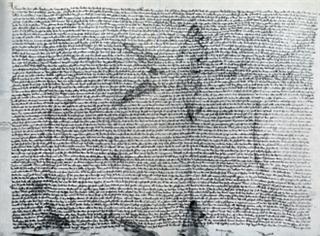
Brabant's influence was political, economic and artistic. The Joyous Entry became one of the best-known charters of liberties in European history: it was invoked against Philip II of Spain during the Dutch Revolt, and the Act of Abjuration of 1581, by which the rebel provinces renounced Philip, is often seen as drawing on its principle that a prince who broke his oath forfeited obedience. Its memory revived in the Brabant Revolution of 1789. Sixteenth-century Antwerp was the first great hub of a world economy linking the Baltic, England, southern Germany, the Mediterranean and the Iberian empires, and its commercial techniques passed to Amsterdam after 1585 along with many of its merchants and craftsmen. Brabant's towns sustained much of the art of the Low Countries: Rogier van der Weyden was city painter of Brussels, Dieric Bouts worked in Leuven, Pieter Bruegel the Elder lived in Antwerp and Brussels, and Peter Paul Rubens made Antwerp the centre of Flemish Baroque painting in the seventeenth century. The University of Leuven trained generations of Catholic scholars, and Erasmus helped to establish its College of the Three Languages in 1517. Brabant's name survives in the Belgian provinces of Flemish Brabant and Walloon Brabant and the Dutch province of North Brabant, the Brussels region lies at the heart of the old duchy, and the Belgian national anthem is called the Brabançonne.
Decline & Fall

Duchess Joanna, childless, passed the duchy to her great-nephew Antoine of Burgundy, a younger son of Philip the Bold, who was killed at the Battle of Agincourt in 1415; after his sons John IV and Philip of Saint-Pol died without heirs, Philip the Good of Burgundy inherited Brabant in 1430. From then on it was one of the Burgundian and later Habsburg Netherlands, keeping its estates and charters but sharing its ruler with the other provinces. The Dutch Revolt split it. Brabant joined the rising against Spain in the 1570s, but Alexander Farnese reconquered the south and took Antwerp in 1585, after which the Dutch closed the Scheldt and Antwerp's trade withered. The Peace of Münster in 1648 confirmed the division: the north, around 's-Hertogenbosch and Breda, became States Brabant, a territory ruled directly by the States General without a voice of its own, while the south remained under Spain and from 1714 under Austria. When Joseph II tried to override the Joyous Entry, the Brabant Revolution of 1789 drove out the Austrians and proclaimed the United Belgian States in January 1790, but Austrian troops returned by the end of that year. After French victories at Jemappes in 1792 and Fleurus in 1794, the French Republic annexed the southern Netherlands on 1 October 1795 and divided Brabant into French departments, ending the duchy.
The Duchy of Brabant joined a powerful urban economy to a strong tradition of written liberties: its Joyous Entry of 1356 bound every ruler to respect the estates' rights, and its city of Antwerp became the commercial capital of sixteenth-century Europe before the Dutch Revolt divided the duchy.
References
- Blockmans, W. and Prevenier, W. (1999) The Promised Lands: The Low Countries under Burgundian Rule, 1369–1530. Philadelphia: University of Pennsylvania Press.
- Israel, J.I. (1995) The Dutch Republic: Its Rise, Greatness, and Fall, 1477–1806. Oxford: Clarendon Press.
- Parker, G. (1977) The Dutch Revolt. London: Allen Lane.
- Van der Wee, H. (1963) The Growth of the Antwerp Market and the European Economy (Fourteenth–Sixteenth Centuries). 3 vols. The Hague: Martinus Nijhoff.
- Vaughan, R. (1970) Philip the Good: The Apogee of Burgundy. London: Longman.
Connections
Open the full connections map →