Europe
Novgorod Republic
At a glance
- A merchant city-state of the Russian north that elected its officials and archbishop and hired princes by contract.
- It ruled a huge fur-producing hinterland to the White Sea and the Urals and traded with the Hanseatic League.
- Ivan III of Moscow crushed its army in 1471, annexed it in 1478 and took away its veche bell.
Rise & Fall
- 1136Novgorodians expel Prince Vsevolod Mstislavich; the republic begins
- 1170Novgorod repels the army of Andrey Bogolyubsky
- 1242Alexander Nevsky defeats the Livonian knights on Lake Peipus
- 1323Treaty of Nöteborg draws the first border with Sweden
- 1348Treaty of Bolotovo recognises Pskov’s independence
- 1456Treaty of Yazhelbitsy limits Novgorod’s independence
- 1471Ivan III’s army defeats Novgorod at the Shelon River
- 1478Novgorod surrenders to Ivan III; the veche bell is taken to Moscow
Foundation

Novgorod stands on the Volkhov River just north of Lake Ilmen, on the river route that linked the Baltic with the Dnieper and the Volga. The Primary Chronicle places the arrival of the Varangian Rurik there in 862, while archaeology dates the earliest streets of the city to the tenth century. As the second city of Kievan Rus’, Novgorod was usually governed by a son of the grand prince of Kiev: Vladimir the Great and Yaroslav the Wise both ruled there before taking the throne in Kiev, and the stone Cathedral of Saint Sophia was built in 1045–1050. In the early twelfth century Novgorodians began to assert themselves against princes sent from Kiev, and the city’s own officials, the posadnik and the tysyatsky, came to be chosen locally. The decisive break came in 1136, when the citizens arrested Prince Vsevolod Mstislavich, accused him of neglecting the city and fleeing a battle, and then expelled him. Historians usually date the republic from this event. From then on Novgorod invited princes from the various branches of the Rurikid dynasty and bound them by written agreements, and in 1156 the townspeople began electing their own bishop. The city called itself Lord Novgorod the Great (Gospodin Velikiy Novgorod), and for over three centuries it remained the largest self-governing state in the Russian lands.
Socioeconomy

Novgorod’s poor soils and cold climate made it dependent on imported grain from the Volga region, but its vast northern hinterland supplied the forest products that Europe wanted. Through tribute collected from Finnic and Ugric peoples and through trading expeditions, Novgorodians gathered furs, above all squirrel pelts, as well as wax, honey and walrus ivory from lands stretching to the White Sea, the Pechora and beyond the Urals. These were sold to merchants from Gotland and later from the German towns of the Hanseatic League, who from the late twelfth century had their own trading court, the Peterhof, in the city, and who brought cloth, silver, salt, herring and wine. The city was divided into five ends (kontsy) and many streets, each with its own assemblies, and society ranged from great boyar landowners and wealthy merchants organised in associations such as that of Saint John to artisans, poorer townsfolk and dependent peasants. Since 1951 archaeologists have found more than a thousand birchbark letters preserved in Novgorod’s waterlogged soil, covering business, debts, family matters and lessons; one group shows a boy named Onfim practising his letters and drawings in the thirteenth century. They show that literacy reached well beyond the clergy. Orthodox Christianity shaped city life, and churches were built by streets, guilds and wealthy patrons.
Military
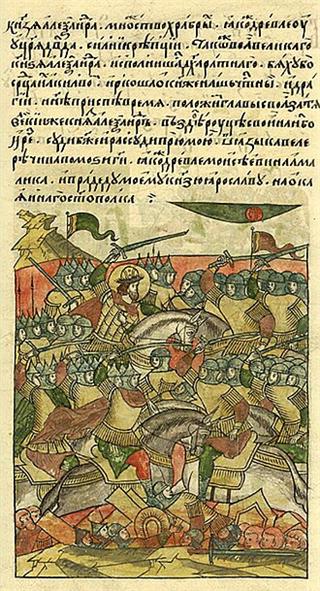
Novgorod’s armies combined the prince’s retinue with a militia raised from the city and its territory, commanded by the prince, the posadnik and the tysyatsky. In 1170 the city repelled a siege by the forces of Andrey Bogolyubsky of Vladimir-Suzdal, a victory later attributed to the miraculous Icon of the Sign. When the Mongols invaded in 1237–1238, their army turned back before reaching Novgorod, perhaps because of the spring thaw, and the city escaped destruction. Its main wars were fought in the north-west. Prince Alexander Yaroslavich defeated a Swedish force on the Neva in 1240, earning the name Nevsky, and in 1242 defeated the Livonian branch of the Teutonic Order on the ice of Lake Peipus, the Battle on the Ice. In 1268 Novgorod and its allies fought Danish and Livonian forces at Rakvere (Wesenberg). Conflict with Sweden over Karelia and the Neva ended for a time with the Treaty of Nöteborg of 1323, which drew the first border between them, after Novgorod built the fortress of Oreshek at the source of the Neva. Bands of river raiders known as ushkuiniki sailed down the Volga and the Kama in the fourteenth century, plundering Tatar and Russian towns. Novgorod’s militia proved no match for Moscow’s armies: Vasily II defeated it at Staraya Russa in 1456, and Ivan III’s commanders routed it on the Shelon River in 1471.
Governance & Law
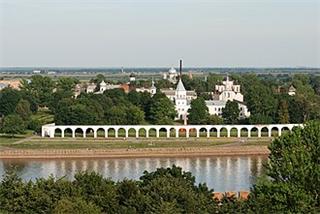
Novgorod’s constitution was never written down as a single document, and historians still debate how it worked in practice. Its supreme body was the veche, an assembly of citizens that met at Yaroslav’s Court on the trading side of the city, summoned by a bell. It elected the posadnik, the chief civic official, the tysyatsky, who represented the wider population and dealt with commercial courts, and the archbishop, who presided over the church’s large estates, whose cathedral by tradition kept the city treasury, and who acted as a mediator in disputes; the elected archbishop was chosen by lot among candidates. Princes were invited under written contracts that limited them to military command and certain judicial functions, forbade them to acquire land in Novgorod territory and required them to live at Gorodishche outside the city. In practice power lay with a small number of boyar families, who competed for office through factions based in the city’s ends, and veche meetings could end in street fighting on the Volkhov bridge. From the mid-fourteenth century several posadniks held office together, and by the fifteenth century there were dozens. The distant territories, including Pskov until it became independent by the Treaty of Bolotovo, traditionally dated to 1348, were governed by officials sent from the city or ruled through tribute, and the rural lands around the city were later organised into five districts, the pyatiny.
Global & Regional Impact

Novgorod is the most important example of a republican city-state in medieval Eastern Europe, and its history has often been used, by nineteenth-century liberals and Decembrists as well as later historians, to show that Russian history contained a tradition of self-government before Muscovite autocracy. Because the city was never sacked by the Mongols, it preserved much of early Russian culture. Its churches and icons, the Cathedral of Saint Sophia, the frescoes painted by Theophanes the Greek in the Church of the Transfiguration on Ilyina Street in 1378 and the Novgorod school of icon painting, are among the finest works of medieval Russian art; the historic monuments of Novgorod are a World Heritage Site. The Novgorod First Chronicle is a key source for Russian history, and the birchbark letters have transformed knowledge of everyday life and language in medieval Russia. Novgorod linked Russia to the Baltic and the Hanseatic world, and German merchants’ records of the Peterhof are central sources for Hanseatic trade. Its expansion to the north and east, by colonists, monasteries and fur traders, laid the foundation for the later Russian presence in the European north and beyond the Urals. Its defeats of Swedish and Livonian forces, especially Alexander Nevsky’s victories, entered Russian national memory and were celebrated in Sergei Eisenstein’s 1938 film.
Decline & Fall

Novgorod depended on grain from the south and on the balance between the Russian principalities, and it was weakened by the rise of the Grand Duchy of Moscow. From the fourteenth century Moscow’s princes, holding the title of grand prince of Vladimir, claimed the right to be Novgorod’s prince and demanded tribute; Dmitry Donskoy forced the city to pay a large indemnity in 1386. Novgorod tried to balance between Moscow and the Grand Duchy of Lithuania, sometimes inviting Lithuanian princes. After Vasily II defeated its army, the Treaty of Yazhelbitsy of 1456 limited Novgorod’s right to conduct its own foreign policy. In 1470–1471 a boyar party associated with Marfa Boretskaya, widow of a posadnik, sought an alliance with Casimir IV, king of Poland and grand duke of Lithuania. Ivan III treated this as treason, and after the Battle of the Shelon in July 1471 Novgorod had to accept the Treaty of Korostyn and renounce ties with Lithuania. In 1477 Ivan demanded to be recognised as sovereign, besieged the city and received its surrender in January 1478. The veche was abolished and its bell taken to Moscow, Marfa Boretskaya was arrested, and over the following decade thousands of boyars and merchants were deported and replaced by Muscovite servitors. The Hanseatic Peterhof was closed in 1494, and Novgorod became a provincial city of the Muscovite state.
The Novgorod Republic was medieval Russia’s great experiment in self-government, a merchant city that elected its officials and archbishop, bound its princes by contract and ruled a vast fur-trading hinterland, preserving early Russian art and literacy until Ivan III of Moscow abolished its liberties in 1478.
Test yourself
5 questions on this page, from its key events and facts.
The questions open here once the page has loaded.
References
- Birnbaum, H. (1981) Lord Novgorod the Great: Essays in the History and Culture of a Medieval City-State. Part One: The Historical Background. Columbus, OH: Slavica.
- Franklin, S. and Shepard, J. (1996) The Emergence of Rus, 750–1200. London: Longman.
- Martin, J. (2007) Medieval Russia, 980–1584. 2nd edn. Cambridge: Cambridge University Press.
- Fennell, J. (1983) The Crisis of Medieval Russia, 1200–1304. London: Longman.
- Michell, R. and Forbes, N. (trans.) (1914) The Chronicle of Novgorod, 1016–1471. London: Royal Historical Society.
Connections
Open the full connections map →