
Ancient Near East
Kingdom of Armenia (Artaxiad)
At a glance
- Tigranes the Great entered Syria in 83 BCE at the invitation of a faction in its civil wars and ruled it for 17 years, putting the Seleucid Empire virtually at an end.
- At its peak Armenia held Iberia, Albania, Cappadocia, Cilicia, Osroene, Adiabene, Syria, Judea and Atropatene, with Parthia and some Arab tribes as Tigranes' vassals.
- Armenia became a Roman client kingdom in 66 BCE after Pompey defeated its ally Mithridates VI of Pontus at the Battle of the Lycus; the last Artaxiad kings were overthrown in 12 CE.
Rise & Fall
- 190 BCEThe Seleucids are defeated by Rome at the Battle of Magnesia; in the same year Artaxias I founds a Hellenistic Armenian state, with Zariadres ruling the kingdom of Sophene.
- 189 BCEArtaxias I's reign begins; he seizes Yervandashat and unites the Armenian Highlands at the expense of neighbouring tribes.
- 185 BCEArtaxias founds Artaxata (Artashat) near the Araxes, at the junction of trade routes linking the Greek world with Bactria, India and the Black Sea.
- 83 BCETigranes the Great enters Syria and establishes himself as its ruler, ending the Seleucid Empire in all but name.
- 69 BCERome conquers Tigranes' empire; Armenia's brief imperial period ends.
- 66 BCEAfter Pompey defeats Mithridates VI of Pontus at the Battle of the Lycus, Armenia becomes a Roman client kingdom.
- 34 BCEMark Antony invades and defeats the kingdom; Rome loses its hegemony in the Final War of the Republic of 32–30 BCE.
- 12 CEThe last Artaxiad kings are overthrown, suspected of allegiance to Parthia.
Foundation
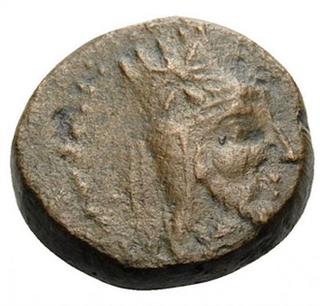
The Armenian Highlands were first ruled as one by the Kingdom of Urartu, which fought Assyria for the highlands of Ararat until Medes and then Achaemenid Persians overran both in the 6th century BCE. The land became the satrapy of Armenia, held for three centuries by the Orontid dynasty, who after Alexander's victory at Gaugamela in 331 BCE and the brief tenure of the Macedonian general Neoptolemus returned not as satraps but as kings: Orontes III and Mithridates of Lesser Armenia declared themselves independent. Weakened by the Seleucid Empire, the last Orontid king, Orontes IV, was overthrown in 201/200 BCE by a Seleucid commander, Artaxias (Artashes) I, who is presumed to have been related to the Orontids himself.
The Seleucid defeat at the Battle of Magnesia in 190 BCE loosened their hold, and in the same year Artaxias I founded a Hellenistic Armenian state while Zariadres ruled the kingdom of Sophene. When his reign began in 189 BCE, Media, Caucasian Iberia and the Seleucids had seized the kingdom's remote regions; Strabo records how Artaxias campaigned east to reunite Caspiane and Paytakaran, north to defeat the Iberians and regain Gugark, west to recover Karin, Ekeghik and Derjan, and south, after many battles with the Seleucids, Tmorik. He seized Yervandashat and in 185 BCE founded a new capital, Artaxata, near the Araxes where the Metsamor joined it, by the heights of Khor Virap below Mount Ararat.
Socioeconomy
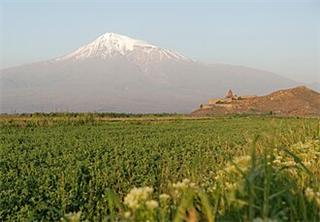
Artaxata was laid out at the junction of trade routes connecting the Greek world with Bactria, India and the Black Sea, and the Armenians prospered on that traffic. Its position in the Araks valley on the Silk Road soon made it a centre of bustling economic activity and international trade, linking Persia and Mesopotamia with the Caucasus and Asia Minor; the bathhouses, markets, workshops and administrative buildings that sprang up in the reign of Artashes I show its wealth, and the city had its own treasury and customs. The remains of the huge walls that Artashes built can still be found, and an amphitheatre was added under Artavasdes II (55–34 BCE).
Tigranes the Great founded Tigranakert in the 1st century BCE as a new capital more central to his expanding empire; it had 120,000 people, many temples and an amphitheatre. Josephus describes Tigranes' marching host with its camels, donkeys and mules for baggage, its sheep, cattle and goats for food and its hoards of gold and silver, 'like locusts or the dust of the earth', though the numbers Israelite historians gave were probably exaggerated. Horses had been the pride of the Armenian warrior since ancient times, and Sallust called the cavalry 'remarkable by the beauty of their horses and armor'. The kingdom's traditional fifteen provinces never all existed at once; in reality it comprised nearly 200 districts of varying size and type.
Military
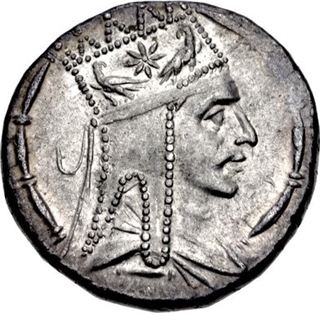
The army reached its peak under Tigranes the Great. The author of Judith credits him with chariots and 12,000 cavalry, most likely heavy cavalry or cataphracts of the kind the Seleucids and Parthians used, and his force consisted mainly of 120,000 infantry and 12,000 mounted archers, a Parthian feature too; like the Seleucids he relied on foot soldiers for the bulk. Josephus speaks of 500,000 in all with camp followers. The royal guard, the Azatavrear, drawn from elite Armenians, numbered 6,000 heavily armoured horsemen in the ancient period, with light cavalry of mounted archers beside them; in war the cavalry rose to 10,000 or at least 20,000, and part of it always patrolled the borders under a general, the sparapet.
Tigranes used that army to make an empire. He reincorporated Sophene, completed Artaxias' reunification with Lesser Armenia and Corduene, and in 83 BCE entered Syria at the invitation of a faction in its civil wars, ruling it peacefully for 17 years. He defeated the Hasmonean Jews, and at its zenith his realm stretched over parts of the Caucasus and what is now south-eastern Turkey, Iran, Syria and Lebanon, one of the most powerful states of the Roman East. Rome conquered the empire in 69 BCE, and the defeat of Armenia's ally Mithridates VI of Pontus by Pompey at the Battle of the Lycus made the kingdom a Roman client in 66 BCE.
Governance & Law
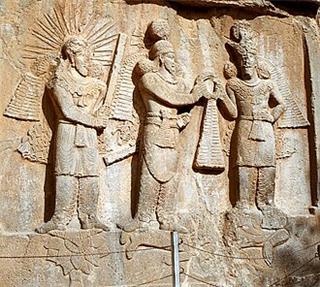
The Artaxiads ruled a Hellenistic kingdom from Artaxata, and after Tigranes also from Tigranakert. Strabo notes that Iberia recognised itself a vassal of Armenia in Artaxias' time, and at the height of Tigranes' rule Parthia itself and some Arab tribes were his vassals; the kingdom was bordered by Caucasian Albania to the east, Iberia to the north along the Kur, Rome to the west and Parthia to the south. Traditionally Greater Armenia was divided into fifteen provinces, which all existed at some time but never together, while Lesser Armenia, a region of the Kingdom of Pontus, stayed outside. Under Rome the kings ruled as clients, sometimes with Roman partners: Augustus installed Tigranes V in 6 CE, who ruled with Erato of Armenia, and the Artaxiads were overthrown in 12 CE for their possible allegiance to Parthia.
Religion before Christianity was a pantheon headed by Aramazd, cognate of the Iranian Ahura Mazda and identified with Zeus, with Anahit, goddess of fertility and birth, whose temples stood at Armavir, Artashat and Ashtishat; Mihr, god of the sun and light, at Bagaharich and Garni; Vahagn the storm god and dragon slayer at Derik; Tir, god of wisdom, near Artashat; Nane, goddess of war and motherhood; and Hayk, legendary forefather of the Armenians and slayer of the Titan Bel. Until the late Parthian period Armenia was predominantly Zoroastrian, and the founder of the later Arsacid line, Tiridates I, was a Zoroastrian priest or magus.
Global & Regional Impact
For a brief period Tigranes the Great raised Armenia into an empire that ended the Seleucids and ruled from Iberia and Albania through Cappadocia, Cilicia, Armenian Mesopotamia, Osroene, Adiabene, Syria, Assyria, Commagene and Sophene to Judea and Atropatene. Its collapse before Rome made Armenia the hinge of the eastern frontier: a client kingdom de jure, a buffer between Rome and Parthia after Augustus' truce of 20 BCE, and for centuries the prize over which the two powers set up rival kings. In 66 CE Nero crowned Tiridates I, a Parthian Arsacid, under the Treaty of Rhandeia of 63; contemporary Roman writers thought Nero had in fact yielded Armenia to the Parthians.
The Artaxiad capital endured. Artashat kept its importance until it lost its status as capital, and the kingdom's cities, Vagharshapat, later Ejmiatsin, and Dvin, built by Khosrov III in 335, carried Armenian statehood on under the Arsacids. That later line made Armenia, in 301 or 314, the first state in history to adopt Christianity officially, and gave it the alphabet of Mesrop Mashtots in 405. By the 2nd century BCE, Strabo says, the people of Greater Armenia spoke Armenian, implying that modern Armenians descend from the population Artaxias ruled. The kingdom founded in 189 BCE lasted, through its two dynasties, until 428, when the nobility overthrew the last king and the Sasanians installed a marzban in his place.
Decline & Fall

The empire of Tigranes lasted from 83 to 69 BCE. Rome conquered it in 69 BCE, and the final defeat of Armenia's ally Mithridates VI of Pontus by Pompey at the Battle of the Lycus made Armenia a Roman client kingdom in 66 BCE. Mark Antony invaded and defeated the kingdom in 34 BCE, but Rome lost hegemony in the Final War of the Republic, 32–30 BCE, and in 20 BCE Augustus negotiated a truce with the Parthians that left Armenia a buffer zone between the two powers. The remaining Artaxiad kings ruled as clients of Rome: Augustus installed Tigranes V in 6 CE, who ruled with Erato of Armenia, and in 12 CE the dynasty was overthrown because of its possible allegiance to Parthia.
What followed was half a century of contest. The Romans installed Mithridates of Armenia, whom Caligula arrested and Claudius restored; the Parthians forced submission in 37 CE, Rome retook the kingdom in 47 CE, Rhadamistus' Iberians seized it in 51 CE and Tigranes VI ruled from 58 CE. Nero's war of 55–63 against Vologases I of Parthia ended in the Treaty of Rhandeia of 63, by which Parthian Arsacids would rule Armenia as Roman clients, and in 66 CE Nero crowned Tiridates I. The Arsacid kingdom survived Trajan's annexation of 114–118, the Sasanian occupation of 252 and the restoration of Tiridates III in 287, adopted Christianity, and was partitioned between the Eastern Roman and Sasanian empires in 387; in 428 the nobility deposed the last king and a Sasanian marzban took his place.
The Artaxiad Kingdom of Armenia, founded by Artaxias I in 189 BCE with its capital at Artaxata, united the Armenian Highlands and under Tigranes the Great (83–69 BCE) ruled an empire from the Caucasus to Syria; conquered by Rome in 69 BCE and a client kingdom from 66 BCE, its last kings fell in 12 CE.
Test yourself
5 questions on this page, from its key events and facts.
The questions open here once the page has loaded.
References
- Richard G. Hovannisian (ed.), The Armenian People from Ancient to Modern Times, vol. 1: The Dynastic Periods (St. Martin's Press, 1997)
- M. Chahin, The Kingdom of Armenia (Croom Helm, 1987)
Connections
Open the full connections map →