South & Southeast Asia
Indo-Greek Kingdom
At a glance
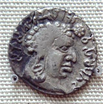
- The Indo-Greeks struck the first bilingual coins, Greek on one face and Prakrit in Kharoshthi (at first Brahmi) on the other, with Indian animals and Buddhist symbols, a concession to another culture never before made in the Hellenic world.
- Menander I, ruling the Punjab from Sagala from 165 to 130 BCE, carried the kingdom to its greatest extent, campaigned to Mathura and is remembered in the Milinda Panha as a convert to Buddhism who became an arhat.
- After Menander the realm splintered among some twenty known kings, lost the Hindu Kush to the Yuezhi after Hermaeus (c. 80 BCE) and its centre to the Indo-Scythian Azes I in 48/47 BCE; Strato II and Strato III fell to Rajuvula about 10 CE.
Rise & Fall
- c. 200 BCEDemetrius I of Bactria, son of Euthydemus, invades the Kabul valley, Arachosia and perhaps Gandhara, founding the Indo-Greek realm.
- c. 185–170 BCEPantaleon and Agathocles strike the first bilingual coins, with Indian inscriptions in Brahmi, found as far east as Taxila.
- c. 180/175 BCEApollodotus I makes himself independent of Bactria as the first proper Indo-Greek king, ruling Gandhara and western Punjab.
- 165–130 BCEMenander I rules the Punjab from Sagala, extends the kingdom to its greatest extent and campaigns across northern India to Mathura.
- c. 130 BCEThe Greco-Bactrian kingdom falls to the Scythians and Heliocles is probably killed; the Indo-Greeks are cut off from the Greek world.
- c. 113 BCEHeliodorus, ambassador of Antialcidas to the Shunga king Bhagabhadra, raises a pillar to Vāsudeva at Vidisha.
- 48/47 BCEHippostratus loses to the Indo-Scythian Azes I, who founds an Indo-Scythian dynasty in the central territories.
- c. 10 CEThe Northern Satrap Rajuvula conquers the eastern Punjab kingdom of Strato II and Strato III, the last Indo-Greek kings.
Foundation

Greeks had lived in the northwest of the Indian subcontinent since the Achaemenids relocated rebellious Greek communities there, and Alexander the Great's conquest of 326 BCE left satrapies and cities such as Bucephala behind. In 305 BCE Seleucus I ceded his eastern territories to Chandragupta Maurya for 500 war elephants and a marriage agreement. Bactria seceded from the Seleucid Empire under Diodotus I around 250 BCE; Euthydemus, a Magnesian Greek, seized its throne about 230 BCE and withstood a three-year siege of Bactra by Antiochus III, who in about 206 BCE recognised him and offered a daughter to his son Demetrius.
Demetrius I is generally considered the Greco-Bactrian king who first launched the Greek expansion into India, around 200 BCE, and so the founder of the Indo-Greek realm; the overthrow of the Mauryas by Pushyamitra Shunga about 185 BCE is thought to have encouraged it. His coins have been found in Arachosia and the Kabul valley; he conquered those regions and perhaps Gandhara, though he struck no Indian coins. Bopearachchi believes he took the title "King of India", and he may have founded the Yavana era of 186/5 BCE. After his death the Bactrian kings Pantaleon and Agathocles struck bilingual coins found as far as Taxila, and civil wars among them allowed Apollodotus I, from about 180/175 BCE, to rule Gandhara and western Punjab as the first king independent of Bactria.
Socioeconomy

Very little is known of the Indo-Greek economy, though it appears to have been vibrant. The abundance of the coinage suggests large mining operations, particularly in the Hindu Kush, and an important monetary economy; the kings struck bilingual coins in both the Greek round standard and the Indian square standard, so money seems to have circulated through every part of society, and the Kunindas to the east and the Satavahanas to the south adopted Indo-Greek monetary conventions, which points to extensive cross-border trade. The coinage is counted among the most artistically brilliant of antiquity.
Trade ran in every direction. Zhang Qian, visiting Bactria about 128 BCE, found bamboo canes from Qiong and cloth from Shu in its markets and was told that merchants bought them in Shendu, northwestern India, a settled farming land like Bactria. Across the Indian Ocean the Ptolemies had built the Red Sea ports of Myos Hormos and Berenike for voyages to the Indus delta, Kathiawar and Muziris; Eudoxus of Cyzicus sailed to India about 130 BCE and returned with perfumes and gemstones, and by the time Indo-Greek rule was ending up to 120 ships a year left Myos Hormos for India. The Periplus of the Erythraean Sea records old drachmas of Apollodotus and Menander still current at Barygaza. Yavana donors funded Buddhist caves at Karla, Nasik and Junnar, and Nasik's grapes were probably first brought by the Greeks.
Military
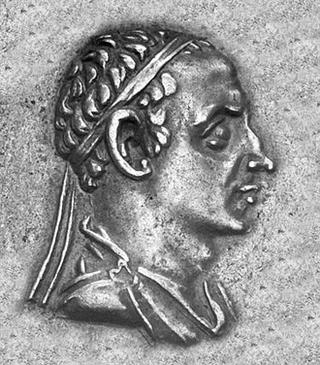
The coins show Hellenistic uniforms, helmets either round in the Greco-Bactrian style or the flat Macedonian kausia of Apollodotus I's coins, and weapons of spear, sword, longbow and arrows. Around 130 BCE the Central Asian recurve bow and its gorytos case appear on the coins of Zoilos I, a sign of contact and apparently alliance with the Yuezhi or the Scythians, and by 90 BCE it was standard for Indo-Greek horsemen, as Hermaeus's coins show. The Milinda Panha describes Menander reviewing his fourfold army of elephants, cavalry, bowmen and foot soldiers.
The wars are known only in fragments. Justin records that a Demetrius, "king of the Indians", besieged the Bactrian Eucratides for four months with 60,000 men, only for Eucratides to break out with 300 and hold land as far as the Indus between about 170 and 150 BCE, until Menander reclaimed it. Patanjali, around 150 BCE, wrote of the Yavanas besieging Saketa and Madhyamika, and the Yuga Purana prophesies that they would reach Pataliputra and cast down its mud walls before civil war called them home; whether such a campaign took place is disputed, and the Hathigumpha inscription has King Kharavela of Kalinga driving a demoralised Yavana army back to Mathura. The Indo-Greeks were finally conquered by the Indo-Scythians: Maues ruled briefly in the northwest around 80 BCE, Azes I defeated Hippostratus in 48/47 BCE, and Rajuvula took the last kingdom around 10 CE.
Governance & Law
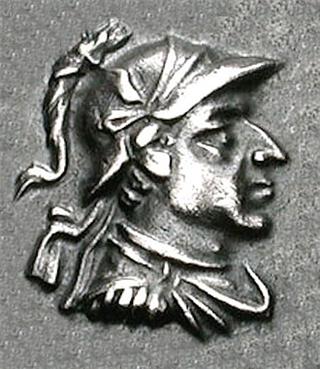
The Indo-Greek Kingdom was never one state but a number of Hellenistic kingdoms ruled from regional capitals such as Taxila, Sagala, Pushkalavati and Bagram. Thirty-six kings are known, most only from coins, and their sequence is still worked out from overstrikes and coin types, following Osmund Bopearachchi and R. C. Senior. Menander I and Apollodotus I were the first to put "Saviour King" on coins minted in India, a title that in the Greek world marked a great defensive victory, inscribed in Pali as "Tratarasa"; seven late kings around Gandhara, from Zoilos I to Peukolaos, called themselves Dharmikasa, "Follower of the Dharma".
From Apollodotus I onward almost all coins were bilingual, Greek on the obverse and Prakrit in the Kharoshthi script on the reverse, and from Apollodotus II, about 80 BCE, Kharoshthi letters served as mintmarks beside Greek monograms, which suggests local technicians in the mints. These coins were the key by which James Prinsep and Carl Ludwig Grotefend deciphered Kharoshthi in 1835–36. The kings worshipped the Greek pantheon shown on their coins, Zeus, Herakles, Athena and Apollo, but also took part in Indian religions: Heliodorus, ambassador of Antialcidas, called himself a devotee of Vāsudeva on his pillar at Vidisha around 113 BCE, the first known inscription of the Bhagavata movement, and Sirkap, founded by Demetrius, mixed Greek and Indian elements without segregation.
Global & Regional Impact

The Indo-Greeks combined Greek and Indian languages and symbols on their coins and Greek and Indian ideas in their cities, and the diffusion of their culture is still felt, above all through Greco-Buddhist art. Buddhism flourished under them, and Menander's rule was remembered as benevolent: the Milinda Panha has him debating the monk Nagasena, converting and attaining arhatship, and Plutarch says that when he died the cities under his rule contested the honour of his remains and divided his ashes among their monuments, as with the Buddha.
Craftsmen from the northwest, leaving mason's marks in Kharoshthi, carved the earliest reliefs at Sanchi around 115 BCE and the torana gateways of Bharhut in 100–75 BCE, where a warrior in Greek dress with a Buddhist triratana on his sword guards the stupa; a Sanchi frieze of about 50–1 BCE shows devotees in Greek tunics playing the aulos, and Yavana donors account for nearly half the dedications on the pillars of the Great Chaitya at Karla. The Yavana era of 186 BCE dated Gandharan Buddha statues for centuries: the Loriyan Tangai Buddha of "year 318" is about 143 CE. Yavanesvara translated the Yavanajataka, India's first Sanskrit work on horoscopy, at Nahapana's court; the Kunindas, Satavahanas and others copied Indo-Greek coinage, a legacy traceable to the Guptas in the 4th century, and the Indo-Scythians who followed kept Greek mints, legends and gods.
Decline & Fall
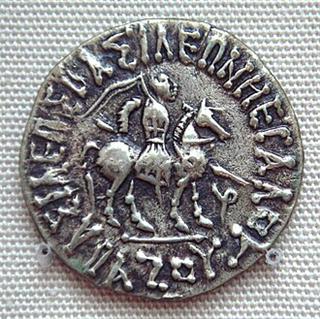
After Menander's death around 130 BCE there are no historical records of the Indo-Greeks at all, and their later history is reconstructed from coins and archaeology. In the same years the Scythians, pushed on by the Yuezhi, overran Bactria, the last Greco-Bactrian king Heliocles was probably killed, and the Indo-Greeks were cut off from the Graeco-Roman world. In India the Yaudheya and Arjunayana republics struck coins celebrating victory, and the Mitra and Datta dynasties rose in Mathura, where the Maghera inscription of the 116th year of the Yavanas, about 70 BCE, is the last trace of Greek rule. Philoxenus (100–95 BCE) briefly held everything from the Paropamisadae to western Punjab, but the territories fragmented again among some twenty kings.
Hermaeus, one of the last important kings in the Paropamisadae, ruled until about 80 BCE; soon after his death the Yuezhi or Sakas took the Hindu Kush and minted posthumous coins in his name until about 40 CE, when they merge into the coinage of the Kushan Kujula Kadphises. Around 80 BCE the Indo-Scythian Maues, perhaps a general in Indo-Greek service, ruled briefly in the northwest; Hippostratus (65–55 BCE) recovered ground until he lost to Azes I, who founded an Indo-Scythian dynasty in 48/47 BCE. Fleeing the Sakas, the Indo-Greeks kept a kingdom in the eastern Punjab until the Northern Satrap Rajuvula conquered Strato II and Strato III around 10 CE.
The Indo-Greek Kingdom comprised the Hellenistic Greek states of the northwestern Indian subcontinent, founded when Demetrius I crossed from Bactria about 200 BCE and greatest under Menander I, which joined Greek and Indian art, coinage and religion before the Indo-Scythians ended the last of them around 10 CE.
References
- Osmund Bopearachchi, De l'Indus à l'Oxus, Archéologie de l'Asie Centrale (Association imago-musée de Lattes, 2003)
- A. K. Narain, The Coin Types of the Indo-Greek Kings (Ares Publishing, 1976)
- Richard Foltz, Religions of the Silk Road: Premodern Patterns of Globalization (Palgrave Macmillan, 2010)
- Demetrios Vassiliades, The Greeks in India: A Survey in Philosophical Understanding (Munshiram Manoharlal, 2000)
- Julian Wünsch, 'Die Indo-Griechen. Konflikte und dynastische Verflechtungen der Nachfolger Menanders I.', Jahrbuch für Numismatik und Geldgeschichte 73 (2023)
Connections
Open the full connections map →