Europe
Principality of Catalonia
At a glance
- The Catalan counties united under the counts of Barcelona, who were also kings of Aragon from 1162.
- Its Corts, Generalitat and merchant capital Barcelona made it one of the most commercial and parliamentary states of medieval Europe.
- Revolts in 1640 and 1705 ended in defeat, and the Nueva Planta decree of 1716 abolished its institutions.
Rise & Fall
- 1162Alfonso II inherits Barcelona and Aragon, uniting them in the Crown of Aragon
- 1258Treaty of Corbeil: France renounces its claims over the Catalan counties
- 1283Peter III promises to summon the Catalan Corts every year
- 1359The Corts of Cervera create the Diputació del General, later the Generalitat
- 1462–1472Civil war between the Generalitat and John II
- 1640The Reapers’ War breaks out with the Corpus de Sang in Barcelona
- 1714Barcelona falls to Philip V’s army on 11 September
- 1716The Nueva Planta decree abolishes Catalonia’s institutions
Foundation
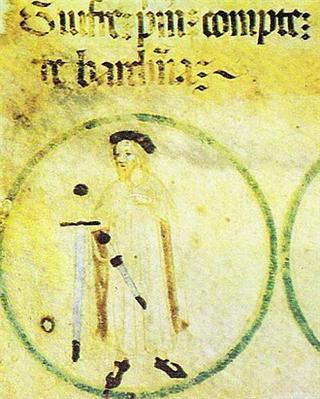
Catalonia grew out of the Marca Hispanica, the frontier counties that the Carolingians created south of the Pyrenees after taking Girona in 785 and Barcelona in 801. In the late ninth century Wifred the Hairy, count of Barcelona, Girona, Urgell and Cerdanya, made his counties hereditary in his family and founded the monastery of Ripoll, and his successors in Barcelona gradually gained precedence over the other counts. After al-Mansur sacked Barcelona in 985 and no Frankish help came, Count Borrell II ceased to seek confirmation from the new Capetian kings, and the counties became independent in practice. Ramon Berenguer I extended Barcelona’s authority in the eleventh century, and Ramon Berenguer IV conquered Tortosa in 1148 and Lleida in 1149, completing what became known as New Catalonia. His marriage to Petronila, heiress of the Kingdom of Aragon, agreed in 1137, joined the two dynasties, and in 1162 their son Alfonso II inherited Barcelona and soon Aragon, so that the Catalan counties became one constituent of the Crown of Aragon. The term Catalonia appears in the early twelfth century, and the name Principality became usual in the fourteenth. In the Treaty of Corbeil of 1258 Louis IX of France renounced his old claims to suzerainty over the Catalan counties.
Socioeconomy

Medieval Catalonia combined a mountainous, seigneurial countryside with dynamic coastal towns. Barcelona grew rich on Mediterranean trade, sending cloth, coral, saffron and other goods to Sicily, Sardinia, North Africa, Egypt and the Levant and importing spices, grain and slaves. Its merchants were organised in consulates abroad and governed by maritime customs collected in the Llibre del Consolat de Mar, which became widely used in Mediterranean commercial law. The city government, the Consell de Cent, dates from the 1260s, and the Taula de Canvi of 1401 was among the first public banks in Europe. Many peasants, the remences, were bound to their lords and subject to the so-called evil customs, the mals usos. The Black Death of 1348 and later epidemics cut the population sharply, perhaps by half over the following century and a half, unsettled the economy and sharpened conflict between lords and peasants and between the urban factions of the Biga and the Busca. The War of the Remences ended with Ferdinand II’s Sentence of Guadalupe of 1486, which let peasants buy their freedom from the evil customs. Catalan culture flourished in Romanesque churches such as Sant Climent de Taüll, the Gothic basilica of Santa Maria del Mar, the works of Ramon Llull and a body of royal chronicles in Catalan.
Military
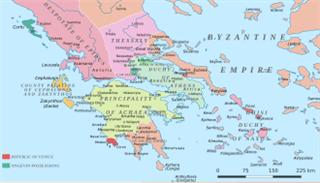
The Principality’s wars were fought within the Crown of Aragon, whose expansion depended heavily on Catalan ships, money and men. Catalan nobles and towns contributed to James I’s conquest of Majorca in 1229, and the royal shipyards at Barcelona, the Drassanes, built the galleys that made the Crown a leading naval power. The admiral Roger of Lauria won a series of victories against the Angevins and the French, and when Philip III of France invaded Catalonia in the Aragonese Crusade of 1285, the French army was forced to retreat after its fleet was destroyed at the Battle of Les Formigues. Light infantry known as almogavers fought in Sicily, and as the Catalan Company they served the Byzantine emperor from 1303 before seizing the Duchy of Athens after the Battle of Halmyros in 1311. At home the towns raised militias and the countryside a general levy, the sometent. Later wars were fought on Catalan soil. In the civil war of 1462–1472 the Generalitat raised armies against John II, and in the Reapers’ War Catalan and French troops defeated a royal army at the Battle of Montjuïc in January 1641. The final defence came in the War of the Spanish Succession, when Barcelona withstood a siege of more than a year before falling to the Duke of Berwick on 11 September 1714.
Governance & Law

Catalonia was governed under its own laws and institutions, with the count of Barcelona, who was also king of Aragon, as its prince. Customary law was gathered in the Usatges of Barcelona, traditionally attributed to Ramon Berenguer I but compiled in the twelfth century. The Catalan Corts, the parliament of clergy, nobility and royal towns, took definite form under Peter III, who in 1283 promised to summon them every year; legislation required the consent of king and Corts together, an early form of contractual government that Catalans called pactism. In 1359, at the Corts of Cervera, Peter IV accepted a standing committee to collect the taxes voted by the Corts, the Diputació del General, later called the Generalitat, which grew into a powerful body defending the Principality’s constitutions. Barcelona’s Consell de Cent and the other municipal councils enjoyed wide autonomy. After the Compromise of Caspe in 1412 brought the Castilian Trastámara dynasty to the throne, conflict between king and institutions grew, and the Constitution of Observance of 1481 bound royal officials to respect Catalan law. Under the Habsburgs the kings, usually absent in Castile, governed through a viceroy in Barcelona, and the Corts met rarely. These institutions survived until the Nueva Planta decree of 1716.
Global & Regional Impact

The Principality of Catalonia was the commercial and maritime engine of the Crown of Aragon, whose rule spread through the Mediterranean from the Balearics to Sicily, Sardinia, Naples and, briefly, Athens. Through that expansion Catalan language and law reached Valencia, the Balearic Islands and the town of Alghero in Sardinia, where a Catalan dialect is still spoken. Its maritime code, the Consolat de Mar, influenced commercial law across the western Mediterranean, and its consuls and merchants created one of the great trading networks of the late Middle Ages. Catalan was a major literary language: Ramon Llull wrote philosophy and fiction in it, the chronicles of James I, Bernat Desclot, Ramon Muntaner and Peter IV are major works of medieval historiography, and the wider Catalan-speaking world produced the poetry of Ausiàs March and the chivalric novel Tirant lo Blanc. The Principality’s tradition of representative assemblies, contractual government and a standing fiscal committee made it one of the earliest parliamentary polities in Europe. Its loss of self-government in 1714–1716 became central to modern Catalan identity: the fall of Barcelona is commemorated on 11 September, Catalonia’s national day, and the name Generalitat was revived for the autonomous government of the twentieth century.
Decline & Fall

Catalonia’s relative decline began with the plagues of the mid-fourteenth century and the crises of the fifteenth, when population loss, bank failures, peasant revolt and the civil war of 1462–1472 against John II weakened Barcelona and its trade. Under the Habsburgs the Principality was a peripheral part of a monarchy centred on Castile, and it resisted royal demands for men and money. When Olivares tried to make it contribute to the Union of Arms and quartered troops there during the war with France, revolt broke out: on 7 June 1640, the Corpus de Sang, reapers killed the viceroy, Count of Santa Coloma. Led by Pau Claris, the Generalitat proclaimed a short-lived Catalan Republic in January 1641 and then accepted Louis XIII of France as count of Barcelona. Barcelona surrendered to Philip IV’s forces in 1652, and by the Treaty of the Pyrenees in 1659 Roussillon and northern Cerdanya were ceded to France. In the War of the Spanish Succession Catalonia backed the Habsburg claimant Archduke Charles, but after the Treaty of Utrecht left it alone against Philip V, Barcelona fell in 1714. The Nueva Planta decree of 16 January 1716 abolished the Corts, the Generalitat and the Consell de Cent, and Catalonia was ruled as a province of Bourbon Spain.
The Principality of Catalonia, with its parliament, Generalitat and merchant capital Barcelona, drove the Mediterranean expansion of the Crown of Aragon, developed one of Europe’s earliest traditions of contractual government and Catalan literature, and its loss of self-government in 1714–1716 still shapes Catalan identity.
Test yourself
5 questions on this page, from its key events and facts.
The questions open here once the page has loaded.
References
- Balcells, A. (1996) Catalan Nationalism: Past and Present. Basingstoke: Macmillan.
- Bisson, T.N. (1986) The Medieval Crown of Aragon: A Short History. Oxford: Clarendon Press.
- Elliott, J.H. (1963) The Revolt of the Catalans: A Study in the Decline of Spain (1598–1640). Cambridge: Cambridge University Press.
- Freedman, P. (1991) The Origins of Peasant Servitude in Medieval Catalonia. Cambridge: Cambridge University Press.
- Vilar, P. (1962) La Catalogne dans l’Espagne moderne. 3 vols. Paris: SEVPEN.
Connections
Open the full connections map →