At a glance
- Napoleon's alliance turned the Electorate of Bavaria into a kingdom in 1806, the second largest German state.
- Montgelas built a centralised, tolerant administration, and the constitution of 1818 created one of Germany's first parliaments.
- Ludwig I and Ludwig II made Munich and the Bavarian Alps famous for art, architecture and fantasy castles.
Rise & Fall
- 1806Maximilian IV Joseph is proclaimed King Maximilian I Joseph of Bavaria
- 1813The Treaty of Ried brings Bavaria over to the Allies
- 1818The constitution of 26 May creates a two-chamber parliament
- 1835Germany's first railway opens between Nuremberg and Fürth
- 1848Ludwig I abdicates after the Lola Montez affair and revolution
- 1871Bavaria joins the German Empire with extensive reserved rights
- 1886Ludwig II is declared unfit to rule and dies in Lake Starnberg
- 1918Kurt Eisner proclaims a republic in Munich and Ludwig III flees
Foundation

The Kingdom of Bavaria was proclaimed on 1 January 1806, when Elector Maximilian IV Joseph, of the Wittelsbach dynasty that had ruled Bavaria since 1180, took the title King Maximilian I Joseph. His chief minister, Maximilian von Montgelas, had steered Bavaria into alliance with Napoleon, who offered it protection against Austria and territorial gains. The Imperial Recess of 1803 had already given Bavaria the Franconian prince-bishoprics of Bamberg and Würzburg (the latter given up again in 1805), other church lands and imperial cities, and the Peace of Pressburg in 1805 added Tyrol, Vorarlberg and further Swabian territory together with full sovereignty. As a member of the Confederation of the Rhine from 1806, Bavaria absorbed Nuremberg, Ansbach, and in 1810 it gained Bayreuth, Regensburg, Salzburg and the Innviertel, bringing it to its greatest extent. In October 1813, by the Treaty of Ried, Maximilian changed sides on condition that the Allies guaranteed his sovereignty. The final settlement came with the Treaty of Munich of 1816: Bavaria, which had already given back Tyrol and Vorarlberg and gained Würzburg and Aschaffenburg in 1814, returned Salzburg and the Innviertel to Austria and received the Palatinate on the left bank of the Rhine. The result was a kingdom of about 76,000 square kilometres, the second largest German state, joining Catholic Old Bavaria with largely Protestant Franconia and the Palatinate.
Socioeconomy

Bavaria remained predominantly agrarian throughout the nineteenth century. Old Bavaria and Swabia were lands of large peasant farms, Catholic piety and village life, while Franconia and the Palatinate had a stronger Protestant presence, more crafts and a tradition of commerce. The Montgelas reforms removed many feudal and church privileges, and the secularisation of 1802–1803 dissolved the monasteries and transferred their estates and libraries to the state. Peasant obligations were finally commuted after 1848. Industry developed in a few centres. Augsburg became a textile and engineering town, Nuremberg built machines, toys and electrical equipment, and the firms that merged in 1908 as MAN supported Rudolf Diesel's development of his engine at Augsburg in the 1890s. Germany's first railway, the Ludwig Railway between Nuremberg and Fürth, opened in December 1835, and the Ludwig Canal linking the Main and the Danube was completed in 1846. Brewing was a major industry, and Munich's breweries pioneered refrigerated lager production. The Oktoberfest began with the wedding celebrations of Crown Prince Ludwig and Therese of Saxe-Hildburghausen in October 1810. Munich grew from about 40,000 inhabitants around 1800 to roughly 600,000 by 1910, when the kingdom had about 6.9 million people. Many Bavarians, especially from the Palatinate and Franconia, emigrated to North America in the nineteenth century.
Military

The Bavarian army fought as Napoleon's ally from 1805 to 1813. It took part in the campaigns of 1805, 1806–1807 and 1809, when Bavarian troops fought alongside the French against Austria and faced the Tyrolean uprising led by Andreas Hofer, which they could suppress only with French help. In 1812 Bavaria sent a corps of some 30,000 men into Russia, where it fought at Polotsk and was almost entirely destroyed. After the Treaty of Ried, General Karl Philipp von Wrede tried to block Napoleon's retreat but was defeated at the Battle of Hanau in October 1813. Under the German Confederation the Bavarian army formed its own federal army corps. In the war of 1866 Bavaria fought for Austria and its troops were defeated by the Prussians at Kissingen in July. In the Franco-Prussian War two Bavarian army corps took part in the Battle of Sedan, where Bavarian troops fought the bitter battle for the village of Bazeilles, and in the campaign around Orléans. Under the treaty by which Bavaria entered the German Empire, its army remained under the king's command in peacetime and passed to the emperor only in war. It kept its own war ministry, uniforms and general staff, and in the First World War Crown Prince Rupprecht of Bavaria commanded a German army and later an army group on the Western Front.
Governance & Law

Montgelas, chief minister from 1799 to 1817, turned the patchwork of old and new territories into a centralised state on the French model. He created a professional civil service, divided the kingdom into administrative districts named after rivers, introduced religious toleration and compulsory schooling, made smallpox vaccination compulsory in 1807 and commissioned Anselm von Feuerbach's criminal code of 1813. After his dismissal in 1817 a concordat with the papacy was concluded, and the constitution of 26 May 1818 established a parliament of two chambers, a Chamber of Imperial Councillors for princes, nobles and appointed members and an elected Chamber of Deputies. Ludwig I, king from 1825, began as a liberal but became increasingly authoritarian, especially after the Hambach Festival of 1832 in the Bavarian Palatinate, a mass demonstration for German unity and freedom. His affair with the dancer Lola Montez discredited him, and he abdicated in March 1848 in favour of his son Maximilian II, who accepted liberal reforms. Ludwig II, who succeeded in 1864, withdrew increasingly from government, and in June 1886 his ministers had him declared unfit to rule. His uncle Luitpold ruled as prince regent for his insane brother Otto until 1912, and Luitpold's son became King Ludwig III in 1913. Within the German Empire Bavaria kept its own army, railways, posts and telegraphs and its legations abroad.
Global & Regional Impact
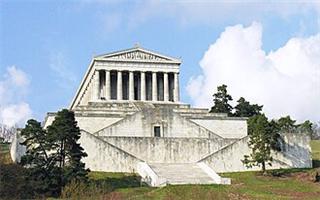
Bavaria's most lasting legacy is cultural. Ludwig I set out to make Munich a capital of the arts. His architects Leo von Klenze and Friedrich von Gärtner laid out the Ludwigstrasse and built the Glyptothek for classical sculpture and the Alte Pinakothek, opened in 1836, one of the first large public picture galleries in Europe, while the Walhalla near Regensburg, completed in 1842, celebrated German national heroes. He moved the university from Landshut to Munich in 1826. His son Otto became the first King of Greece in 1832, carrying Bavarian officials and classical taste to Athens. Maximilian II invited scholars from northern Germany and founded the Historical Commission in 1858 under the historian Leopold von Ranke. Ludwig II made Munich the scene of Richard Wagner's Tristan und Isolde in 1865 and helped finance the festival theatre at Bayreuth, and his castles of Neuschwanstein, Linderhof and Herrenchiemsee became some of the most visited sights in Europe. Around 1900 Munich was a leading art city: the Munich Secession was founded in 1892, the magazine Jugend gave its name to German Art Nouveau, and the Blue Rider group of Wassily Kandinsky and Franz Marc formed there in 1911. Politically, Bavaria's insistence on its own rights within the empire helped fix the federal character of modern German government.
Decline & Fall

Bavaria's sovereignty was reduced in two stages. Defeat in 1866 dissolved the German Confederation, cost Bavaria an indemnity and small border districts, and bound it to Prussia by a secret alliance. In 1870 it fought alongside Prussia against France, and Ludwig II, after negotiations in which he received secret payments from Bismarck's funds, signed the so-called Kaiserbrief inviting William I of Prussia to take the imperial title. The Bavarian parliament approved entry into the German Empire in January 1871 against strong opposition from the Catholic Patriots' Party. Bavaria kept more reserved rights than any other state, but foreign policy, war and most economic legislation were henceforth decided in Berlin. The long regency of Luitpold was a period of stability and prosperity, and the Catholic Centre became the dominant party, but the First World War brought heavy casualties, food shortages and growing resentment of Prussian leadership. On 7 November 1918 the Independent Social Democrat Kurt Eisner proclaimed a republic in Munich, and Ludwig III fled the capital; on 12 November, at Anif near Salzburg, he released his officials and soldiers from their oath without formally abdicating. The kingdom became the Free State of Bavaria. After 1945 the Palatinate was separated, and the Free State remains a state of the Federal Republic of Germany.
Created as Napoleon's ally in 1806 and remodelled by Montgelas into a centralised constitutional state, the Kingdom of Bavaria was the second German power after Prussia, made Munich a European art capital under Ludwig I and Ludwig II, and secured the federal character of the German Empire.
Test yourself
5 questions on this page, from its key events and facts.
The questions open here once the page has loaded.
References
- Sheehan, J.J. (1989) German History, 1770–1866. Oxford: Clarendon Press.
- Nipperdey, T. (1996) Germany from Napoleon to Bismarck, 1800–1866. Trans. D. Nolan. Princeton: Princeton University Press.
- Blackbourn, D. (1997) The Fontana History of Germany, 1780–1918: The Long Nineteenth Century. London: Fontana Press.
- McIntosh, C. (1982) The Swan King: Ludwig II of Bavaria. London: Allen Lane.
- Spindler, M. (ed.) (1974–1975) Handbuch der bayerischen Geschichte, vol. IV: Das neue Bayern 1800–1970. Munich: C.H. Beck.
Connections
Open the full connections map →