Europe
Republic of Genoa
At a glance
- A Ligurian port that became one of the great medieval sea powers, with colonies from Chios to Caffa in the Crimea.
- It pioneered commercial contracts, marine insurance and the Bank of Saint George, which managed debt, taxes and colonies.
- After 1528 an aristocratic republic allied to Spain, its bankers financed the Spanish Empire until c. 1627.
Rise & Fall
- 1099Genoese citizens form the compagna communis as their ships join the capture of Jerusalem
- 1261Treaty of Nymphaeum with Byzantium opens the Black Sea to Genoese trade
- 1284Oberto Doria destroys the Pisan fleet at the Battle of Meloria
- 1339Simone Boccanegra is elected the first doge of Genoa
- 1381The Peace of Turin ends the War of Chioggia with Venice
- 1407The Bank of Saint George is founded to manage the public debt
- 1528Andrea Doria allies Genoa with Charles V and reforms its constitution
- 1797The republic is replaced by the French-backed Ligurian Republic
Foundation
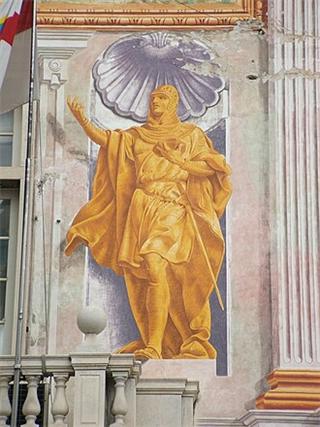
Genoa was an old Ligurian port, squeezed between the Apennines and the sea, which had suffered Muslim raids in the tenth century and by the eleventh was raiding back, joining Pisa in attacks on Sardinia and on Mahdia in 1087. Around 1099 its leading citizens bound themselves by oath into a sworn association, the compagna communis, led by elected consuls; this is conventionally taken as the birth of the commune. The timing was not accidental. Genoese fleets took part in the First Crusade, and Guglielmo Embriaco built siege engines at Jerusalem in 1099 and helped take Caesarea in 1101, bringing back booty that included the green glass bowl revered as the Sacro Catino. In return the crusader princes granted Genoa quarters, tax exemptions and a share of revenues in Acre, Antioch and other ports. The young commune also fought for the western Mediterranean, joining Alfonso VII of Castile against Almería and Ramon Berenguer IV of Barcelona against Tortosa in 1146–1148. These campaigns left Genoa heavily in debt, an early sign of a lasting pattern: public enterprise financed by private creditors. The city’s official chronicle, begun by the consul Caffaro di Rustico da Caschifellone, recorded these early decades from the commune’s own point of view.
Socioeconomy
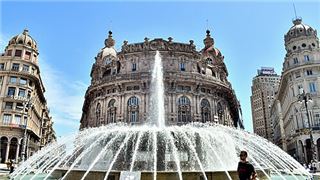
Genoa had little farmland, and its wealth came from the sea. Its merchants carried grain, salt, alum, wine, silk, spices and slaves between North Africa, Spain, Provence, the Levant and the Black Sea. The register of the notary Giovanni Scriba, covering 1154–1164, is the oldest surviving notarial cartulary in Europe and shows the commenda contracts by which investors entrusted goods and capital to travelling partners. After the Treaty of Nymphaeum of 1261 with the Byzantine emperor Michael VIII Palaiologos, Genoa gained privileged access to the Black Sea, its colony at Pera faced Constantinople, and Caffa in the Crimea became a hub for grain, fish, furs and slaves from the steppe. Alum from Phocaea and mastic from Chios brought large profits. Society was dominated by great clans, the Doria, Spinola, Fieschi and Grimaldi among them, organised from the fourteenth century in alberghi, associations of related families sharing a name and a neighbourhood. Genoese finance was precocious: public debt was divided into transferable shares, marine insurance contracts appear in the fourteenth century, and in the sixteenth century the city’s bankers became the principal lenders of the Spanish crown. The city’s population probably reached 60,000 or more around 1300 before the Black Death, which by most accounts first reached Europe on ships from the Black Sea in 1347.
Military

Genoa’s power rested on its galleys and on the readiness of its citizens and great families to arm ships. Its long rivalry with Pisa over Corsica, Sardinia and trade ended at the Battle of Meloria in 1284, when Oberto Doria destroyed the Pisan fleet and took thousands of prisoners, crippling Pisa as a naval power. The contest with Venice was longer. Genoa backed the restoration of Byzantine rule in Constantinople in 1261, and in the war that followed Lamba Doria defeated a Venetian fleet at the Battle of Curzola in 1298; according to tradition Marco Polo was among the captives and dictated his travels in a Genoese prison. In the War of Chioggia (1378–1381) a Genoese fleet under Pietro Doria seized Chioggia at the edge of the Venetian lagoon in 1379, but was itself blockaded and forced to surrender in 1380, and the Peace of Turin of 1381 ended Genoese hopes of supremacy. Genoese crossbowmen served as mercenaries across Europe, notably for France at Crécy in 1346, and Genoese admirals commanded the fleets of foreign kings. In 1453 Giovanni Giustiniani Longo led the defence of the land walls of Constantinople against Mehmed II. From 1528 Andrea Doria’s galleys served Charles V against the Ottomans and the Barbary corsairs, but in later centuries Genoa’s small navy could not protect it from the French bombardment of 1684.
Governance & Law

The commune was governed at first by consuls chosen from the leading families. Their feuds led to the appointment from 1191 of a podestà, an outside magistrate serving a fixed term, and later to captains of the people such as Guglielmo Boccanegra (1257–1262) and the joint rule of Oberto Doria and Oberto Spinola from 1270. In 1339 a popular revolt made Simone Boccanegra the first doge, elected for life and supposed to come from the non-noble families. Factional struggle between Guelph and Ghibelline clans and between nobles and popolari remained endemic, and Genoa repeatedly submitted to foreign lords: Charles VI of France in 1396–1409, the Visconti of Milan in 1421–1435 and the Sforza after 1464. A distinctive institution was the Bank of Saint George, founded in 1407 to consolidate the public debt, which collected state revenues and even governed Caffa and Corsica on behalf of the republic; Niccolò Machiavelli thought it a state within the state. Andrea Doria’s reform of 1528 created an aristocratic republic: the nobility was grouped into 28 alberghi, doges served two-year terms, and power lay with the councils and collegi of the nobility. Disputes between old and new nobles led to brief civil war and to the new laws of 1576, which governed the republic until its end.
Global & Regional Impact

Genoa was one of the creators of the commercial economy of medieval Europe. Its notarial records, partnership contracts, insurance and public debt shares make it a key case for historians of business and finance, and the Bank of Saint George is often cited among the first public banks. Its colonies, from Pera and Caffa to Chios and Famagusta, linked the Mediterranean with the steppe and the Black Sea, and Genoese sailors pushed into the Atlantic: the Vivaldi brothers set out to sail around Africa in 1291 and were never seen again, and Lanzarotto Malocello reached the Canary Islands in the early fourteenth century. Christopher Columbus, born in Genoa around 1451, came out of this world of Genoese Atlantic trade, and Genoese merchants in Seville financed early Spanish voyages and the sugar economy of the Atlantic islands. The historian Fernand Braudel spoke of an age of the Genoese from 1557 to 1627, when Genoese bankers handled the silver of the Spanish Empire and the exchange fairs at Piacenza became the clearing house of European finance. The city’s legacy is visible in the palaces of the Strada Nuova and the Rolli system of lodging state guests, now a World Heritage Site, in its Baroque art, and in Genoese communities that shaped Gibraltar, Corsica, Sardinia’s Carloforte and the Río de la Plata.
Decline & Fall

Genoa’s decline was gradual. The loss of the War of Chioggia, factional strife and foreign domination weakened it in the late fourteenth and fifteenth centuries, while the Ottoman advance stripped away its eastern empire: Pera surrendered to Mehmed II in 1453, Caffa fell in 1475 and Chios in 1566. The Spanish alliance of 1528 gave the republic stability and great banking wealth, but it was a client of Madrid, exposed to the repeated bankruptcies of the Spanish crown, the last of which in 1627 hit Genoese lenders hard. Plague in 1656–1657 killed a large part of the population. When Genoa built galleys for Spain and resisted French pressure, Louis XIV had the city bombarded in 1684 and forced its doge to apologise in person at Versailles in 1685. In the War of the Austrian Succession Austrian troops occupied Genoa in 1746 until a popular rising, traditionally begun by the boy known as Balilla, drove them out. The long Corsican revolt from 1729, including the rule of Pasquale Paoli from 1755, led Genoa to cede the island to France by the Treaty of Versailles in 1768. In 1797 French pressure under Napoleon Bonaparte replaced the aristocratic constitution with the Ligurian Republic; Genoa was annexed to France in 1805 and given to the Kingdom of Sardinia in 1815.
The Republic of Genoa built a commercial empire from the Black Sea to the Atlantic, pioneered the contracts, insurance and public debt of European capitalism, and through its bankers financed the Spanish Empire, making a small Ligurian city one of the makers of the early modern world economy.
References
- Epstein, S.A. (1996) Genoa and the Genoese, 958–1528. Chapel Hill: University of North Carolina Press.
- Kirk, T.A. (2005) Genoa and the Sea: Policy and Power in an Early Modern Maritime Republic, 1559–1684. Baltimore: Johns Hopkins University Press.
- Kedar, B.Z. (1976) Merchants in Crisis: Genoese and Venetian Men of Affairs and the Fourteenth-Century Depression. New Haven: Yale University Press.
- Greif, A. (2006) Institutions and the Path to the Modern Economy: Lessons from Medieval Trade. Cambridge: Cambridge University Press.
- Braudel, F. (1972) The Mediterranean and the Mediterranean World in the Age of Philip II. Trans. S. Reynolds. London: Collins.
Connections
Open the full connections map →