Islamic Caliphates & Middle East
Kingdom of Jerusalem
At a glance
- The principal Crusader state, founded after the First Crusade took Jerusalem in July 1099.
- A small Frankish elite ruled a mostly Muslim and Eastern Christian population, relying on castles, military orders and Italian fleets.
- Saladin’s victory at Hattin in 1187 broke it; the kingdom survived on the coast until the Mamluks took Acre in 1291.
Rise & Fall
- 1099The First Crusade takes Jerusalem
- 1100Baldwin I is crowned the first king at Bethlehem
- 1124Tyre falls to the Franks and a Venetian fleet
- 1177Baldwin IV defeats Saladin at Montgisard
- 1187Saladin destroys the Frankish army at Hattin and takes Jerusalem
- 1191The Third Crusade recovers Acre
- 1229Frederick II regains Jerusalem by treaty
- 1291The Mamluks take Acre, ending the kingdom
Foundation

The Kingdom of Jerusalem was created by the First Crusade, launched after Pope Urban II’s appeal at Clermont in 1095. After taking Antioch in 1098, the crusaders reached Jerusalem, then held by the Fatimid Caliphate, and stormed it on 15 July 1099, massacring much of its Muslim and Jewish population. The leaders chose Godfrey of Bouillon, duke of Lower Lorraine, to govern the city; he declined the title of king and was known as Advocate of the Holy Sepulchre. In August 1099 he defeated a Fatimid relief army at the Battle of Ascalon, securing the conquest. When Godfrey died in July 1100, his brother Baldwin, count of Edessa, came south and was crowned King Baldwin I at Bethlehem on Christmas Day 1100. Baldwin I spent his reign fighting the Fatimids and extending the kingdom along the coast with the help of Genoese, Pisan and Venetian fleets, taking Arsuf and Caesarea in 1101, Acre in 1104 and Beirut and Sidon in 1110, and pushing south-east of the Dead Sea, where he built the castle of Montréal in 1115. Tyre fell in 1124 under his successor Baldwin II, and Ascalon, the last Fatimid outpost on the coast, in 1153. The other crusader states, the County of Edessa, the Principality of Antioch and the County of Tripoli, looked to the king of Jerusalem as their leader.
Socioeconomy

The Franks, as the Latin settlers were called, were a minority in the kingdom. Most of the population consisted of Muslim peasants and Eastern Christians, including Greek Orthodox, Syriac, Armenian and other communities, alongside Jews and Samaritans. The Franks lived mainly in the towns, but archaeological work has shown that many also settled in rural villages, especially in areas with Christian populations. The Latin Church established a patriarch in Jerusalem and filled the bishoprics with Western clergy, while pilgrimage to the holy places brought money and visitors every year. The economy combined agriculture, notably cereals, olives, vines and sugar cane grown around Tyre and Acre, with long-distance trade. Acre became the kingdom’s greatest port and one of the busiest in the Mediterranean, where goods from Damascus and the East met Italian shipping. In return for naval help, Venice, Genoa and Pisa received quarters in the coastal cities with their own churches, courts and markets; under the Pactum Warmundi of 1123, Venice was promised a third of Tyre. The kingdom minted gold coins imitating Fatimid dinars, with Arabic inscriptions, for use in regional trade. Daily life involved constant contact across religious lines, recorded by the Syrian Muslim nobleman Usama ibn Munqidh, though for long periods Muslims and Jews were barred from living in Jerusalem itself.
Military

The kingdom’s army was small. Its core consisted of knights owing feudal service; a list preserved by John of Ibelin suggests about 675 knights, supplemented by mounted sergeants, infantry from the towns, light cavalry called turcopoles, and crusaders arriving from Europe. From the 1120s and 1130s the military orders, the Knights Templar and the Knights Hospitaller, and later the Teutonic Knights, provided permanent garrisons and the money to maintain them. Castles were essential: Kerak and Montréal guarded the route east of the Jordan, Belvoir overlooked the Jordan valley, and in the thirteenth century the Templars built Atlit and the Teutonic Knights Montfort. The kingdom won important victories, including King Baldwin IV’s defeat of Saladin at the Battle of Montgisard in 1177, and King Amalric I invaded Egypt several times between 1163 and 1169, briefly forcing it to pay tribute. But it could not afford to lose a field army. At the Battle of Hattin on 4 July 1187, Saladin surrounded and destroyed the army of King Guy of Lusignan, perhaps 20,000 men, cut off from water near Lake Tiberias. Jerusalem surrendered in October 1187. Richard I of England’s victory at Arsuf in 1191 helped restore the coast, but another field army was destroyed by the Khwarazmians and Ayyubids at La Forbie in 1244.
Governance & Law
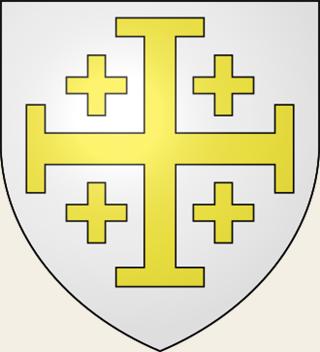
The kingdom was a feudal monarchy in which the king’s power was limited by his barons. Kings were usually crowned in the Church of the Holy Sepulchre, and accession required recognition by the High Court, the assembly of the king’s vassals, which also judged disputes among nobles and advised on war and law. A separate Court of the Burgesses dealt with the affairs of non-noble Franks, and local courts handled the business of Eastern Christians and Muslims. The great lordships, among them Galilee, Jaffa and Ascalon, Sidon and Oultrejordain, held extensive rights over their lands and subjects. The crown passed several times through women: Melisende, daughter of Baldwin II, ruled with her husband Fulk of Anjou from 1131 and remained powerful after his death, and the claims of Sibylla, Isabella I and Isabella II brought in husbands from the West. Factional struggles weakened the monarchy at critical moments, especially during the reign of the leper king Baldwin IV (1174–1185). In the thirteenth century the kings were often absent, as Frederick II and his Hohenstaufen heirs ruled from Europe, and the baronial Ibelin family led resistance to imperial officials. Jurists such as John of Ibelin, count of Jaffa, wrote legal treatises later known as the Assizes of Jerusalem, which set out the customs of the High Court.
Global & Regional Impact

The Kingdom of Jerusalem was the centre of the crusading movement for nearly two centuries. Its foundation inspired repeated expeditions from Europe, including the Second Crusade, the Third Crusade led by Richard I and Philip II of France, and the crusades of Frederick II and Louis IX of France. The military orders created to defend it became wealthy international institutions with estates across Europe. Italian merchant cities used their privileges in its ports to build commercial networks that outlasted the kingdom. Crusader builders rebuilt the Church of the Holy Sepulchre, reconsecrated in 1149, and works such as the Melisende Psalter show the blending of Western, Byzantine and Eastern Christian art. William, archbishop of Tyre, born in the kingdom, wrote one of the finest histories of the Middle Ages. In the Muslim world the kingdom’s presence provoked a revival of the ideal of jihad under Zengi, Nur al-Din and Saladin, which helped unite Syria and Egypt. The legal texts of the kingdom shaped the laws of Cyprus, and the title of king of Jerusalem was claimed by the kings of Cyprus, Naples and others for centuries. The memory of the crusades and of the kingdom remains a subject of debate and political rhetoric in Europe and the Middle East.
Decline & Fall

The fall of the County of Edessa to Zengi in 1144 and the failure of the Second Crusade before Damascus in 1148 revealed the weakness of the crusader states, while the union of Egypt and Syria under Saladin after 1169 surrounded the kingdom with a single powerful enemy. Defeat at Hattin in 1187 cost it almost all its territory, though Tyre held out under Conrad of Montferrat. The Third Crusade recovered Acre in 1191 and much of the coast, and the Treaty of Jaffa in 1192 confirmed a reduced kingdom with Acre as its capital. Frederick II regained Jerusalem by treaty with the Ayyubid sultan al-Kamil in 1229, but the city was sacked by Khwarazmian troops in 1244 and never recovered. Divided by baronial quarrels and by the War of Saint Sabas (1256–1258) between Venice and Genoa, the kingdom faced the Mamluk Sultanate, which defeated the Mongols at Ain Jalut in 1260. The Mamluk sultan Baybars took Caesarea and Arsuf in 1265, Safed in 1266 and Jaffa in 1268. After a siege of about six weeks, al-Ashraf Khalil stormed Acre on 18 May 1291, and the remaining Frankish towns, including Tyre, Sidon, Beirut and Atlit, were abandoned within months. The kings of Cyprus continued to bear the title.
The Kingdom of Jerusalem, born of the First Crusade, was the main Latin Christian state in the Levant for almost two centuries, drawing repeated crusades from Europe, enriching Italian merchants and the military orders, and provoking the Muslim revival that culminated in Saladin’s victory at Hattin and the Mamluk conquest of Acre.
References
- Barber, M. (2012) The Crusader States. New Haven: Yale University Press.
- Ellenblum, R. (1998) Frankish Rural Settlement in the Latin Kingdom of Jerusalem. Cambridge: Cambridge University Press.
- Mayer, H.E. (1988) The Crusades. 2nd edn. Translated by J. Gillingham. Oxford: Oxford University Press.
- Prawer, J. (1972) The Latin Kingdom of Jerusalem: European Colonialism in the Middle Ages. London: Weidenfeld and Nicolson.
- Riley-Smith, J. (1973) The Feudal Nobility and the Kingdom of Jerusalem, 1174–1277. London: Macmillan.
- Runciman, S. (1951–1954) A History of the Crusades. 3 vols. Cambridge: Cambridge University Press.
Connections
Open the full connections map →