
Ancient Near East
Ur
At a glance
- The Royal Cemetery of Ur, most of whose royal tombs date to about 2600 BCE, held gold and semi-precious stones brought from Iran, Afghanistan, India, Asia Minor, the Levant and the Persian Gulf, and attendants killed to accompany their rulers.
- Sargon of Akkad made his daughter Enheduanna high priestess of Nanna at Ur, and control of that priesthood remained a symbolic marker of political control over the region for five centuries.
- Ur-Nammu, governor of Ur under Utu-hengal of Uruk, made the city the seat of a new kingdom, built its ziggurat and issued the Code of Ur-Nammu, one of the oldest law codes known.
Rise & Fall
- c. 2600 BCEThe royal tombs of the Royal Cemetery are built, among them the unlooted tomb of Queen Puabi, with the Standard of Ur and the Lyres of Ur among their treasures.
- 26th century BCEMesannepada, the first king of Ur recorded in the Sumerian King List, rules; a cylinder bearing his name was found in the Royal Cemetery.
- 25th century BCEUr comes under the control of Eannatum of Lagash, whose successor Enannatum I leaves memorials there.
- c. 2400 BCELugalkinishedudu, king of Uruk, proclaims himself king of Ur.
- c. 2334 BCESargon of Akkad conquers Ur and installs his daughter Enheduanna as high priestess of Nanna.
- 22nd century BCEThe Akkadian Empire ends under Sharkalisharri; Ur passes to Gutian or local rule and then to the influence of Lagash under Ur-Bau and Gudea.
- c. 2112 BCEUr-Nammu, governor of Ur under Utu-hengal of Uruk, moves the kingship to Ur and founds the Third Dynasty.
Foundation

Ur, now Tell el-Muqayyar in Dhi Qar Governorate, Iraq, stood near the mouth of the Euphrates on the Persian Gulf; the coast has since moved and the mound lies 16 km south-west of Nasiriyah. Settlement began in the Ubaid period, around 3800 BCE by one reckoning, in marshy surroundings where fish, birds, tubers and reeds could feed a town without irrigation, and the canals that cross the site were probably used for transport. A thick layer of clay over the Ubaid levels was read by the excavators of the 1920s as the Flood of the Epic of Gilgamesh and the Book of Genesis, though later carbon dating gave such layers at different Sumerian cities different dates. Proto-cuneiform tablets of about 2900 BCE show writing in use in the Early Dynastic town.
Ur enters written history as a city-state in the 26th century BCE. Mesannepada is the first of its kings named in the Sumerian King List, and a cylinder inscribed with his name was found in the Royal Cemetery; five more kings followed before the List says the kingship was taken by Awan. The List may omit an earlier line, the so-called Kalam dynasty, to which Meskalamdug and Akalamdug perhaps belonged. The city's patron was the moon god Nanna, Sin in Akkadian, and its name derives from UNUGKI, 'the abode of Nanna'. The occupied area grew from about 15 hectares in the Jemdet Nasr period to 90 in the Early Dynastic period.
Socioeconomy

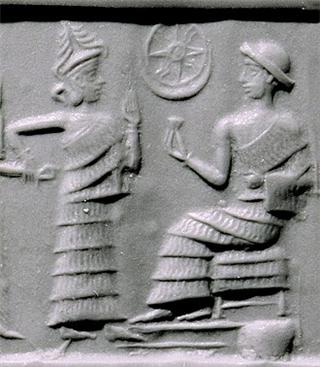
The wealth of Early Dynastic Ur is plainest in the Royal Cemetery. Its tombs of the Early Dynastic IIIa period held luxury goods of precious metals and semi-precious stones brought from Iran, Afghanistan, India, Asia Minor, the Levant and the Persian Gulf, evidence of the city's commercial reach in the Early Bronze Age. Among about 1,850 burials Woolley counted sixteen or seventeen royal tombs; the unlooted tomb of Queen Puabi, known from a cylinder seal, yielded the Standard of Ur, and the Lyres of Ur, bull-shaped instruments with eleven strings, came to light in 1928. The people buried with the dead bore the skeletal marks of long manual labour.
Ur stayed a trading city long after its kings. In the Isin-Larsa period, when the occupied area reached 140 hectares, the merchant Ea-nasir dealt in copper from Dilmun, shipping ingots that originated in Magan by water to Ur for resale and probably supplying the palace; he was active in the 11th and 19th regnal years of Rim-Sin I of Larsa. The Complaint tablet to Ea-nasir, written c. 1750 BCE in Akkadian and found by Woolley in what is thought to have been his house at 'Number 1 Old Street', carries the grievance of a customer, Nanni, who had paid in advance and whose servant was offered poor ingots with the equivalent of 'take it or leave it'; other letters in the house complain of copper never delivered. Guinness World Records lists it as the oldest written customer complaint.
Military
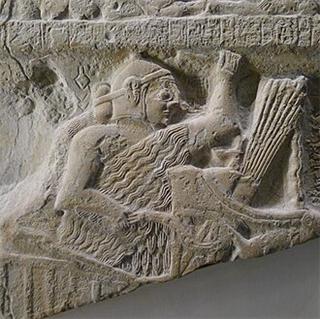
Ur's wars are known mostly from its defeats and from the arms buried with its dead. In the 'King's Grave', PG 789, lay 63 attendants equipped with copper helmets and swords, thought to be a ruler's army buried with him; in the Great Death Pit, PG 1237, 74 bodies were found, 68 of them women, the men with weapons and whetstones. Early Dynastic Ur was itself conquered: Eannatum of Lagash in the 25th century BCE, Lugalkinishedudu of Uruk around 2400 BCE and Lugalzagesi of Umma in the 24th century all held the city.
Sargon of Akkad's conquest met resistance. His son Rimush had to put down a revolt led by a local ruler of Ur; an inscription records 8,040 men killed, 5,460 taken prisoner and the leaders of the rebellion captured, and Rimush dedicated vessels seized in his Elamite campaign to the gods at Ur. Naram-Sin set up triumphal inscriptions in the city that scribal students copied for centuries. The Akkadian Empire fell in the 22nd century BCE to internal strain and to the Gutians from the Zagros Mountains, and it is not known whether a Gutian king or a local governor then ruled Ur. In the 21st century BCE Utu-hengal of Uruk drove the Gutians out of southern Babylonia; on his death his governor at Ur, Ur-Nammu, moved the kingship there. The Third Dynasty's own end came by arms, when the Elamites took the city and carried off King Ibbi-Sin, the event mourned in the Lament for Ur.
Governance & Law
Kingship at Ur was bound to the cult of Nanna. The Sumerian King List names only thirteen rulers in three dynasties of Ur, and the once-supposed second dynasty may never have existed. When Sargon of Akkad took the city he appointed his daughter Enheduanna high priestess of Nanna, an act that historians such as Marc van de Mieroop read as a way of legitimising his rule over southern Babylonia; control of that priesthood remained a symbolic marker of political control over the region for five centuries. The office survived every change of master: Naram-Sin appointed Enmenana, Ur-Bau of Lagash installed Enanepada and Ur-Nammu appointed Ennirgalana.
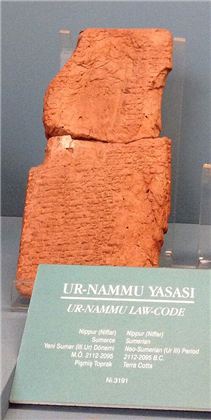
Under the Akkadian Empire Ur served as the hub of southern Babylonia, and the Akkadians imposed their language on the Sumerian-speaking population, adapting cuneiform to its grammar. Ur-Nammu, who ruled c. 2047–2030 BCE by one chronology and c. 2112–2094 BCE by another, built temples including the Ziggurat of Ur, improved agriculture by irrigation and issued the Code of Ur-Nammu, which precedes the Code of Hammurabi by 300 years. He and his son Shulgi were deified in their lifetimes; Shulgi, who ruled at least 42 years, reshaped the realm into a highly centralised bureaucratic state. The Akiti festival of Nanna ran each year from the god's temple in Ur to Ga'esh, perhaps the site of Tell Sakhariya, a day's journey away by canal.
Global & Regional Impact

Ur was one of the religious and literary centres of Mesopotamia. Enheduanna, Sargon's daughter and high priestess of Nanna, composed hymns such as The Exaltation of Inanna and a Temple Hymn to the Karzida sanctuary at Ga'esh, and is a candidate for the first identifiable author in world history, though Assyriologists are unsure whether a scribe wrote on her behalf. In the Ur III period hymns praising rulers became a popular genre, and a poem describes the death of Ur-Nammu and his journey to the underworld; at that period's end the Lament for Sumer and Ur and the Lament for Ur recorded the city's fall. By one estimate Ur was the largest city in the world from c. 2030 to 1980 BCE, with about 65,000 people.
The city's name travelled further than its goods. Ur is possibly the 'Ur of the Chaldees' that the Book of Genesis names as the birthplace of Abraham, although Şanlıurfa, Urkesh, Urartu and Kutha have also been proposed, and the Chaldeans did not settle nearby until about 850 BCE. Pope Francis visited the site in March 2021. The Royal Cemetery made headlines in the 1920s and drew visitors by rail to 'Ur Junction'; Agatha Christie met Max Mallowan, Woolley's assistant, there. The treasures are now divided between the British Museum, the Penn Museum and the Baghdad Museum, and the partly restored ziggurat, built by Ur-Nammu and repaired by Ishme-Dagan of Isin, Kurigalzu I and Nabonidus, remains the best-preserved landmark of the site.
Songs in history
Decline & Fall
The city-state's independence ended not with a sack but with a promotion: when Ur-Nammu moved the kingship to Ur, the city became the capital of an empire, and the Third Dynasty of Ur ruled through Shulgi, Amar-Sin, Shu-Sin and Ibbi-Sin. In Ibbi-Sin's 24th regnal year, around 1940 BCE, the Elamites took Ur and carried off its king; the Lament for Ur commemorates the disaster, and archaeology suggests the city was severely damaged.
What followed was a long afterlife. Ur stayed important under Isin, then fell to the Elamite kings of Larsa, who rebuilt much, added to the ziggurat and made Ur their second capital; it was in Larsa's time that Ea-nasir traded copper from Dilmun and received the Complaint tablet to Ea-nasir, c. 1750 BCE. In the 19th century BCE, under Rim-Sin I, Hammurabi of Babylon conquered the city, and in the reign of Samsu-iluna it was abandoned. It later belonged to the Sealand Dynasty, to the Kassites from the 16th century BCE, when Kurigalzu I rebuilt the temple of Ningal, at times to the Middle Assyrian Empire, and to the Neo-Assyrian Empire from the 10th to the late 7th century BCE. Nebuchadnezzar II and Nabonidus of Babylon built there in the 6th century BCE, but after Babylonia fell to the Achaemenid Persians around 530 BCE Ur declined, and by the early 5th century BCE it was uninhabited, perhaps through drought, shifting rivers and the silting of the Gulf outlet.
Ur, a Sumerian city-state near the ancient mouth of the Euphrates and seat of the moon god Nanna, rose to great wealth in the Early Dynastic period, passed under Lagash, Uruk and Akkad, and in c. 2112 BCE became the capital of Ur-Nammu's Third Dynasty, whose fall to the Elamites the Lament for Ur mourns.
References
- Harriet Crawford, Ur: The City of the Moon God (Bloomsbury, 2015)
- C. J. Gadd, History and Monuments of Ur (Chatto & Windus, 1929)
- Leonard Woolley, The Royal Cemetery, Ur Excavations II (Oxford University Press, 1927)
- Susan Pollock, 'Chronology of the Royal Cemetery of Ur', Iraq 47 (British Institute for the Study of Iraq, 1985)
- Giacomo Benati, 'The Beginning of the Early Dynastic Period at Ur', Iraq 76 (2014)
Connections
Open the full connections map →